


HYPE Funding Rate Arbitrage: Capturing the Hyperliquid vs Binance Spread in June 2026

with ArbitrageScanner!
Funding on Hyperliquid takes place about once a hour while on Binance it occurs every 8 hours. The difference of this timing gives delta-neutral traders an edge because of the structure. In the first week of June 2026, HYPE-USD on Hyperliquid pays a funding rate of approximately .011% to .018% per hour compared to Binance Futures, which has a funding of .005% to .012% every 8 hours. If you have a fully hedged position (long Binance and short Hyperliquid) and no fee associated with that position, you could have a 28% to 42% annualized rate of return on your carry yield. Additionally, certain altcoins go through temporary spikes in funding, as occurred with the HOME token, with rates exceeding -901 bps on KuCoin on June 7. However, the execution lag time from placed orders to completion, the hourly settlement risk associated with Hyperliquid and wider bid/ask spreads exist. This guide will provide users with an understanding of live data, how to construct a hedge and use the monitoring tool.
Why Does Funding Rate Arbitrage Exist in 2026?
Perpetual futures (or pftr) do not have expiration dates. In order to tether the pftr price to the index price, the exchanges charge fees in the form of a funding rate that every so often is flipped from long to short (positive funding rate has longs pay shorts and negative funding rate has shorts pay longs).
Funding rates aren't the same for every exchange. Each exchange has a user-defined index, a user defined clamp range, and a user-defined settlement cadence. Hyperliquid has a 4% hourly cap, while Binance, Bybit and OKX and still others have a settlement cadence of eight hours. Timing is the entire difference in funding arbitrage.
When holders of HYPE-USD start adding to their positions on Hyperliquid because they will qualify for native HYPE airdrop, the funding rate on Hyperliquid is greater than the corresponding funding rate on Binance. By holding equal opposite positions of equal value on two exchanges, a market-neutral trader can capture an arbitrage opportunity by taking advantage of the price differences between the two exchanges, without having any directional risk.
The funding spread snapshot (June 2026)
This shows real data taken from CoinGlass and Hyperliquid on the first week of June 2026. This should be used as a sign of an existing trading regime but should not be used to signal trade action:
| Asset | Hyperliquid (1 hr funding) | Binance (8 hr equivalent) | Net Carry (8hr) |
|---|---|---|---|
| HYPE-USD | 0.014% | 0.008% | +0.034% net to short hyperliquid leg |
| BTC-USD | 0.0042% | 0.0035% | +0.0001% (not worth it) |
| ETH-USD | 0.0061% | 0.0048% | +0.0001% (not worth it) |
| SOL-USD | 0.013% | 0.0072% | +0.038% net |
| BEAT-USDT | 0.038% | 0.021% | +0.115% net (high vol risk) |
In 2026, the current funding delta of Bitcoin and Ethereum has contracted down to almost a zero value across tier 1 exchanges; therefore, the best option to create an arbitrage scenario is in altcoin perps, which do not have fully arbitraged rates between venues. Specifically, HYPE, SOL and other recently introduced mid-cap exotic perps (e.g., BEAT, DEXE) provide retail arbitrage traders access to extracting profits through traditional arbitrage strategies.
Step-by-Step Hedge Construction
To initiate this arb strategy, you will need two accounts (Hyperliquid and Binance) that are funded with either USDC or USDT and have matching notional amounts. In order to complete this process, you must first select an asset whose verified funding rate on Hyperliquid exceeds that of Binance by a minimum of .01% per 8-hour equivalent since these are the only tradable assets for which there is an arbitrage opportunity at this time. At the time of writing, HYPE, SOL and several other mid-cap altcoin perps meet this criteria.
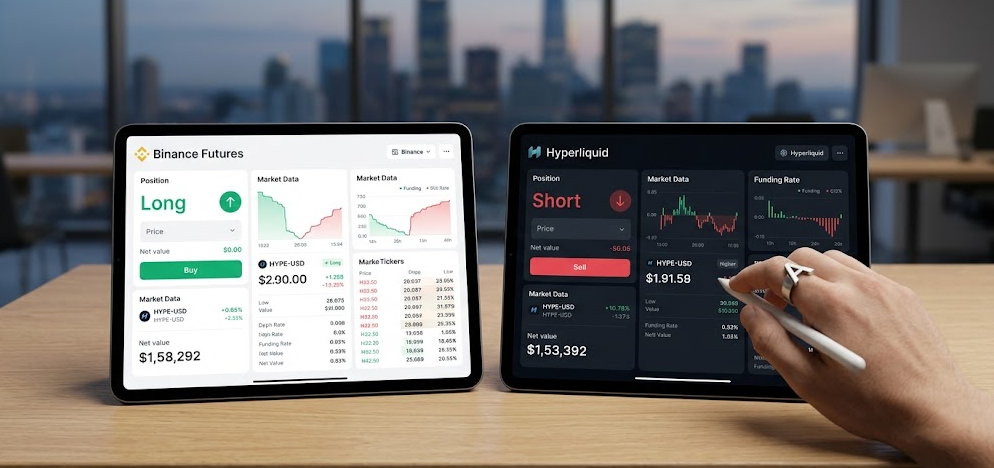
Second, you will need to calculate your notional for both legs. For example, if your trading account has $20,000 worth of available capital, then place $10,000 on each leg. It is important to note that cross-margining can mitigate capital lock-up; however, this increases the risk of liquidation should the price gap widen. Utilizing limit orders on the Binance exchange to open a long (longer term than traditional trading using longer data delivery methods) at 0.02% maker rebate on perps. Simultaneously, use the Hyperliquid exchange to open a short (shorter period than traditional running short and using constructive methods) on the same notional amount as a post-only maker (0.015% fee).
To check the delta, the difference in the converted amount of money spent by each participant should not be more than $50, given that each comprised $20,000 in the opening transaction. If the difference is greater than this, there is an increased possibility of loss associated with your long entry.
Monitoring the funding cadence is essential to understanding the profitability of this strategy. The short on Hyperliquid pays hourly, while the long on Binance pays each 8 hours; therefore the expected cash flow netted to you from the difference between the two is positive as long as the spread between the two remains in place.
What Eats the Gross Carry
Three items impact the predictability of gross carry (rate of return on an investment):
- Funding regime shift. Typically, the reward for holding a long or short position can change in less than 4 hours once delta-neutral funds enter the market.
- Loss due to incrementally inaccurate pricing on opening/closing. Multi-layer entries to the total size of your account will substantially lower the ability of this investment to generate cash flow for you. Total costs on a $50,000 Trade carry will average approximately 0.10% round trip (round trip trading claims a one-week return versus a right-way investment at APR of 28%).
- Lack of Access to a Maker Fee at Both Exchanges. If you are unable to be a maker at both exchanges, then you will incur a known difference of all three of the below amounts. To access the huge fee discount via Stake HYPE, the taker fee will be reduced to just 0.027% when Hyperliquid is used to access it. It is possible to reduce fees using BNB for a fee discount on Binance and increase your VIP tier on Binance through trading volume.
The HOME Case Study, June 7 2026
On June 7, 2026, the HOME case study (the SocialFi token was listed earlier in 2022) had brutal funding on all trading venues, with KuCoin having a -901.20 bps, Bybit -785.60 bps, and Variational -712.63 bps, meaning shorts received 9% of their capital for every 8 hours they held positions until the funding dislocated. Hyperliquid had similar negative numbers, but the negatives were not as severe.
There were three options available to traders who spied out this trade using a funding-rate scanning tool. The three options below are all great opportunities that the average retail trader would most likely not get to see, based on the speed at which the market operates:
- Trader #1 can execute intraday trading strategies longing the HOME ownership spot while shorting the HOME perpetual on KuCoin, receiving 9% for holding their position for the duration of the dislocation; however, liquidity was thin on the listing and would require sourcing the spot fast.
- Trader #2 can execute a cross-exchange funding arbitrage strategy by longing the HOME perpetual on the exchange that posted the least-negative funding, while at the same time shorting the HOME perpetual on the exchange that posted the most-negative funding, and receive a net carry of 1.9% for every 8 hours the spread existed.
- Trader #3 can wait for the opportunity to resolve itself. Typically, funding rates will decrease between 4-12 hours and waiting until the last moment in that timeframe to get into a position will result in a payment of funding vs. a receive of funding.
Retail traders typically are not aware of HOME, do not know the rate exists, and therefore cannot capitalize on the opportunity as the opportunity exists with a 6-hour half-life (45 seconds passes after each relevant update) without a real-time funding rate aggregator for all of Hyperliquid, Binance, Bybit, KuCoin, OKX, MEXC, Bitget and a total of 70+ other trading venues.
Position Sizing and Risk
Funding arbitrage, when viewed through a profitable lens, seems like a safe investment as you have no directional risk, however three risks exist in practice:
Exchange risk. When Hyperliquid pauses withdrawals due to a liquidation cascade, your short position cannot be closed. Therefore, you should limit your total exposure by a maximum of 20% to 25% of your total working capital for all venues.
Basis risk: Hyperliquid's spot feature does not exist for most altcoin perps, which have a composite index to represent the price of the entire market for a given asset. When large price movements happen (for example, 0.5% to 2%), it is possible to trigger a liquidation event for one leg of the position before the other leg has time to react based on differences in their price movements.
Funding regime risk: The Hyperliquid funding regime restricts you to charging a maximum of 4% per hour. In extreme cases, this could result in 96% daily funding costs if you're on the wrong side of the trade. Therefore, you should monitor the hourly status of your trades continually, and place your stop loss orders based solely on funding inversion and not on any other factor.
Conservative rule: You should not have more than 30% of your total perp capital tied to any one funding pair, and you should not have more than five concurrent funding pairs without using an automated monitoring service.
Suggestions for working with this system
You can only use a calculator and browser tabs for one of your trades at a single time. In addition to that, you'll want a scanner that:
- Gathers real-time funding rates from 80 or more CEXs with updates every second
- Calculates the net carry of each pair (after applying your fee tier to both legs)
- Flags rate inversions to prevent you from paying to fund in the opposite direction to what you expect
- Displays historical funding so you can backtest to see if the current spread is a regime shift or just noise
The above items are exactly what ArbitrageScanner's perp screener was designed to provide, 80+ CEXs, 25+ DEXs, updates each second and a historical funding chart for backtesting. The futures spread calculator automatically calculates the fee-adjusted math so you can stop calculating the round-trip costs in a spreadsheet at 2 AM.
For traders who want to layer this by directional sentiment, the AI wallet analysis feature can help you determine if the funding spike is being driven by retail FOMO (likely to revert) or by smart-money accumulation (likely to persist). That distinction is what separates a profitable funding desk from a calculator with good intentions.
FAQ
What percentage APR can I expect to earn when arbitraging Hyperliquid vs Binance funding?
When factoring in fees, slippage and partial periods when spreads have closed, we have received reports from well-executed arbitrage desks that range from 18%-32% APR with between $50K-$200K in working capital. As the amount of funding exceeds that, slippage will scale non-linearly as well as reduce the APR to 12%-20%. It is highly uncommon to obtain an APR above 50%, as this typically requires taking on directional risk or basis risk.
Will I need to use leverage when executing a funding arbitrage trade?
Funding arbitrage trades are by definition leveraged, as both legs are perpetual contracts. The question is how much margin do you want to allocate to this trade. Most desks utilize 2-3x effective leverage. If you increase beyond that, then your potential to get liquidated increases without increasing your carry.
If Hyperliquid inverts on my funding trade while I'm holding the contract what should I do?
Immediately close both legs. Funding on Hyperliquid compounds hourly, and holding an inverted spread for 6 hours is equivalent to two weeks of accumulated carry. If you can't monitor the dashboard constantly, then create an automated trigger to notify you if the funding inverts.
Are funding payments taxable?
Generally, funding payments are treated as ordinary income in most jurisdictions separate from the underlying PnL of the perpetual contracts. Keep good records of these transactions. Don't offset against capital gains based on price - this will complicate your tax audit.
What is the minimum amount of working capital I should have to execute arbitrage trades?
With less than $5K of working capital, you will lose more in fees than you will generate from carry. Begin to see trading math materialize between $10K and $20K per leg with active maker fee tiers.
Enjoy one day of complimentary access to the ArbitrageScanner perp funding scanner across 80+ exchanges, historical funding charts and futures spread calculators.
Please note - We are a software developer. We make no recommendations or guarantees of returns, and we cannot provide directions on how to invest your money. Our applications are completely manual; your funds are never at risk under your direct control. We share data with clients that provide examples of how to earn from arbitrage trades; however, we do not recommend clients seek to replicate our examples. Your returns depend solely upon your actions and market conditions.
Want to learn more about crypto arbitrage?
Get a subscription and access the best tool on the market for arbitrage on Spot, Futures, CEX, and DEX exchanges.

You might be interested
CLARITY Act and Ethereum ePBS: What US Arbitrage Flows Look Like in H2 2026

Margex Review 2026: Leverage, Fees, Security & Copy Trading
Telegram Acquires TON: How a 120% Rally Unlocked New Arbitrage Opportunities Between Binance, Bybit, and STON.fi
