

Algorithmic Trading: A Guide to Strategies and Automation Tools

with ArbitrageScanner!
Algorithmic trading is a sophisticated method of executing market orders using pre-programmed instructions that account for variables such as time, price, and volume. In today’s hyper-competitive financial landscape, where fractions of a second can determine the difference between profit and loss, algo trading has evolved from a niche tool for hedge funds into an industry standard. This guide explores the mechanics of trading robots, the most effective strategies for 2026, and how to transition from manual to automated trading.
What Is Algorithmic Trading and How Does It Work
Algorithmic trading (also known as algo trading or black-box trading) is the process of using computer programs to automate the opening and closing of positions. These programs process a large volume of market data in real-time, monitoring charts and executing trades based on mathematical models and technical analysis. Unlike humans, these algorithms operate 24/7, reacting to market shifts with a level of precision that is impossible to achieve manually.
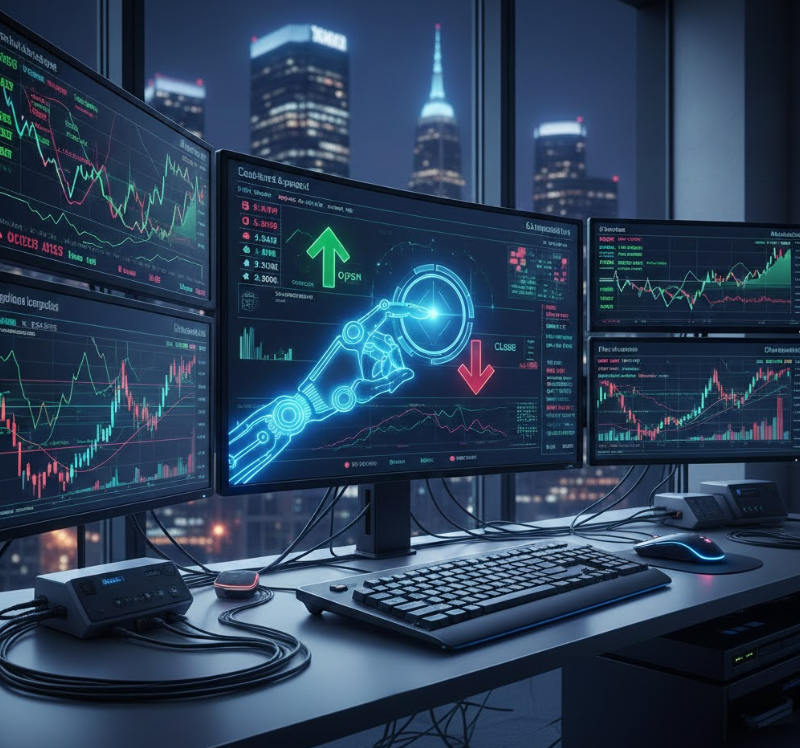
The primary objective of automation is to eliminate human error and maximize decision-making speed. In modern financial markets, particularly in the US and Europe, algorithmic trading accounts for over 70-80% of total trading volume. By utilizing sophisticated trading algorithms, participants can manage risk more effectively and ensure consistent execution of their trading plans.
History: From Quants to Modern Trading Robots
The evolution of exchange trading has seen a dramatic shift from "outcry" pits to server racks in high-speed data centers. The journey began in the 1970s with the introduction of the Designated Order Turnaround (DOT) system on the NYSE. However, the real breakthrough came from "quants"—mathematicians and physicists who applied complex statistical models to finance. Today, what was once exclusive to elite banks is now accessible to any user with a laptop. High-performance APIs and cloud computing have leveled the playing field, allowing retail traders to compete with major funds.
Differences Between Algorithmic Trading and Manual Trading
The fundamental difference lies in discipline and processing power. Humans are inherently prone to emotional bias: fear leads to premature exits, while greed causes traders to hold losing positions too long. Automated systems follow the rules without hesitation.
| Feature | Manual Trading | Algorithmic Trading |
| Execution Speed | Low (seconds/minutes) | Ultra-high (milliseconds) |
| Emotional Factor | High risk of bias/panic | Completely eliminated |
| Data Analysis | Limited to 1-3 assets | Thousands of assets simultaneously |
| Availability | Limited by human stamina | 24/7 without breaks |
Main Types of Algorithmic Trading
Depending on the goals and the frequency of operations, trading algorithms can be categorized into several distinct types.
Signal-Based and Fully Automated Systems
Signal-based systems act as assistants, generating alerts via Telegram or specialized software when certain conditions are met. The final decision remains with the trader. In contrast, fully automated systems (automated trading) manage the entire lifecycle: from fundamental and technical analysis to order placement and profit-taking.
High-Frequency Trading (HFT) and Intraday Trading
High-Frequency Trading (HFT) represents the pinnacle of trading technology. These programs execute thousands of orders in fractions of a second, capturing tiny price discrepancies. For HFT, low latency and "colocation" (placing servers near the exchange) are critical. Intraday algorithms operate on a slower scale, holding positions from a few minutes to several hours, focusing on daily price volatility.
Arbitrage Strategies
Arbitrage is a strategy designed to profit from price differences for the same asset across different exchanges. Because markets are not perfectly efficient, a price gap may occur. Modern robots can instantly buy an asset on Exchange A and sell it on Exchange B, capturing the spread with minimal risk.
Popular Algorithmic Trading Strategies
The success of an automated system depends on its underlying mathematical model. Both institutional banks and private players utilize these core approaches.
TWAP and VWAP: Strategies for Large Orders
These algorithms are essential for institutional investors who need to move large quantities of securities without causing significant market impact.
-
VWAP (Volume Weighted Average Price): Executes the order in proportion to the market volume, ensuring the execution price is as close to the average market price as possible.
-
TWAP (Time Weighted Average Price): Breaks a large order into equal parts and executes them at regular time intervals to prevent "market shock".
Statistical Arbitrage and Pairs Trading
This strategy relies on the historical correlation between two assets, such as two stocks in the same sector. If the price of one asset deviates significantly from its peer, the algorithm opens a pair trade—going long on the undervalued asset and short on the overvalued one—betting on a "mean reversion."
Speculative Strategies for Retail Traders
Private traders often favor trend-following algorithms. These rely on indicators like Moving Averages or RSI to identify the start of a momentum move. The robot automatically enters the market during a breakout, removing the hesitation often felt by manual traders.
How to Build a Trading Robot: Key Steps
Creating a robust trading algorithm requires a systematic approach and careful validation.
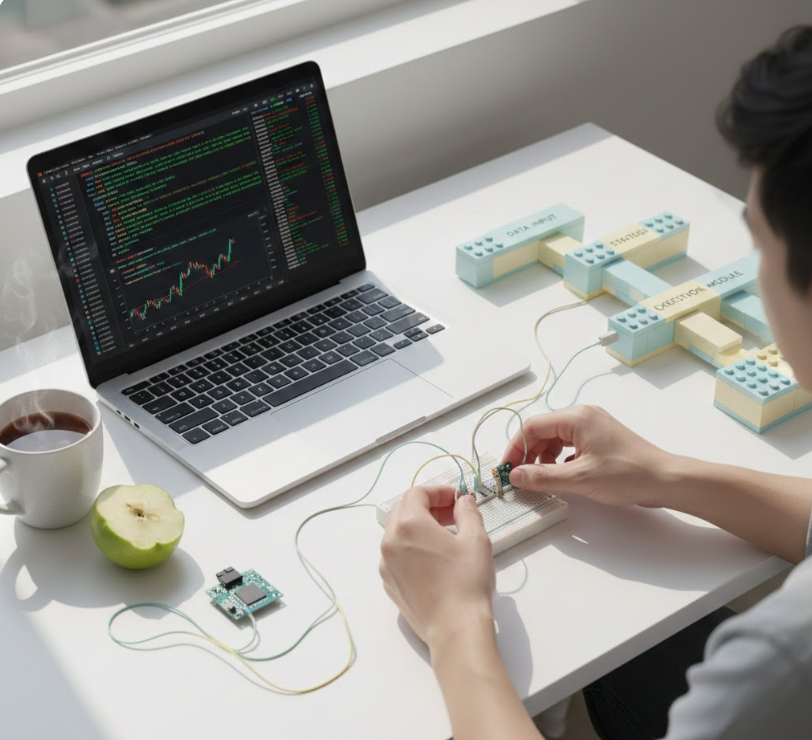
Data Collection and Hypothesis Formation
Every bot starts with a hypothesis. For example: "If Bitcoin rises by 2% in ten minutes, Ethereum will follow within the next five." To test this, you must gather high-quality historical data and financial reports.
Backtesting and Real-Time Validation
Backtesting involves running your algorithm against historical data to see how it would have performed. If results are positive, the next step is "Paper Trading". This allows you to verify the algorithm in real-market conditions using virtual funds to ensure the code handles live API feeds correctly.
Deployment and Algorithm Monitoring
Once validated, the bot is deployed with real capital. However, markets are dynamic; therefore, continuous monitoring and periodic parameter adjustment are necessary to prevent the model from becoming obsolete.
Tools for Algorithmic Trading
Implementing these systems requires a combination of programming languages and specialized platforms.
Programming Languages: Python, R, C++
-
Python: The industry leader due to its vast ecosystem of libraries like Pandas, NumPy, and Scikit-learn.
-
C++: The gold standard for HFT where every microsecond counts.
-
R: Primarily used by academic researchers and "quants" for deep statistical modeling.
Platforms: TradingView, Wealth-Lab, MetaStock
For those who prefer not to code from scratch:
-
TradingView: Uses Pine Script for strategy creation and connection via webhooks.
-
Wealth-Lab: A professional-grade solution for backtesting complex strategies on the stock market.
The Role of Artificial Intelligence in Algo Trading
Artificial Intelligence (AI) and Machine Learning (ML) are shifting automation from static rules to adaptive systems.
Neural Networks and Machine Learning
Modern neural networks can analyze unstructured data, such as news headlines and social media sentiment (X/Twitter). This allows AI-driven bots to predict price movements based on context, not just historical price action.
Risks of Model Overfitting
A common pitfall is "overfitting"—where a model is so finely tuned to historical data that it fails to adapt to new market conditions. Successful developers aim for "robustness," ensuring the model can handle market noise.
Algo Trading for Retail Traders
The democratization of finance means individual players now have access to cloud servers and high-speed APIs once reserved for banks. While the barriers to entry have fallen, retail traders must still navigate risks like technical outages and slippage. Using a VPS (Virtual Private Server) is a standard practice to ensure 99.9% uptime.
Practical Tips for Using Trading Robots
-
Start small: Never allocate your entire portfolio to a new algorithm immediately.
-
Diversify: Run multiple strategies across different asset classes (stocks, forex, crypto).
-
Strict Risk Management: Always implement hard Stop-Losses and "kill-switch" parameters.
-
Maintain infrastructure: A reliable internet connection and a high-quality server are your lifelines.
FAQ
Can you earn stable income from algo trading?
Yes, but it requires constant research. A strategy that works in a trending market might fail in a sideways market.
Do you need technical knowledge to launch a trading robot?
Basic knowledge is enough for "no-code" platforms, but learning Python is highly recommended for unique competitive advantages.
What are the main risks of algorithmic trading?
Risks include coding errors (bugs), "Black Swan" events, high volatility, and execution delays (latency).
How to choose a strategy for your trading robot?
It depends on your capital. Beginners should start with trend-following or simple mean-reversion strategies on liquid assets.
How much does it cost to launch algorithmic trading?
Costs range from $0 (open-source libraries) to thousands of dollars for premium data feeds and high-performance server hosting.
Want to learn more about crypto arbitrage?
Get a subscription and access the best tool on the market for arbitrage on Spot, Futures, CEX, and DEX exchanges.