


What is Litecoin (LTC): Cryptocurrency and Network Features

Litecoin: Features, Advantages, and Development Prospects
Out of the vast number of cryptocurrencies listed on CoinMarketCap, which one stands out from the rest? If you are a newcomer to the crypto world, it might be challenging to choose which coins to invest in or trade. The cryptocurrency space can seem like a minefield of conflicting ideas because everyone has their favorite coins and projects.
You are probably familiar with Bitcoin (BTC) and Ethereum (ETH) because they appear in the crypto news daily, but what about Litecoin (LTC)? Is it an established project, and what does it actually do?
In this article, we will provide a detailed account of Litecoin: what this coin is, how it works, how to mine it, and what its pros and cons are.
What is Litecoin?
Litecoin is one of the first cryptocurrencies ever created, developed based on Bitcoin's core code. Its goal is to use blockchain technology for fast, low-cost, and secure payments. It was named Litecoin to become a "lighter" version of Bitcoin (BTC).
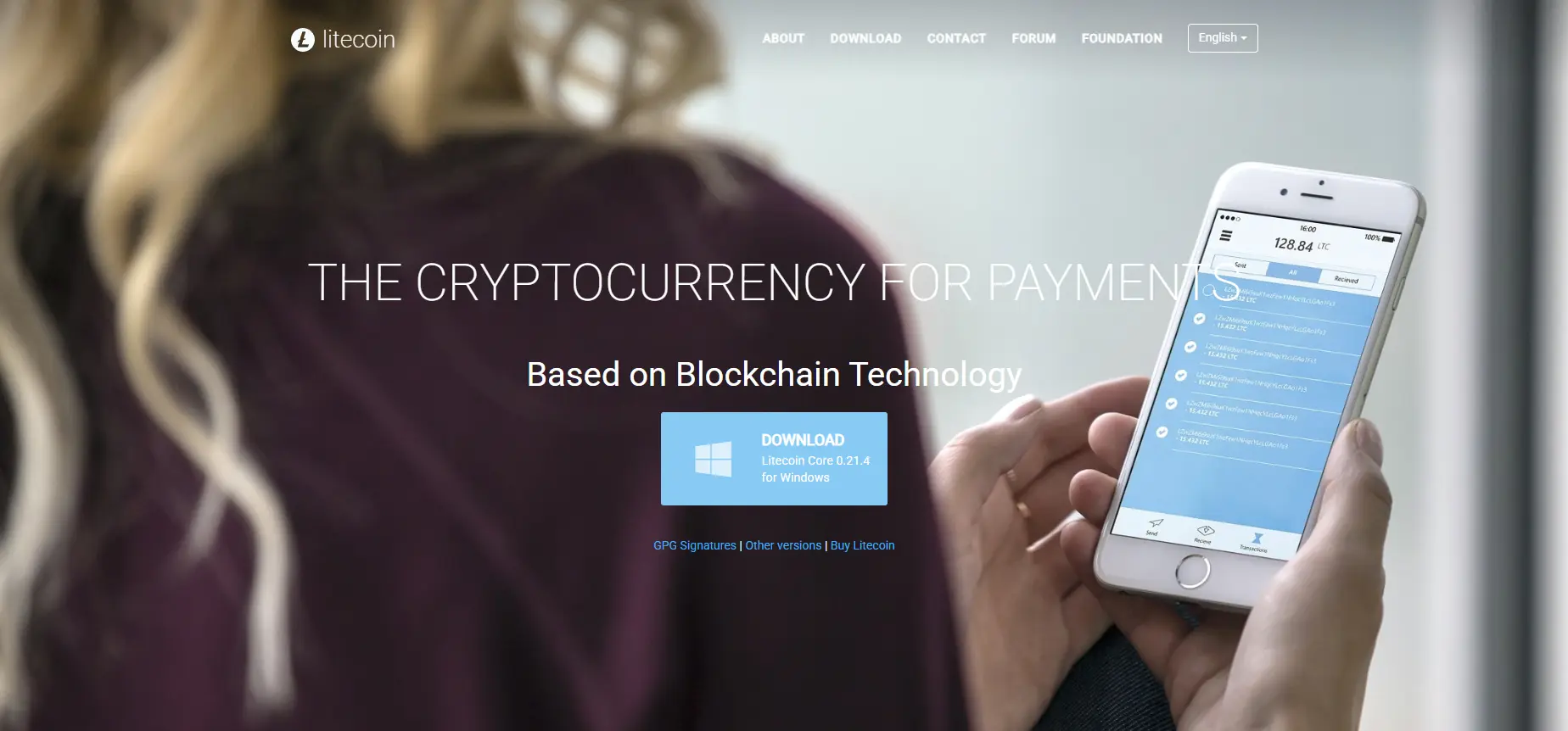
Litecoin is a "peer-to-peer internet currency" capable of supporting nearly free and fast payments worldwide. It is a global open-source network with full decentralization, excellent trading volume, and high liquidity.
History of Litecoin
Litecoin was created by Charlie Lee. Charlie earned a Master’s degree in Computer Science from MIT and worked as a software engineer at Google for nearly 6 years. As an avid poker player, he was one of thousands affected by the US government's ban on online poker in 2011. Seeing regulators shut down online poker sites by banning payment systems from working with them, he "realized the importance of the freedom of money." This led Charlie to Bitcoin.
On October 7, 2011, Charlie created Litecoin. The name comes from his idea of creating a "lighter version of Bitcoin" that would be more convenient for everyday use. Interestingly, Charlie considers Bitcoin the undisputed leader in the crypto sphere and even advises people to invest in Bitcoin rather than anything else, including Litecoin. He also views Litecoin as "digital silver" that complements Bitcoin, which is "digital gold."
How Does Litecoin Work?
Technology and Features
Litecoin works similarly to Bitcoin, with a few minor differences. Like Bitcoin, Litecoin uses the proof-of-work (PoW) consensus mechanism to verify transactions and generate new blocks in its blockchain.
However, instead of the SHA256 mining algorithm used in Bitcoin, Litecoin uses the Scrypt mining algorithm. This was originally intended to mean that anyone with a "regular" computer could mine Litecoin (LTC), unlike Bitcoin mining, which requires significant computational power to solve the hash puzzle.
Unfortunately, the situation changed with the advent of specialized Scrypt ASIC miners. Mining Litecoin (LTC) became unaffordable for the average person. Today, most Litecoin (LTC) mining is carried out in Litecoin mining farms and pools.
A new Litecoin block is generated approximately every 2.5 minutes, which is 4 times faster than Bitcoin's 10-minute block generation time. Just like in the main cryptocurrency's blockchain, the block reward was 50 LTC when it was first created. The block reward is halved approximately every four years (840,000 blocks).
The last halving occurred in August 2023, and the block reward structure was halved from 12.5 LTC to 6.25 LTC. Immediately after the successful halving, the LTC price dropped by 8%.
The final halving will take place in 2042.
Comparison with Bitcoin
Litecoin (LTC) is based on the Bitcoin protocol but differs from it in many aspects, such as the hashing algorithm, low transaction fees, transaction block time, and hard limit.
Notably, the average transaction processing time for Bitcoin is 10 minutes compared to 2.5 minutes for Litecoin (LTC).
Due to these advantages, Litecoin (LTC) has become popular among millions of merchants worldwide as it is suitable for microtransactions and point-of-sale payments.
For a more detailed comparison, we have compiled a table of differences between Litecoin and Bitcoin:
|
Litecoin |
Bitcoin |
|
|
Founder |
Charlie Lee |
Satoshi Nakamoto |
|
Release Date |
October 2011 |
January 2008 |
|
Maximum Coin Supply |
84 million |
21 million |
|
Consensus Algorithm |
Proof of Work (PoW) |
Proof of Work (PoW) |
|
Privacy |
Yes |
Yes |
|
Transaction Traceability |
Yes |
Yes |
|
Smallest Unit |
Litoshi |
Satoshi |
|
Ticker Symbol |
LTC |
BTC |
|
Transaction Fee |
0.001 LTC (average) |
Variable: depending on network load |
|
Algorithm |
Scrypt |
SHA-256 |
|
Block Mining Time |
2.5 minutes |
Over 10 minutes |
How to Buy and Store Litecoin in 2026
Exchanges for Buying Litecoin
Litecoin is available on almost all existing cryptocurrency exchanges. Hundreds of trading pairs exist for Litecoin, and it can be purchased on leading crypto exchanges such as Binance, KuCoin, Bitget, Bybit, and others.
Most crypto exchanges have mobile apps for Android and iOS for investing or trading on the go. Buying Litecoin (LTC) is simple even for beginners.
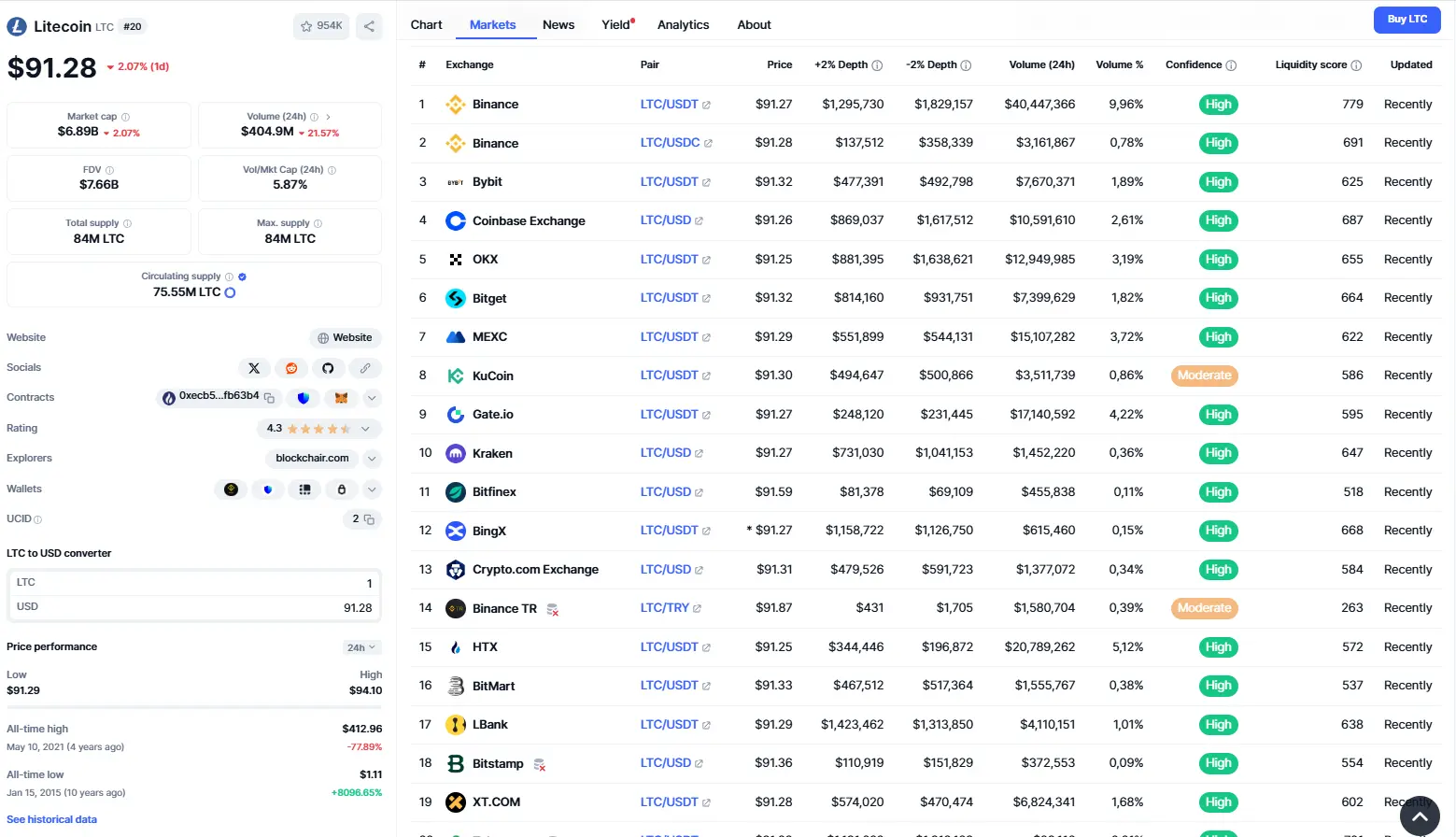
Wherever you can buy Bitcoin (BTC), you can purchase Litecoin (LTC). You are not limited to crypto exchanges; the coin can also be bought in online exchangers or on P2P platforms.
Types of Wallets for Storage
The coin has an official wallet – Litewallet. Interestingly, this wallet is open-source, meaning its creators are confident in the security of user funds and have nothing to hide. Additionally, you can download the Litecoin wallet for Android and iOS.
Most available wallets also support Litecoin, such as the cold storage wallets Trezor and Ledger. The choice of wallets for storing LTC is vast; the selection depends on the holder's goals.
How to Mine Litecoin
Steps to Start Mining
The LTC mining process occurs through GPUs, CPUs, or ASIC devices. The hash-finding function in Litecoin's chains is the Scrypt algorithm, unlike Bitcoin's SHA-256.
To start mining LTC, you need to follow these steps:
-
Purchase an ASIC miner and set up an uninterrupted internet and power connection;
-
Also, take care of a room that is well-cooled, as mining devices generate a lot of heat;
-
Choose a pool and register with it, then enter the received configuration data into the device settings;
-
Create and add a wallet address where the mining rewards will be sent.
Choosing a Mining Pool
Now let's talk in more detail about how to correctly choose a pool for mining LTC:
-
It is better to choose pools whose servers are located closer to your geographic location. This ensures good data speed and a stable connection, which positively affects mining;
-
What the payment consists of and what the fees are. There are several ways to calculate mining rewards: Shared (SMPPS), Pay-per-share (PPS), and Proportional (PPLNS). Each option has pros and cons. You must also consider the pool's commission fee for participation;
-
The pool should have a good reputation and security. Quick customer support, protection against hacker attacks, and transparent statistics are important. Additionally, security mechanisms like two-factor authentication should be implemented in the pool's website user area;
-
The larger the pool, the more often it finds blocks. However, competition will be higher, and the payment for a found block will be smaller due to the many participants in the pool. If you choose a small pool, blocks will be found less frequently, but the reward will be larger.
Tracking Transactions on the Litecoin Blockchain
To check a transaction on the Litecoin network, you can use a blockchain explorer – a specialized service that provides access to information about completed operations. One such tool is GetBlock, which supports data analysis across six different blockchains, including Litecoin.
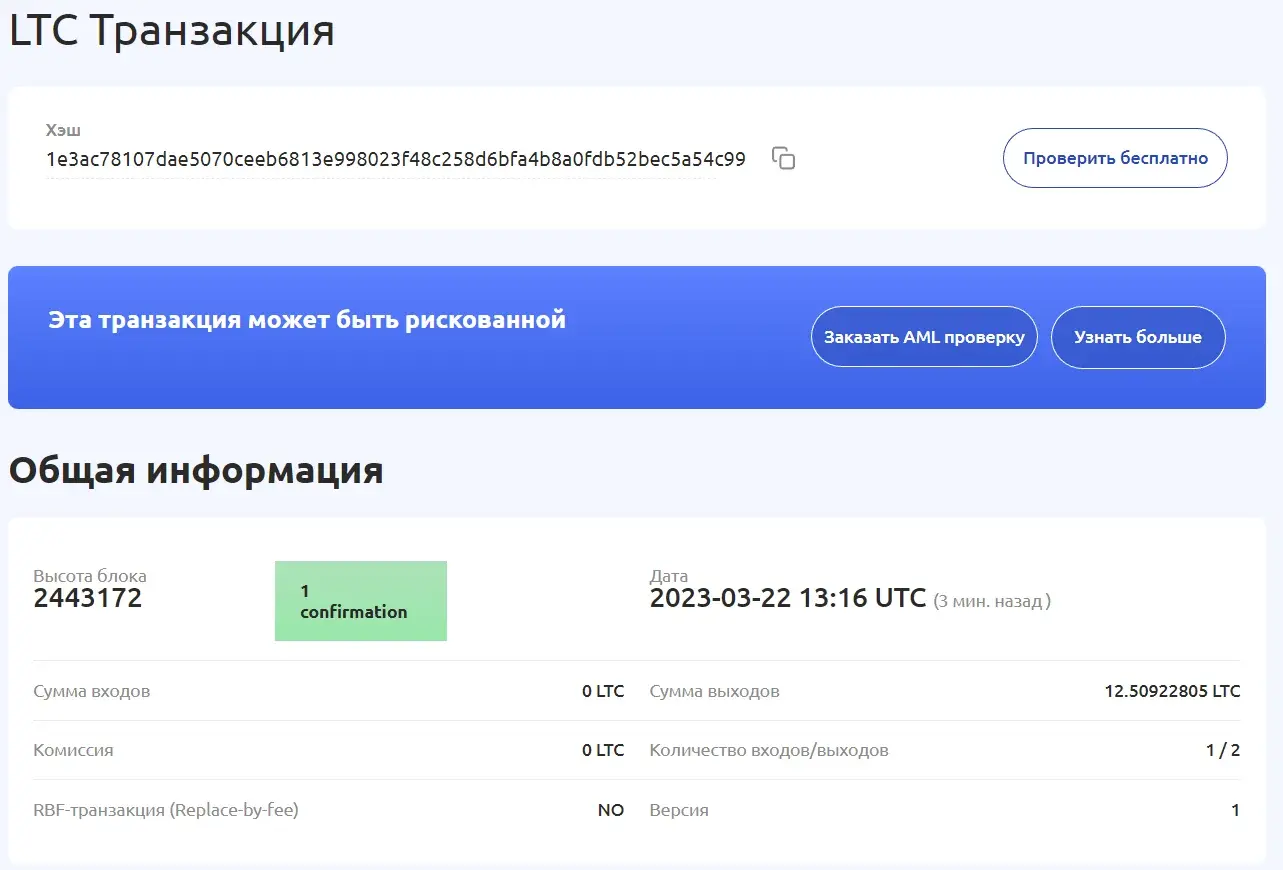
To track a transaction, you will need either the hash (transaction ID) or the wallet address of the sender or receiver. An address is a unique set of characters identifying a network user, while a hash is a code that allows you to find a specific operation in the blockchain.
Litecoin Privacy
As noted earlier, Mimblewimble was launched on the Litecoin blockchain in 2022, creating a parallel Litecoin chain with Mimblewimble integrated. This technology allows interaction with the main chain on a voluntary basis. In other words, you can send your LTC to the Mimblewimble chain if you want your Litecoin transactions to be 100% private.
Charlie Lee, Director of Litecoin, announced the push for privacy in Litecoin in early 2019. Lee calls privacy the "next battleground" in the crypto space, and since then, he has spoken about privacy in nearly every interview.
Reasons for Litecoin's Popularity
Besides fast transactions, block creation, and low fees, Litecoin possesses several unique features that together create a unique value proposition in the crypto sphere:
-
Litecoin SegWit. Litecoin implemented SegWit in 2017, and Bitcoin eventually followed suit. SegWit is a technology that prevents extra data from being written to new blocks. This process frees up storage space for more transaction data in blocks, increasing transactions per second (TPS);
-
Lightning. Litecoin also supports the Lightning Network, an off-chain scaling solution that increases TPS. It does this by opening a payment channel between two parties where multiple transactions can occur, with network nodes only recording the final balances to the blockchain after closing the payment channel;
-
Litecoin Atomic Swap. At the end of 2017, Litecoin performed some of the first-ever atomic swaps with Decred, Vertcoin, and Bitcoin. Atomic swaps allow different types of cryptocurrencies to be exchanged directly without using centralized services like exchanges.
-
Mimblewimble. In May 2022, Mimblewimble privacy technology was implemented in Litecoin, which is used in Grin Privacy Coin (also based on Bitcoin code). Mimblewimble technology is very complex but allows wallet addresses to be viewed only by the parties involved in the transaction;
-
Omnilite. In September 2021, a new technology was launched that allowed for the creation of custom currencies and tokens on the Litecoin blockchain, performing crowdfunding without intermediaries via the Omni layer, and issuing NFTs directly on the Litecoin platform.
Litecoin Price and Dynamics
Generally, the LTC price depends on two factors:
-
Market sentiment;
-
Major blockchain updates or partnerships.
The LTC price hasn't been noticed for being specifically "pumped" by anyone. Rather, on the contrary: Litecoin acts as a highly fundamental asset whose value will not grow just for no reason.
This is also related to the project's moderate popularity, which we discussed earlier.
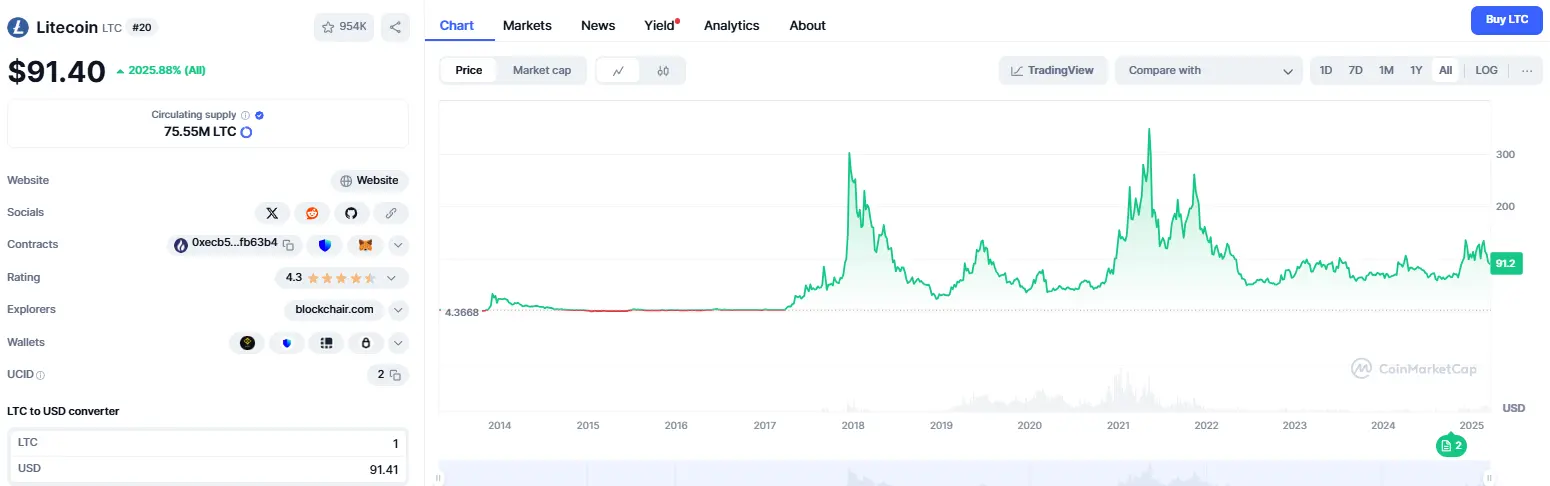
Litecoin's all-time high was recorded on May 10, 2021, at $412.96. The all-time low was on January 15, 2015, at $1.11.
Pros and Cons of Litecoin
Pros:
-
Fast transactions. Litecoin has a faster block generation time (2.5 minutes) compared to Bitcoin (10 minutes), which means faster confirmations;
-
Scalability. Thanks to faster block generation, Litecoin can handle a larger volume of transactions than Bitcoin;
-
Liquidity and Availability. Litecoin is widely represented on almost all crypto exchanges and possesses high liquidity;
-
Mimblewimble allows for anonymous transactions in Litecoin;
-
Technology and Innovation. Litecoin often implements new technologies and improvements before Bitcoin. For example, it was one of the first cryptocurrencies to implement Segregated Witness (SegWit) and the Lightning Network.
-
Time-tested. Litecoin was one of the first major cryptocurrencies and is one of the three cryptocurrencies (alongside BTC and ETH) that remain relevant today.
Cons:
-
Lower Popularity. Despite its technological advantages, Litecoin is less popular than Bitcoin and some other cryptocurrencies;
-
Centralization Concerns. Some critics argue that the Litecoin blockchain is more centralized than Bitcoin's and that Litecoin founder Charlie Lee has a great influence on its development;
-
Competitive Market. There are thousands of available cryptocurrencies, and many have unique features. Litecoin faces tough competition in the crypto market.
Frequently Asked Questions
Is Litecoin a Good Investment?
Litecoin (LTC) has been around for a long time, has proven use cases, has demonstrated demand, and is among the top 20 most popular cryptocurrencies according to CoinMarketCap. However, it is worth considering that any investment is a risk, but LTC can be classified more as a "blue chip" in crypto than as a high-risk asset.
What is Litecoin Used For?
Litecoin (LTC) is designed for peer-to-peer global payments. It is fast and inexpensive, placing it on par with many other cryptocurrency networks. It provides privacy and scalability, making it a more suitable form of payment than cryptocurrencies like Bitcoin. Many investors use Bitcoin as a store of value and protection against inflation, while Litecoin is used for payments.
If you actively trade LTC, Arbitrage Scanner will allow you to automatically find profitable arbitrage opportunities between exchanges, increasing the profitability of your operations.
What is the Future of Litecoin?
The future of Litecoin largely depends on its adoption, technological updates, and the overall situation in the cryptocurrency market. Thanks to low fees, high transaction speeds, and the implementation of technologies like Mimblewimble and the Lightning Network, Litecoin remains a sought-after payment method. However, competition with other cryptocurrencies, including Bitcoin and Ethereum, as well as the emergence of new digital asset solutions, may affect its position in the crypto rankings. If the community continues to develop the ecosystem and integrate with financial platforms, Litecoin will maintain its significance and liquidity in the long run.
Want to learn more about crypto arbitrage?
Get a subscription and access the best tool on the market for arbitrage on Spot, Futures, CEX, and DEX exchanges.
You might be interested

What are stablecoins?
What is Bitcoin ETF and Ethereum ETF
