


What is Polkadot (DOT): Overview of the Polkadot Cryptocurrency and its Future Prospects

with ArbitrageScanner!
What is Polkadot? DOT Token Explained
As blockchain technology evolves and new popular cryptocurrencies emerge, ensuring interaction between different blockchains becomes increasingly in demand. Moreover, it is desirable to organize this interaction also through the blockchain; otherwise, the idea loses its meaning. At the moment, there is a project that solves this task – Polkadot.
In this article, we will tell you in detail about Polkadot, how it works, its ecosystem, and the future of the project.
What is Polkadot?
Polkadot is a blockchain project that aims to provide a decentralized future for the internet (Web 3.0). Polkadot is often called a Layer 0 blockchain, unlike networks such as Bitcoin, Ethereum, Solana, and others, which are Layer 1 blockchains, as well as Arbitrum, Lightning Network, Optimism, and others, which are Layer 2 blockchains.
For a quick reference:
-
Layer 0 provides common security and compatibility. Other notable projects in the Layer 0 category include Avalanche and Cosmos. Of these projects, Polkadot is the only Layer 0 that provides full shared security across the entire ecosystem;
-
Layer 1 is an application-oriented network. Examples are major networks like Bitcoin, Ethereum, Solana, and others;
-
Layer 2 most often refers to scaling solutions at Layer 1. Clear examples are Arbitrum and Optimism for Ethereum and the Bitcoin Lightning network.
The primary utility of Polkadot is that it aims to provide a secure foundation for continuous general-purpose computing. Simply put, Polkadot provides shared security and robust interoperability with the ability to support multiple compatible blockchains running in parallel. The term "Layer 0" refers to Polkadot's main chain (Relay Chain), which is intentionally limited in providing security and finality for Layer 1 chains, which in turn host smart contract applications and more. You can compare Polkadot to a giant shopping mall that provides space and security to various stores. The stores are located close to each other and can easily interact within the same building.
How does the Polkadot network work?
Polkadot is certainly one of the most technologically advanced blockchains in existence. In its whitepaper, the Polkadot network is called a scalable heterogeneous multi-chain. Layer 1 blockchains like Bitcoin and Ethereum perform all blockchain functions on a single level. Functions are mainly divided into three categories:
-
Data Availability. The blockchain maintains a distributed ledger that stores records of all transactions or data entries. Data availability implies that this ledger must be accessible to all network participants. In a public blockchain, anyone can join the network, download a copy of the entire blockchain, and verify transactions. This ensures transparency and trust in the system, as participants can independently verify the presence and integrity of data;
-
Consensus. Consensus mechanisms are protocols that allow blockchain participants to agree on the validity of transactions and the order in which they are added to the blockchain. Consensus is crucial for preventing double-spending and maintaining the integrity of the blockchain. Common consensus mechanisms include Proof of Work (PoW), Proof of Stake (PoS), and others, which vary in how they achieve agreement among participants;
-
Execution. Execution refers to the process of verifying and executing smart contracts or transactions on the blockchain. Smart contracts are self-executing contracts with terms written directly into code. When the conditions specified in the smart contract are met, the code automatically executes the contract terms without the need for intermediaries. Smart contract execution is a key feature of many blockchain platforms like Ethereum.
These three functions work together to create a secure, decentralized, and tamper-proof system where data can be reliably recorded, transactions agreed upon, and smart contracts executed automatically. Legacy blockchain networks like Ethereum use a single global blockchain network to perform all three core tasks within a monolithic structure, which is the cause of scalability issues as network nodes can become overloaded by the need to perform all processes independently. Polkadot, on the other hand, is a heterogeneous multi-chain that performs these functions on two separate levels: the Relay Chain and parachains.
Heterogeneous Sharding Explained
Heterogeneous sharding in Polkadot allows multiple blockchains to be connected in a single network so they can exchange data with each other and process transactions with guaranteed security.
Each shard in Polkadot is its own blockchain optimized for specific types of data. For example, a shard for storing images, text, or video. These shards are called parachains.
Heterogeneous sharding allows for:
-
Distributing transaction processing responsibilities across network nodes. This reduces overall latency and solves scalability issues;
-
Optimizing each blockchain for a specific use case. This provides more opportunities for innovation.
Polkadot Ecosystem
Relay Chain
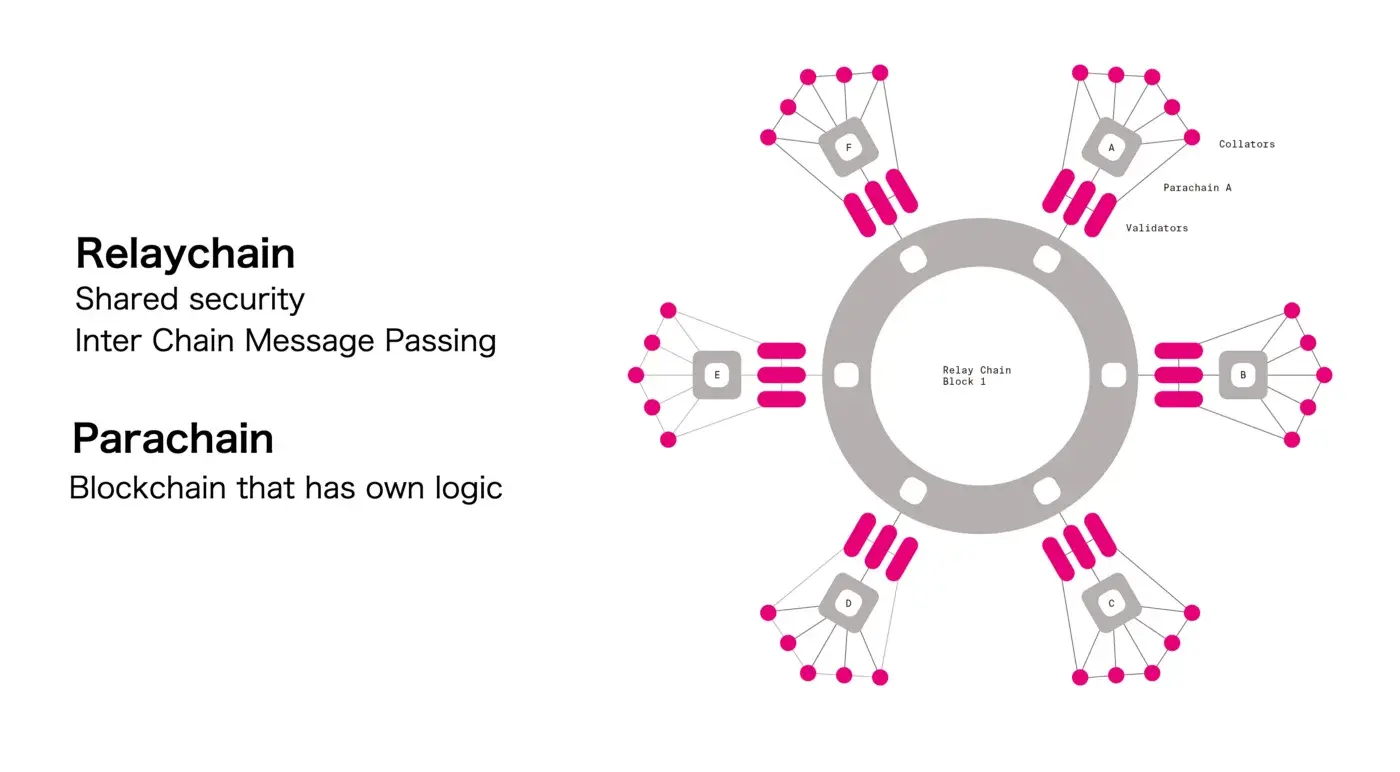
Polkadot operates through many parachains – blockchains subordinate to the "mother" blockchain, the Relay Chain, which determines the global state of the network. Each parachain is responsible for interacting with a specific third-party blockchain.
Each parachain can use its own rules for conducting transactions and forming blocks, and its own consensus algorithm, but it is the Relay Chain validators who ultimately approve blocks in all parachains.
On the one hand, this provides a high level of network security – each parachain is protected by all the validators of the "mother" blockchain. On the other hand, it gives excessively broad powers to Relay Chain validators, up to the possibility of completely blocking a specific parachain. As a result, Polkadot had to introduce an additional class of validators – Fishermen, whose sole task is to "hunt" for malicious Relay Chain validators.
Consensus Algorithm
Parachain developers receive a toolkit – Substrate, which comes with three "approved" algorithms: GRANDPA, Rhododendron, and Aurand. Any of them can be used in a parachain, and additional alternatives may appear in the future.
However, the "final word" always remains with the Relay Chain validators using the GRANDPA algorithm. This algorithm is fast and supports a large number of validators because they do not need to vote on every block. Voting is performed for the highest block in the chain, after which the algorithm applies it to all the block's ancestors.
Parachains and Bridges
Parachains are several Layer 1 networks that run in parallel on the Polkadot network. The execution of smart contracts or transactions is also carried out by individual parachains. Each parachain can have its own set of rules, logic, and runtime, providing flexibility and innovation at the parachain level. Parachains can implement their own consensus mechanisms and runtimes, such as those compatible with Ethereum, for executing smart contracts. Unlike Ethereum Layer 1, parachains are not burdened by consensus, allowing them to achieve the desired scalability. All parachains exchange necessary block data with the Polkadot mainnet to achieve consensus and maintain security and transaction finality.
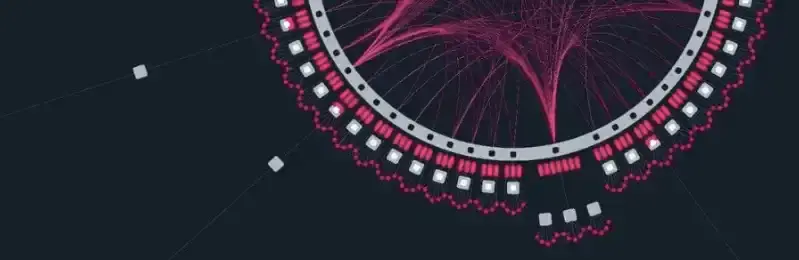
A common misconception is that Polkadot will be able to directly connect multiple networks like Bitcoin and Ethereum, but this is not exactly true. Polkadot provides interoperability through bridges that can be built on parachains. Polkadot does not connect disparate blockchain networks, but rather connects parachains, providing them with the necessary infrastructure so they can focus on applications and utility.
Parachain systems can provide interoperability with other networks as a useful feature. An example of this already in practice is the Moonbeam network, an EVM-compatible parachain that supports cross-chain interaction with Ethereum, allowing developers to create decentralized applications and NFTs on Moonbeam. There is also Snowbridge, a parachain bridge between Ethereum and Polkadot that enables interaction between the two networks.
Polkadot parachains allow for the creation of smart contracts, and the relay chain supports new blockchains (and tokens), allowing blockchains to exchange information. Notably, Polkadot can be upgraded without a hard fork, and the protocol is governed by those who own DOT, Polkadot's native cryptocurrency. Upgrading Polkadot to version 2.0 could open up smart contract capabilities in the relay chain.
The Future of Polkadot
The project has good prospects thanks to the Polkadot 2.0 update, which occurred in the fall of 2024. This transition corresponds to the growing importance of Web3 in the crypto industry and aligns with global technological trends developing in this field:
-
Interoperability. Polkadot 2.0, focused on improved interoperability, fits well into the Web3 concept – a decentralized and interconnected internet. As new blockchain projects and decentralized applications emerge, the ability to interact and exchange resources across different networks will become increasingly important;
-
Scalability. Although the Polkadot network was already highly scalable and had sufficient resources to handle a large volume of traffic, the Polkadot 2.0 update aims to increase scalability so the network is ready for the mass adoption of Web3 technologies. Through efficient and dynamic resource allocation (using mechanisms like elastic cores and dynamic core time), Polkadot can better handle the growing number of transactions and users;
-
User Experience. Increasing transaction speed, reducing costs, and increasing overall network efficiency can significantly improve the user experience, which is a key aspect of broader Web3 adoption. Polkadot updates are expected to make the work of users and developers more convenient and accessible;
-
Decentralization and Security. Polkadot's shared security model and decentralized governance structure embody the core principles of Web3. Updates that improve these aspects will further bring Polkadot closer to the ideal of a decentralized internet where users have more power.
-
Innovation and Flexibility. As Web3 evolves, the needs and aspirations of its participants change. The more flexible structure of Polkadot 2.0 is likely to foster innovation, allowing developers to adapt and create solutions that meet new needs and opportunities.
It can be assumed that without the Polkadot 2.0 update, the project's affairs would be somewhat worse than they might be, in theory, in the future.
Conclusion
Polkadot represents a significant and innovative force in the blockchain space, seeking to redefine how different networks can interact and scale. With its multi-chain architecture, Polkadot promises increased scalability, interoperability, and flexibility, which aligns well with the evolving Web3 paradigm.
However, it also faces challenges inherent in advanced blockchain systems, including complexity, slow adoption, and low trading volumes in the ecosystem. (It is in such conditions that tools like Arbitrage Scanner become indispensable — they help find hidden arbitrage opportunities even in low-liquidity markets, maximizing profits with minimal risks.)
As Polkadot evolves, its ability to address these challenges and leverage its unique advantages will be crucial in determining its role and success in the broader blockchain ecosystem.
Frequently Asked Questions
What is Polkadot and how does it work?
Polkadot serves as a segmented multi-chain network that simplifies the transfer of messages and value between different blockchains without the need for trust. Its goal is to create a fully decentralized network. The blockchain consists of a relay chain connecting several parachains, allowing transactions to be processed in parallel and ensuring shared security.
Can Polkadot connect any blockchain? What is the difference between a parachain and a bridged blockchain?
Polkadot can connect to various blockchains, but they must be adapted to the Polkadot environment using bridges built on parachains. A parachain is a parallelized chain that runs directly on the relay chain, while a bridged blockchain operates independently and interacts with Polkadot via a bridge.
How does Polkadot differ from Ethereum and other blockchain platforms?
Polkadot differs from Ethereum and other blockchain platforms by its Layer 0 architecture, which allows multiple blockchains (parachains) to interact within a single ecosystem. Unlike Ethereum, which is a monolithic network performing all tasks (consensus, transaction execution, and data storage) on a single blockchain, Polkadot uses heterogeneous sharding, where different parachains can be optimized for specific tasks.
Additionally, Polkadot uses a shared security model where parachains inherit protection from the Relay Chain, whereas in Ethereum, each Layer 2 network must provide its own security. Polkadot also allows protocol updates without hard forks, while Ethereum requires hard forks for major changes.
Thus, Polkadot is focused on creating an interconnected and scalable ecosystem of blockchains, while Ethereum is more focused on smart contracts and decentralized applications within a single network.
Want to learn more about crypto arbitrage?
Get a subscription and access the best tool on the market for arbitrage on Spot, Futures, CEX, and DEX exchanges.

You might be interested
SUI Cryptocurrency: Complete Review of the Blockchain Project and its Token
What is Solana (SOL): Project Overview and Future Prospects
