


Inside Bar Trading Strategy for Cryptocurrency Markets

with ArbitrageScanner!
Finding equilibrium in crypto markets can be where you find the next big move; therefore, much effort has gone into using price action methods to identify these times of confusion. Inside bar trading is among the most popular price-action styles employed by professional traders to identify consolidation periods in crypto and determine where they can expect the price to break out (both upside and downside). This guide will go into detail on why understanding how an inside bar is formed will assist in predicting and managing your risk during market breakouts for both Bitcoin and altcoin trades.
Understanding the Pattern
The Inside Bar is comprised of two candles creating an ‘inside bar’ pattern that represents a slowdown of momentum within the marketplace, allowing it to take a ‘breath’ after having momentum on the market, resulting in periods of indecision within the marketplace. The effect of this indecision on technical analysis is viewed as a ‘coiled spring,’ and the shorter the consolidation period (the inside bar pattern), the bigger the possible escape from it.
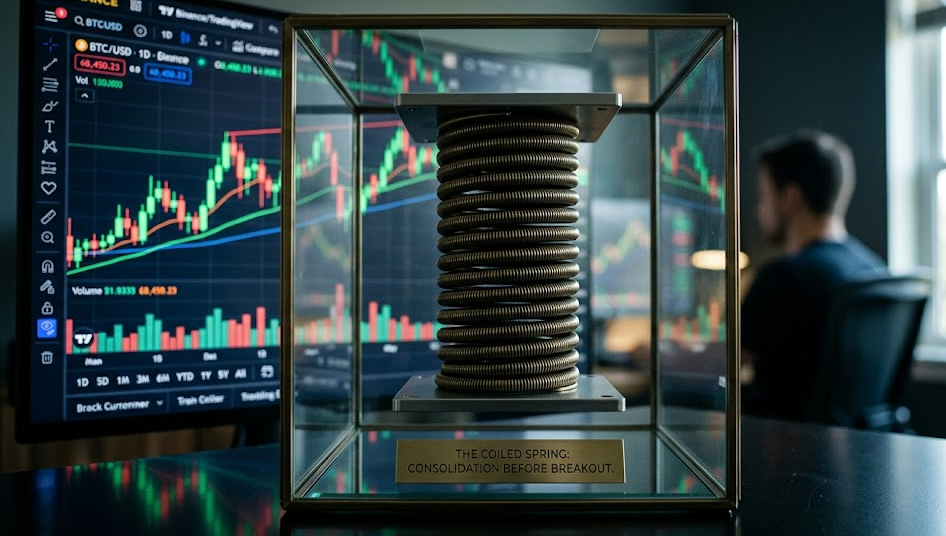
Inside Bar Key Features
The relationship between the most recent price bar (the “Mother Bar”) and the inside bar candle pattern together create the inside bar. For an inside bar to be a valid candle pattern, it must be created entirely within the previous price bar’s high and low; that is, it must have a higher low and a lower high than its predecessor, and represent a period of congestion (low volatility) prior to a possible price explosion.
Visual Identification
The inside bar can be visually identified using common price action principles. If you examine a candlestick chart, you will see (or be able to see) one significant (large) candlestick (called the 'Mother Bar', which is the largest candlestick) and then one or more smaller candlesticks forming after it (this is what is called the 'Inside Bar'). Some traders consider 'multiple inside bars' as showing that the price has been consolidating for an even longer period of time by being 'locked in' between the range of highs and lows of the previous 'Mother Bar'.
Market Implications
The 'Inside Bar' formation can mean one of two things — either continuation of the existing trend (in this case, up trend) or change of trend (in this case, down trend) or reversal. If you see an 'Inside Bar' when the price is in a strong bullish or bearish momentum, there is a good likelihood of that being the case for continued movement in that direction. Conversely, if the 'Inside Bar' appears on significant support or resistance levels where established lines have formed (a lot of traders will be placing orders in the area of those horizontal or vertical lines), you may have a high probability of seeing the price reverse.
When you have an 'Inside Bar(s)' formation (s) is established, typically there is a neutral or balanced buyer and seller balance (standoff) between buyers and sellers. There is no winner on either side.
The Strategy of Trading the 'Inside Bar'
Successfully trading the 'Inside Bar' requires more than just spotting an 'Inside Bar' (This is the easiest part of the strategy), you must create a solid plan (trading strategy). Many times, because of high volatility in crypto markets and the tendency for 'fake outs', it is common practice for traders to wait for the price to move outside of the range between the high and low of the 'Mother Bar' before taking long or short positions (meaning the momentum must move in the direction you are willing to trade (long or short)).
Entry Points
The most common method to trade the 'Inside Bar' formation is to place pending orders. For example, using a bullish setup: place a 'Buy Stop' order just above the 'Mother Bar' high, or using a bearish setup: place a 'Sell Stop' order just below the 'Mother Bar' low, then you are able to trade with the established momentum after the breakout direction has been established.
Stop-loss Placement
You should always protect your capital. When establishing stop losses, many traders will often place their stop loss on the opposite side of the Mother Bar. But, when trading in highly volatile crypto markets, doing so can cause the stop loss to be wide. Instead of this method, an alternative may be placing the stop loss at the low of the inside bar for a long position or at the high for a short position, which will cause the risk to be tighter. However, tighter stop losses will increase the likelihood of being stopped out due to "noise."
Target Setting
When attempting to take a profit, look for the nearest support or resistance level to your entry price. A good rule of thumb is to use a 1:2 (benefit/risk) ratio. That is, if your stop loss is $100 away from your entry price, your profit target will be a minimum of $200 away from your entry price. Alternately, you can see how price reacts to interactions with the moving average to determine if you will trail the stop to capture a larger move.
Risk Management
Every trading plan requires strict risk management to be effective. Due to the historical performance of cryptocurrency, it is recommended to never risk more than 1-2% of your total account balance on a trade made with an inside bar. Many sites, such as the TrendSpider Learning Center, provide back-testing templates to analyze the profitability of inside bar trades based on the various market conditions.
Plan of Action
The key to determining how to utilize and trade this pattern is having a solid plan. It should be noted that not every inside bar provides a profitable trade. However, what separates winning traders from losing traders is validation.
Validation of a Pattern
A quality inside bar pattern should form on higher timeframes such as H4 or Daily and inside bars formed on the 1 Minute or 5 Minute are often dismissed as just noise from the market. The close of the inside bar based on where it falls within the entire range of the pattern can also be an excellent piece of information when determining which direction the breakout will go.
Execution of a Trade
Once you determine that the pattern is valid, examining the points surrounding it can help you decide how you would like to participate in the trade. Do you see any bullish reversal signals around it? Are we at a significant resistance area? You should only trade the inside bars that coincide with the overall market structure. If the market for Bitcoin is trading in chop, you would be best suited to wait for a definite trend before trading the inside bars on the market.
Determination of Position Size
The distance from your entry point to your stop loss will assist you in determining the correct size of your trade. Since leverage is a common practice in cryptocurrency and more like forex, the use of small position sizes will give a trader a much better opportunity to have longevity in this market. It is recommended to first determine direction, then calculate size.
Exit Strategy
Don't assume that your trade will be profitable simply because the take profit order has been placed. A good time to consider a long-term trade position based on moving the stop loss to break-even.
Suggestions for Trading
- Complete an Inside Bar Trade Before Trade Entry: When considering trading an inside bar, it is crucial to wait until the inside bar has closed before making a trade. Entering a trade before the inside bar has closed (before the candle has completed) can result in being "caught" and having to close out your trade at a loss.
- The Importance of the Inside Bar in its Context: If you see an inside bar that has formed near a support or resistance level, it carries more weight than when an inside bar forms in a random area of the chart. The location of the inside bar in relation to all of the candles that have been created before it adds importance to the inside bar.
- The Inside Bar in Context of the MA: Additionally, it is recommended to utilize a 20-day EMA. If there is an inside bar forming at the EMA and the EMA is in alignment with the trend, it will give a high probability of continuation in the same direction that the inside bar is currently moving.
- Does it Trade Within a Range? If the length of the "Mother Bars" is unusually long, the range from its high to low may be wider than is reasonable. Therefore, a stop loss cannot be used for an inside bar in this case because the inside bar formed inside of the "Mother Bar," therefore there would not be an inside bar to use.
- Effect of Significant News Events on Inside Bar Trading: If a high-impact news release or event, relating to currency or cryptocurrency, is going to occur, do not enter into a trade based on the inside bar because of increased volatility that will cause excessive price movement to potentially stop you out.
Final Thoughts
The inside bar trading strategy forms a key foundation in technical analysis, utilized for potential breakout trades from consolidation, providing the trader with a high probability of success. No candlestick pattern can give you an absolute assurance that you will be able to profit; however, using inside bars in conjunction with support and resistance, through sound risk management techniques, creates a complete trading strategy for trading cryptocurrency. When developing the skill to trade inside bars, apply the rules consistently through discipline.
Frequently Asked Questions
How do I know if the inside bar is reliable or not?
The inside bar should always have a clear and distinct Mother Bar and should be located within the range of the prior candle. The highest reliable inside bars will be formed at significant support or resistance levels, as identified by a daily chart.
What are the best timeframes to trade inside bars?
The Daily and 4-hour timeframes are the best for trading inside bars within the Cryptocurrency market. Lower timeframe charts create “false” inside bar trades; this is a direct result of the extreme range created through Bitcoin price volatility.
How should I calculate my position size when trading inside bars?
To know your position size, you will first need to establish your stop loss distance based on the Mother Bar's high/low, then based on this, determine how much total dollar amount can be placed at risk. The total amount placed at risk should not exceed 1-2% of your overall equity, regardless of how bullish the chart is.
When should I not trade an inside bar?
Do not enter into a trade based on an inside bar trade if it is Sunday/the volume of trades on Sunday is very low; if there is a high-impact event that will cause volatility; or when the range of the Mother Bar is very large compared to the prior candles, this will often lead to unfavorable risk-to-reward ratios.
How do I use inside bars in conjunction with other trading indicators?
Traders frequently employ the 20/50 EMA to help determine the trend when trading inside bars. Volume-based scanners, for example, could be used to ensure enough volume has been generated for a valid breakout from inside bars as part of the inside bar trading strategy.
Want to learn more about crypto arbitrage?
Get a subscription and access the best tool on the market for arbitrage on Spot, Futures, CEX, and DEX exchanges.

You might be interested
Setting Up Your First Crypto Arbitrage Bot
How to Setup Trust Wallet for Binance Smart Chain
Navigating Crypto Bull vs Bear Markets
