


Technical Analysis Mistakes to Avoid in Crypto Trading


with ArbitrageScanner!
Modern cryptocurrency trading relies heavily on the techniques of Technical Analysis (TA), which provide a systematic method for determining how to navigate the continuous fluctuations associated with digital assets that trade 24/7. Unfortunately, the majority of traders view the use of TA as an online crystal ball rather than a statistical method of predicting the probability of an outcome. This misunderstanding is one of the reasons that so many traders make significant mistakes that can result in a total loss of their portfolio in just minutes. In this report, we will focus on identifying some of the most common technical analysis errors and present a guide for improving the discipline and profitability of your decision-making.
Understanding Technical Analysis
Core principles
Technical Analysis (TA) is the analysis and study of past price movements in the market, or how the market has moved, and its trading volume during a given time period, in order to forecast where price is likely to move in the future. Unlike Fundamental Analysis (FA), which assesses how successful a particular company is based on its financial fundamentals or how useful a project is for the marketplace, TA assumes that all of the information available at the time is already reflected in the stock price of the company or in the value of a particular crypto token.
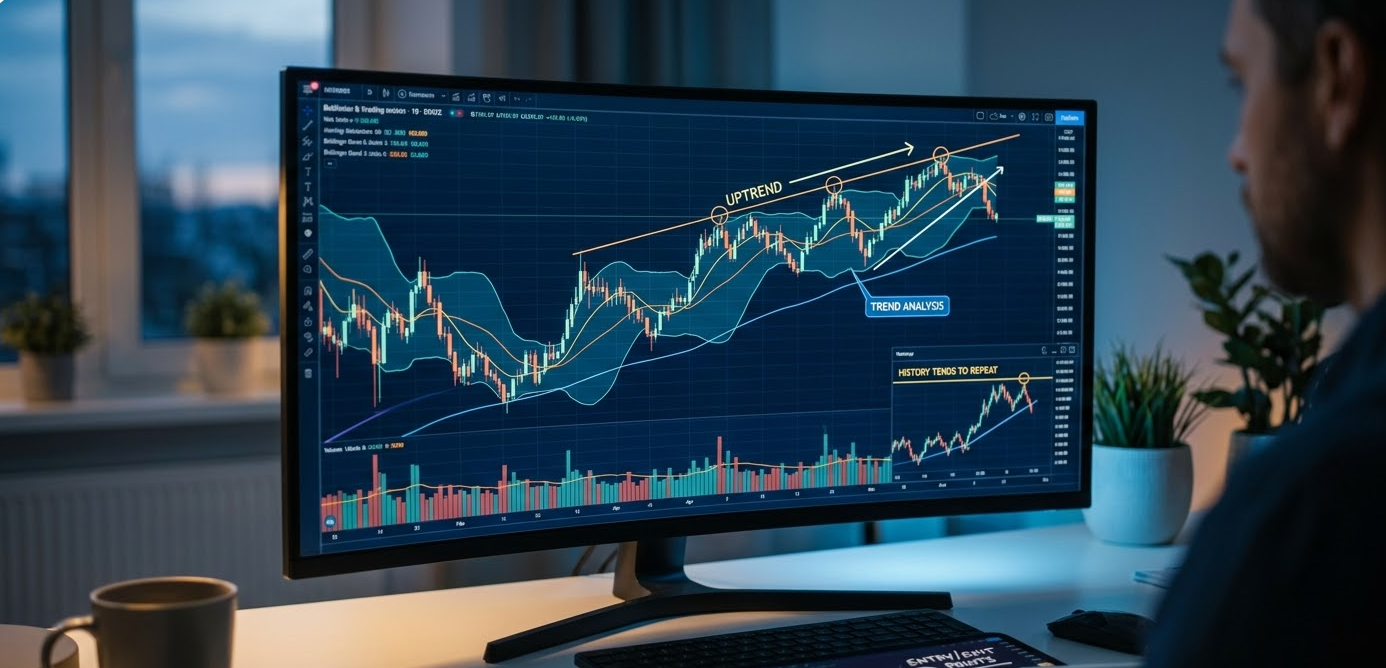
TA has three basic principles that serve as its foundation: 1) The Market Discounts Everything, 2) Price Moves in Trends, and 3) History Tends to Repeat Itself. As a Technical Analyst, you will apply these principles when evaluating past price movements to determine where the next highest-probability entry point for a purchase or exit point for a sale will be.
Key components
TA is based on a combination of the following three key components when analyzing price charts to determine when to buy or sell an asset: Candlestick Charts, Trend Lines, and Technical Patterns. As part of this process, you will be looking for a Support or Resistance Level of the price action of an asset. It is important to have an appropriate understanding of the various Support and Resistance levels when developing any investment strategy.
Application methods
TA can be used to identify Bullish or Bearish signals for trades across multiple asset classes (i.e., Exchange Traded Funds (ETFs), Stocks, or Bitcoin). When using TA, it is important to use a combination of Technical Indicators and Technical Chart Patterns to develop an entry and exit point in the market for trading any asset class. For example, a price breach of a long-term trend line can serve as a buying indicator for investors and traders.
Critical Mistakes
Missing stop-loss
Mistake #1: Using No Stop Losses. Almost all inexperienced traders in the cryptocurrency market neglect to use stop losses when buying. Cryptocurrencies are volatile and when prices drop suddenly against the trader’s position, the trader risks being liquidated or losing all of their invested capital. A stop-loss order is your best protection against losing trades due to price volatility; trading without a stop-loss is speculative rather than strategic.
Overtrading risks
Mistake #2: Overtrading. Overtrading happens when traders feel that they must always be “in the market.” As a result, traders may feel compelled to enter the market even when no valid setup exists according to current market conditions. There are times when a trader’s chart will indicate that they should not be buying or selling; a trader must only trade when a valid setup exists.
Revenge trading
Mistake #3: Revenge Trading. When traders incur losses following bearish price movement in the cryptocurrency market, some feel the need to quickly recover their losses. Revenge trading is driven much more by emotion than by logical or rational thought. Most revenge trades result in larger losses than those incurred during rational trading.
Strategy inflexibility
Mistake #4: Lack of Changing Trading Systems or Strategies. Many traders continue to use the same technical analysis methods and tools after a new trend has formed, which can lead to failure. Most traders cannot adapt their approach once the market has become volatile, which can result in losing trades. Technical analysis has both subjective and objective components, so a trader must be flexible when utilizing TA techniques.
Market sentiment ignorance
Mistake #5: Ignoring Market Sentiment. In the majority of situations, technical analysis does not account for sudden price changes due to news or other external events. TA shows “how” to make trades, while market sentiment explains “why”. If fundamentals are not factored in (like regulatory changes or macro-economic action), then TA may not hold true due to fundamental shifts in the market.
Absolute thinking
TA is not about absolute value; it is about relative probability. Trading successfully is based on weighing the evidence in favor of or against a technical signal or support level. Assuming that a support level “must” hold can result in major losses. The market has no obligation to respect your analysis.
Strategy absence
Trading without an established trading plan is a recipe for losing money very quickly. A trade plan should detail where you will enter and exit the trade, what your profit target is, and what your maximum accepted loss is.
Prevention Strategies
You need to have a system to avoid these common trading mistakes. The system should help you make well-informed decisions when trading.
Risk management
You should never risk more than 1–2% of your overall account balance on any one trade. If you do not utilize effective risk management, a string of losing trades could end your trading career. Position sizing will help you balance your exposure to different financial markets when placing a trade.
Position sizing
Position sizing should be based on the volatility of the underlying asset you are trading. Since stocks have a lower level of volatility than a meme coin, you should keep a significantly smaller position in the meme coin relative to your overall position size in the stock.
Emotional control
Many experienced traders argue that trading is largely psychological. There are times when you see a bullish signal that is already at its peak and you experience FOMO (fear of missing out). The very top traders understand that they need to remain calm during periods of volatility and stick to their established trade plan regardless of outside distractions.
Market adaptation
Make sure to check multiple timeframes for the current trend prior to placing new trades. A candlestick can show strength on a lower timeframe (e.g., the 15-minute chart) while remaining within a broader downtrend visible on the daily chart. All technical indicators can assist you, but price data is where your focus should be.
Research importance
You will want to consider both fundamentals and technical analysis to get an accurate picture. Although market data used for analysis is helpful, past price data may not always predict future changes across the various types of market structures.
Best Practices
In order to succeed as a technical analyst, it is more important to have consistency than to have an occasional large win.
Strategy development
Develop your strategy: build a robust tool set by testing different technical indicators (such as moving averages or RSI).
Market analysis
Conduct market analysis: use charting software to scan charts on a frequent basis for historical data.
Risk assessment
Assess risk: make sure to recalculate the risk-to-reward ratio before placing a trade.
Decision making
Base your decisions on data, not gut instinct.
Continuous learning
Continuous learning is your best long-term protection against the market.
Implementation Guide
Having the right tools is critical to your overall trading and investing success.
Tool selection
Consider using a platform such as TradingView for real-time market data and to create advanced indicator settings. Understand each tool individually before attempting to trade with all of them simultaneously.
Analysis methods
Start with price action. Look for divergence between price and a technical indicator — for example, between price and RSI. If the price hits a new high while the RSI hits a lower high, this is a sign that the market may be overbought and could present a reversal opportunity.
Strategy testing
To test your trading strategy without risking real money, use paper trading tools. Then review historical instances where the strategy would have produced gains or losses to validate its effectiveness.
Performance monitoring
Perform regular documentation of your trades in a trading journal — recording why you entered, what the chart was showing, and why you exited. By documenting your entry and exit levels consistently, you will refine your trading style over time.
Conclusion
Technical analysis is an excellent way to trade the financial markets; however, its power depends on the discipline of the trader. By avoiding common mistakes (such as overtrading) and consistently using stop losses, you will drastically increase your chances of success. Success is not about always being right; it is about making informed decisions and managing risk effectively.
FAQs
How do I develop an effective stop-loss strategy for crypto trading?
When developing a stop-loss strategy, set stop-loss orders below previous major support levels and/or base your stop loss on volatility using ATR (Average True Range) indicators. This allows room for natural price fluctuation while limiting your downside risk.
What are the best ways to control emotions during trading losses?
If you are feeling stressed or worried about a trade, you may be over-leveraged on that position. To reduce stress, use a pre-defined trading plan to create consistency in your process.
How can I balance multiple technical indicators effectively?
To avoid “analysis paralysis”, do not use more than 2–3 technical indicators that work well together. For example, to confirm whether an asset is oversold or overbought, combine moving averages (trend-based indicators) with RSI (oscillator-based indicators).
When should traders adjust their technical analysis strategy?
Traders should consider adjusting their strategy after observing consistent losses or multiple missed opportunities over an extended sample of trades (for example, 20 or more). Adjustments are also necessary when market conditions shift, such as moving from a high-volatility environment to a range-bound market.
What role does market sentiment play in technical analysis?
Market sentiment is the driving force behind price action. TA is a means to determine where price is moving, but market sentiment — such as fear of missing out or panic — creates the momentum that drives price through resistance or support levels.
Want to learn more about crypto arbitrage?
Get a subscription and access the best tool on the market for arbitrage on Spot, Futures, CEX, and DEX exchanges.
You might be interested

Buying and Selling Altcoins: Complete Guide

Falling Knife in Crypto: Proven Buying Strategies

Fiat Currency vs Cryptocurrency
