


Cryptocurrency Decentralization: Complete Guide

with ArbitrageScanner!
When using a standard credit card to make purchases or sending money through an established bank, there is typically a central authority overseeing and approving your transaction, such as a bank or payment processor. When you complete these actions, the central authority validates your transaction, records it in their own systems, and has the ability to block the transaction from occurring if you do not meet the qualifications outlined by the institution. Cryptocurrency was developed to provide users with a different option and is based on decentralisation as a core principle.
Decentralised systems are not just another feature of cryptocurrencies; they are at the heart of cryptocurrencies and allow users to transact without borders, middlemen or governments. This guide will show you how decentralised networks operate, how they are changing the world's economy and what the future may look like without centralised systems of authority.
Understanding Decentralization
Basic principles
Understanding decentralised systems requires understanding what it is replacing. Centralised (or traditional) systems are a Single Point of Failure. All power and authority are concentrated in one location. If that location goes down (the hub), all of the surrounding spokes (the nodes in the network) will go down with it. Conversely, Decentralised systems are designed to distribute power/authority/data and decision making amongst large numbers of participants.
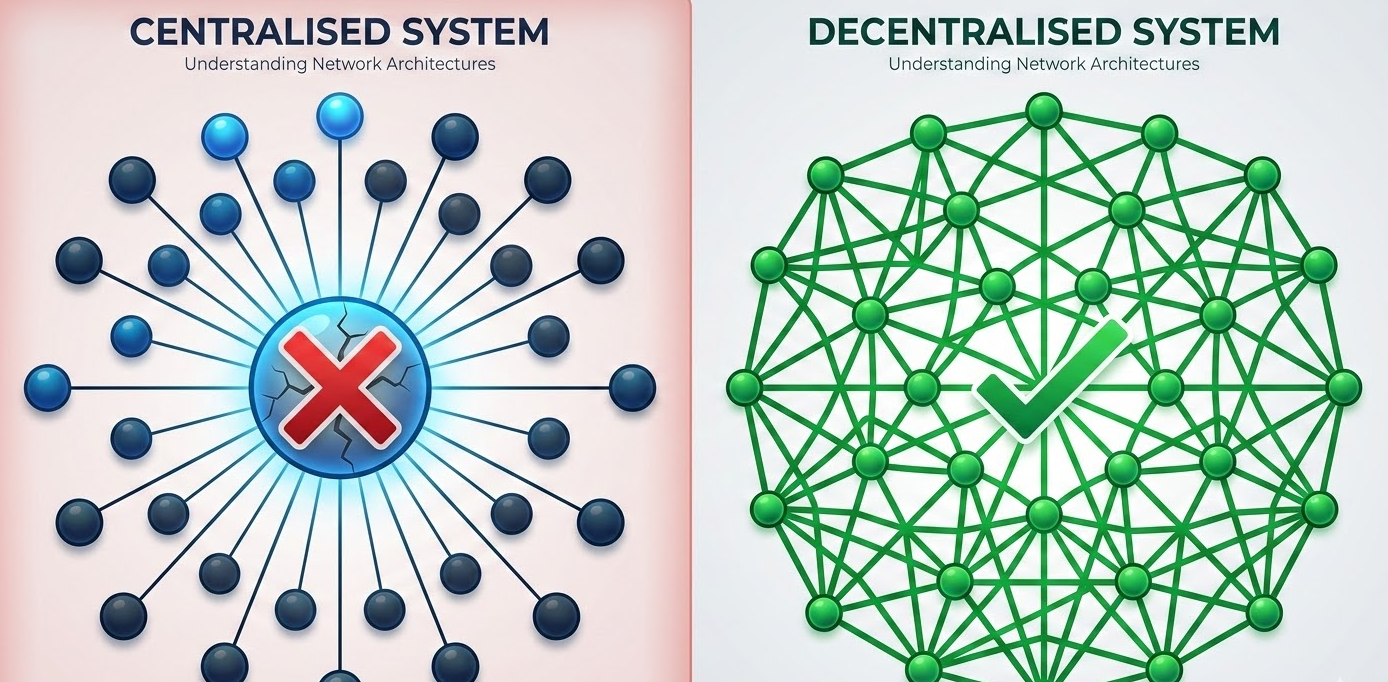
The overall goal of decentralised blockchains is to create a "trustless" environment for participants. It does not mean participants do not trust the system; it means that they do not need to place their trust in any one person or entity. They trust mathematics and computer code over humans and their promises.
Key Principles:
-
No Permission - Anyone with internet access can participate
-
Censorship Resistant - No one has the ability to block or freeze transactions
-
Transparency - All actions are recorded in a publicly distributed ledger.
Blockchain mechanics
What is a Blockchain?!
The blockchain is made from links that create different types of blocks. Each block has a number of transactions in it that have been validated by the network. Unlike databases held by banks, the blockchain is stored on tens of thousands of computers (or nodes) all over the world.
When there is a new transaction, all computers in the blockchain network must come to a “Consensus” before that transaction is added to the blockchain. This is how everyone can agree on the state of a blockchain without needing a central coordinator. This is what we mean by calling a blockchain a distributed system.
Network types
Blockchains can be categorized into 3 main types of blockchains:
-
Public Blockchains - Fully decentralized and open to anyone (e.g., Bitcoin, Ethereum).
-
Private (Permissioned) Blockchains - Operated and controlled by one person or company (these are commonly used in the corporate space).
-
Consortium Blockchains - Operated by a consortium of multiple organizations; this is in between a centralized and a decentralized system.
Implementation methods
To effectively create a decentralized network, blockchains must utilize some form of Consensus Mechanism. The two methods that are primarily used today are as follows:
-
Proof of Work (PoW) - Bitcoin is built on PoW. Miners work hard to solve difficult puzzles and by doing so secure the Bitcoin network.
-
Proof of Stake (PoS) - Ethereum is built on PoS. Instead of miners solving tough problems, Validators lock up (or stake) ETH in order to earn the right to validate transactions.
Both Pros and PoS methodologies will make it almost impossible for an individual or entity to manipulate historical records because it would take enormous computing resources, and therefore cost too much, for any one person or entity to create all the history.
DeFi Ecosystem
Definition and scope
The largest evolution of blockchain technology since Bitcoin is Decentralized Finance (or DeFi). The overall vision of DeFi is to create all of the financial products that exist in the traditional financial system (e.g., loans, insurance, trading) but do so using public blockchains. Decentralized Finance (DeFi) is an ecosystem comprised of financial applications that have been built around blockchain networks. Unlike a traditional bank or a digital currency exchange (e.g., Coinbase), DeFi platforms operate using smart contracts, or self-executing computer code that executes when predetermined conditions are satisfied.

Key components
The DeFi ecosystem is made up of several "money legos," or building blocks:
-
Decentralized Exchanges (DEXs) enable users to swap cryptocurrencies directly through their wallets, such as Uniswap;
-
Liquidity Pools are collections of funds provided by liquidity providers to help facilitate trading; and
-
Stablecoins are digital currencies that are pegged to the dollar and act as stable mediums of exchange; and
-
Governance Tokens give holders the right to vote on the future of a DeFi protocol.
Use cases
DeFi isn't just a concept; it is a very functional way to earn interest on your assets, borrow capital by leveraging crypto as collateral, and yield farm by moving your assets between different protocols to maximize yield.
Market impact
DeFi continues to pose a challenge to the SEC and other global regulators as it removes the intermediary to lower fees and provide financial services to the billions of people (the "unbanked") around the world with smartphones who are shut out of conventional financial systems.
Centralized vs Decentralized
Key differences
With DeFi, users have two options for their cryptocurrency needs: centralized or decentralized.
Important Differences:
-
Straightforward (CEX):
-
The exchange is in control.
-
Identity verification (KYC).
-
Very fast.
-
Vulnerable to hack of exchange.
-
Game-changing (DEX):
-
You are the one in control (hold your key).
-
Usually you are anonymous (no verification).
-
Dependent on congestion on the blockchain.
-
Vulnerable to bug in smart contract.
Operational aspects
What is the operation? Similar to stock exchanges, centralized exchanges (e.g. Coinbase or Binance) are businesses that function as matchmakers between buyers/sellers and hold their assets while they are waiting to find a buyer or seller. Decentralized exchanges (Dex) do not have intermediaries. All swaps occur with a set of smart contracts on the blockchain.
Security considerations
In terms of security, centralized exchanges are honeypots (billions of dollars in a single entity's wallet) for hackers. In return, decentralized exchanges are much more difficult to hack at the protocol level, but the user bears a much greater burden. If you lose your private key, your funds are lost for good.
User implications
What does this mean for you? Using a centralized exchange provides a safety net for you (e.g. password recovery or customer service). However, using a decentralized wallet provides you with true ownership since you control your own keys (the saying "Not your keys, not your coins" is relevant here).
Benefits and Challenges
Network advantages
What are the advantages and disadvantages? Although the advantages of being decentralized are game-changing, there are still many challenges to overcome in order for the technology to be successful.
-
No single point of failure. An entire network can continue to function normally if one or more of its nodes go down.
-
No one can be denied access to use the network based on their region or politics.
-
Immutability denotes that transactions that are recorded cannot be altered, which ensures a permanent record, or “source of truth,” exists for all transactions made.
System drawbacks
Problems Associated With Systems: The primary barrier is the Blockchain Trilemma, which implies that a blockchain network can only place emphases on two or three criteria: Security, decentralization, or scalability. Public blockchains (e.g., Bitcoin) have an extremely high level of decentralization. However, they take much longer to process transactions than centralized blockchains (e.g., Visa).
Security aspects
Security Risks: A major advantage of all Bitcoin and Ethereum is that they have never been compromised or "hacked," although several different blockchain applications displayed vulnerabilities to cyber-attacks or hacking attempts. With too many individuals, or "mining pools," this becomes difficult to achieve on a blockchain platform. If the size of a particular mining pool increases to a point where it dominates other mining pools on a particular blockchain, it will have always had an impact on that network's ability to operate at its originally specified degree of decentralization. This can also happen if the smart contract code was not adequately audited before the implementation of the smart contract.
Implementation issues
Problems Associated With Implementation: Another barrier to using blockchain technology is that there continues to be a lack of regulatory guidance for how various forms of crypto, cryptocurrencies, or decentralized autonomous organizations (DAOs) will be treated and regulated in the U.S. and Europe. Regulatory agencies (e.g., SEC) are continuously working to establish how specific crypto types, cryptocurrencies, or decentralized autonomous organizations (DAOs) are treated under the applicable regulatory framework.
Practical Applications
Exchanges
Examples of Practical Use Cases: Blockchains' decentralization is moving beyond the realm of financial transactions and expanding into many other markets worldwide.
Decentralized Exchanges (DEX): DEX are platforms that allow users to trade with each other (peer-to-peer) without relying on a central intermediary (a company), as well as using crypto or blockchain to perform the same function. The anonymity offered to users who trade on a DEX allows them to trade without a counterparty risk.
Wallets
Cryptocurrency Wallets: Various digital wallets (i.e., MetaMask or Ledger) serve as mechanisms that allow end users to directly access blockchains. Cryptographic wallets facilitate both the sign of transactions and the creation of the decentralized digital identity of users, as well as working within the new Web3 ecosystem.
Smart contracts
Smart contracts represent the foundation of blockchain applications. The options available for using blockchain technology are endless; from automated payout systems for insurance claims to decentralized autonomous organizations (DAOs) being fully integrated.
Financial services
Three prominent examples of how blockchain is being used today are decentralized finance through insurance companies; synthetic assets; and lending using crypto as collateral.
Future Implications
Industry trends
What is the long-term outlook for this market and its use of blockchain over the next ten years?
DAOs have seen tremendous growth in both cryptocurrency use and tokenized projects that operate on the blockchain. By governing their projects through communities, DAOs provide a new way of managing a company that is fully transparent, has no geographical borders, and is created by the individuals that will be using the completed project.
Development potential
With the emergence of layer two solutions, such as Arbitrum and the Lightning Network (L2 systems), decentralized systems will have increased ability to achieve the same level of performance as centralized systems while still maintaining secure infrastructure for data storage and processing.
Adoption challenges
Before we can expect mass acceptance of decentralized technologies, the user experience must be significantly improved. Currently, one of the largest obstacles to the mass public's ability to engage with or deploy decentralized technologies is the high degree of difficulty associated with understanding how they work—this is called the "grandma test" (i.e., can someone who doesn't know anything about technology safely use them?). Until the industry overcomes this primary obstacle, widespread adoption will not occur.
Market evolution
The continued integration of blockchain technology and cryptocurrency into the global trading sector will allow for the creation of "hybrid finance" (HyFi), where traditional financial institutions will use public blockchains as a settlement mechanism so they can save costs associated with traditional settlement and recordkeeping methods, while at the same time improving the global financial infrastructure's transparency.
The Bottom line
In conclusion, the decentralization of cryptocurrencies is not a passing trend, but rather a foundational change in how society will define "value" and "trust." By eliminating the need for a third party or centralized authority to act as an intermediary, distributed ledgers make all transactions more secure, transparent, and accessible to everyone than ever before.
Although significant obstacles still exist (including the blockchain trilemma and increased regulatory scrutiny), there is no doubt that the decentralization movement is well underway and that the genie is permanently out of the bottle! Regardless of whether you use a decentralized exchange, smart contract or simply buy bitcoin, the era of financial independence is upon us.
FAQs
How truly decentralized are cryptocurrencies?
It depends on the network type. While public blockchains like Bitcoin and Ethereum are fully decentralized and open to anyone, other types exist, such as private (permissioned) blockchains controlled by a single entity and consortium blockchains. Additionally, factors like the concentration of power in mining pools or the specific consensus mechanism (PoW or PoS) can impact the actual degree of decentralization.
What are the main benefits of decentralization?
The primary benefits include the elimination of a single point of failure, as the network continues to function even if nodes go down. It also ensures a "trustless" environment where users rely on mathematics instead of intermediaries. Key advantages include censorship resistance (no one can block transactions), transparency through a public ledger, and immutability, which ensures records cannot be altered.
How does DeFi differ from traditional finance?
Traditional finance relies on central authorities like banks to validate, record, and potentially block transactions. DeFi replaces these middlemen with smart contracts—self-executing computer code on a blockchain. This allows for financial services like lending, insurance, and trading to be borderless, lower in fees, and accessible to anyone with a smartphone, regardless of their standing with traditional institutions.
What risks come with decentralized systems?
Decentralized systems face the "Blockchain Trilemma," often sacrificing scalability for security and decentralization. Users also bear a much greater burden of responsibility: if a private key is lost, funds are gone forever since there is no customer service to recover them. Other risks include potential bugs in smart contract code and the ongoing lack of clear regulatory guidance in many regions.
Who benefits most from decentralization?
Decentralization is a game-changer for the "unbanked"—billions of people who are shut out of conventional financial systems but have access to smartphones. It also benefits individuals seeking financial independence and true ownership of their assets, allowing them to transact without the fear of a central authority freezing their accounts or denying them access based on geography or politics.
Want to learn more about crypto arbitrage?
Get a subscription and access the best tool on the market for arbitrage on Spot, Futures, CEX, and DEX exchanges.

You might be interested

Binance Trading Guide: Complete Platform Analysis 2026
Bitfinex Exchange Review 2026: Complete Platform Analysis

Understanding Fiat and Cryptocurrency: A Complete Guide
