


Understanding Fiat and Cryptocurrency: A Complete Guide


with ArbitrageScanner!
The world is currently experiencing the greatest change in the financial system since 1971—the separation of the U.S. dollar from the gold standard. Today we have two types of money: fiat currency, the historical backbone of international commerce and cryptocurrency (digital) which has the potential to redefine how and what we define as a value.
Whether you're seeking ways to understand the new economy or are simply confused by how these two types of money interact, compete and can be equally viable, this article gives you everything you need to know about how fiat and crypto work, their respective advantages and disadvantages, and what they mean for the future of money.
What is Fiat Money?
Historical Perspective
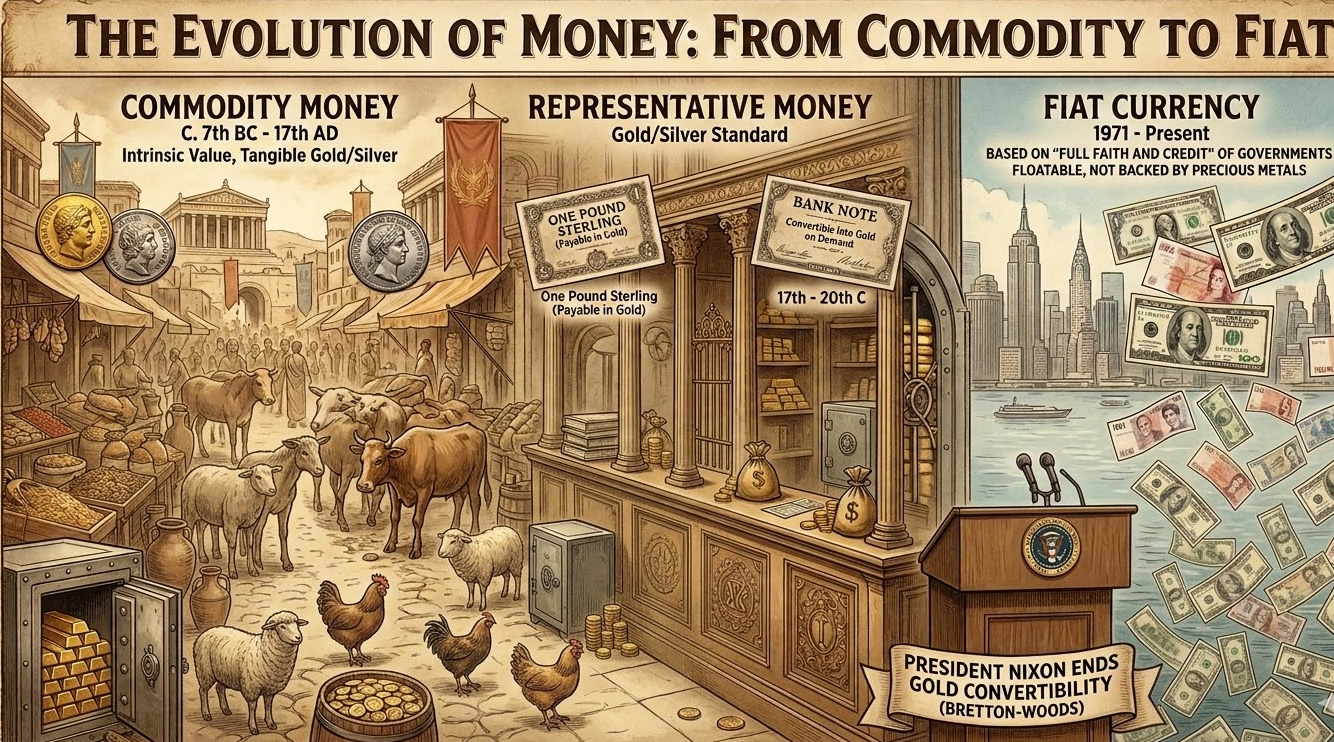
Fiat currency didn't come into being overnight; it took thousands of years for humanity's economy to evolve from utilizing commodity money (coins made from precious metals including gold or silver) through the introduction of representative money (paper notes that represented ownership of an amount of precious metal/commodity) until we reached today's fiat system—the paper money we use today wasn't officially declared legal, non-precious, yet floatable, until 1971 after President Nixon announced the U.S. would cease to allow foreign countries to demand that the U.S. exchange its currency for gold under the Bretton-Woods agreement and all governments could create their own currency, using nothing but their "full faith and credit."
Definition
The word fiat is Latin for, "let it be done." Unlike commodity money, fiat currency has no inherent form. Fiat currency is created solely through governmental regulation: It gets its value from the stability of the issuing government (i.e., political stability of the country issuing it) and the relationship between supply and demand for the particular currency in the currency markets. Currently it is used throughout the world for virtually all types of financial transactions.
Role of Government
Governments and central banks serve as the ultimate authority in fiat systems; i.e., they declare the currency to be legal tender, and therefore all debts, public and private, must be paid in that currency. (Governments also require the payment of taxes to be made in the same legal tender.) As such, these two entities create a baseline level of demand due to being mandated by the government to be accepted as legal tender. With this centralized control, the central bank can derive monetary policy as a means to manage economic cycles; however, the centralization of control also leaves the financial system subject to the political environment.
Foundation of the Economy
Trust is the foundation of fiat. Because it is not backed by any commodity (e.g. gold), purchasing power will be determined by the central banks ability to keep prices stable. If the government becomes perceived as illegitimate or is mismanaging the economy, such circumstances could lead to a collapse of the value of the fiat money, resulting in hyperinflation as seen throughout history (e.g., the Weimer Republic, Venezuela).
Modern Implementation
Today, coins and paper currencies represent only a very small part of the total money supply. The majority of fiat money currently exists as a digital representation in the ledgers of banks. When you pay with fiat via your credit card or banking application (app), you are moving fiat within a centralised network of intermediaries, which authenticate and record your fiat transaction.
Fiat Currency Mechanics
Value definition
The value of fiat currencies (e.g., U.S. dollar, euros) is defined by the monetary policy, interest rates, and the foreign exchange (FX) rates in the global FX market. -Economics. -Government Regulation. A country's Gross Domestic Product (GDP), trade balance, and political environment are key factors used to evaluate the value of that country's currency against the value of other currencies, for example, comparing the dollar with the euro.
Money Supply
The supply of money is easily manipulated by fiat currency. Fiat currencies can be printed or created digitally at any time and by any authority. Central banks can increase the amount of currency in circulation to stimulate the economy during recessionary periods and decrease the amount of currency in circulation to slow the economy during inflationary periods. However, increasing the amount of attached to money in circulation typically decreases the value of that currency over time.
Role of Commercial Banks
Commercial banks function as intermediaries for borrowers and provide an important mechanism for creating new money. Through the process of fractional-reserve banking, commercial banks extend loans to customers based on reserves of money that they hold. As an intermediary, creating new money through the issuance of loans creates systemic risks that require heavy regulation and oversight by crypto authorities, such as The Federal Reserve, The International Monetary Fund and other global administrative bodies.
Monetary Policy
Monetary policy is the management of a nation's overall money supply and interest rates. Central banks can influence the amount of consumer spending and business investment by manipulating the price of money (i.e., by changing interest rates). For example, a central bank can combat inflationary pressures within an economy by increasing interest rates; however, if interest rates are raised to levels that reduce consumer and business borrowing and spending, this action may have the intent of combating inflation but also reduce economic growth rates for the same period. The equation of these various fiscal/economic considerations best illustrates the balance that is required within the fiat monetary system.
Crisis Management
Fiat monetary systems provide issuers (i.e., governments, central banks) with the capacity to respond to extraordinary fiscal/economic crises (i.e., the financially related universal downturns in the global economy that occurred during 2008 and 2020) by providing the necessary liquidity to avert complete global systemic financial collapses. The ramifications of the aforementioned policies over the long run commonly include an enormous boost in the total amount of cash in circulation and the overall accumulation of national debt, which has caused more than a few people to express worries over the long-term economic health of nations.
Fundamentals of Cryptocurrencies
Foundation of Technology
Cryptocurrencies are digital assets that have been designed to act as media of exchange using blockchain technology. Blockchain is a distributed and decentralized ledger system that keeps track of all cryptocurrency transactions throughout a network of computers. Therefore, when the data relating to any cryptocurrency transaction has been confirmed, it becomes both transparent (anyone can verify it) and immutable (it cannot be modified).
Decentralised
Unlike traditional fiat currencies, which are controlled and managed by a central bank (the Federal Reserve in the United States), cryptocurrencies do not have such a centralised point of control or failure. Bitcoin (the first and most widely recognised cryptocurrency) is developed on a peer-to-peer network that functions as a replacement for traditional financial intermediaries, such as banks, creating new bitcoins through bitcoin mining and verifying transactions using nodes.
Value Proposition
The value of cryptocurrencies is primarily determined by their scarcity and their useful life. For example, the total number of bitcoin will be limited to 21 million throughout its entire existence. This restriction on supply is in stark contrast to fiat currency, which has no limits on the total supply. Because of these limitations on the total supply, many bitcoin advocates claim that bitcoin serves the role of a "digital gold" or a vehicle for storing wealth.
Market Dynamics
The cryptocurrency market is volatile with respect to price fluctuations. Prices of cryptocurrencies change primarily as a result of trading in cryptocurrency, external factors (i.e., technological advances), and regulatory news (i.e., announcements from government regulators). Investors use cryptocurrency exchanges to convert bitcoin into fiat money or other cryptocurrencies, while storing the cryptocurrencies that they do own in a digital wallet.
Innovation
While bitcoin is a form of currency, it can also be used as a platform for creating "smart contracts." Smart contracts are self-executing contracts that have the terms of the contract embedded into computer code, which have contributed to the emergence of Decentralized Financial (DeFi) services from crypto customers that allow users to lend, borrow, and trade digitally without using a traditional bank account. According to CoinMarketCap, there are currently many thousands of fiat currency equivalents in digital form, all of which provide some unique technological solution.
Bitcoin: A Look at the Key Differences Between Digital Currency and Traditional Currency
Centralized vs. Decentralized
The most obvious difference between fiat currency and bitcoin is that fiat is centrally controlled and regulated by government, while bitcoin is decentralized and governed by code. Therefore, an action can be taken against the government such as freezing a bank account; however, no action can be taken against bitcoin, meaning that no government, president or bank can "shut down" bitcoin.
The foundation for both types of money
Fiat money has a foundation of being backed by governmental decree and the economic stability of a particular economy whereas cryptocurrency sources its foundation from mathematics, blockchain technology, and the security and integrity of the computer network in which it resides. Fiat currency also has a historical reference point of using raw commodities such as gold, however cryptocurrencies rely upon "proof of work" and/or "proof of stake."
Transaction processing time
The time to complete a fiat transaction is often measured in days, and sometimes longer, because a number of banks are usually involved in the processing of a transaction; therefore, transactions that are being processed across country borders take longer to complete. In contrast to this, cryptocurrency transactions can be completed at any time and from anywhere in the world in seconds, minutes, or hours. However, the blockchain network can be congested and can impact the overall cost of the transaction because of the difficulty in processing a large volume of transactions per second.
Security
The security of fiat money is based on banking regulations, insurance provided by banks (e.g., Federal Deposit Insurance Corporation), and law enforcement to prevent money laundering. Security in cryptocurrencies is based on the use of private keys and cryptographic security. Although blockchain itself is almost unhackable, if an unsuitable or improper management process is used on any individual crypto exchange or personal digital wallet, hackers may still be able to access your account.
Behavioural Differences
The behaviours of bitcoin and fiat differ from one another at completely opposite ends of the spectrum. Fiat currencies have a purpose for their issuing central banks to be stable in price; which will make them less volatile. As the price of cryptocurrencies is very unpredictable, the value of bitcoin fluctuates, making it both a high-risk investment as well as providing opportunities for high returns.
Comparison of Benefits
Fiat Advantages
-
Universal Acceptance: People can buy anything using fiat currency – from tax to groceries.
-
Stable: Central banks govern the currency, therefore creating policies to ensure prices don't dramatically fluctuate.
-
Legal Protections: If a wire transfer is fraudulently made, it can be reversed under financial law.
Cryptocurrency Advantages
-
Accessibility: Anyone with internet connection can hold cryptocurrencies without needing a bank account.
-
Transparency: The whole world has access to the public ledger of all cryptocurrency transactions.
-
Fewer Fees: Most times, when transferring to other countries, cryptocurrencies are cheaper than a wire transfer in foreign currency.
Other Limitations of Each System
Fiat Disadvantages
-
Inflation: An infinite amount of fiat currency can be created; therefore, the purchasing power of existing fiat currency can be diminished.
-
Centralisation: Users are completely at the mercy of what decisions are made by the central bank and subjected to government censorship.
-
Inefficiencies: A lot of the bureaucracy involved with finances through traditional banks results in delays to completing transactions.
Cryptocurrency Disadvantages
-
Volatility: Price of bitcoins fluctuate too much to use for purchases on a daily basis.
-
Uncertainty: The regulatory environment for cryptocurrencies around the world continues to be a rapidly changing situation; thus, there are many countries debating how to regulate digital assets.
-
Complexity: Average users may find the need to manage their wallet complexity and comprehend the underlying blockchain technology to deter from using digital assets.
Future Outcomes
Economic Changes
The global economic system is changing to a mixed model. Many central banks are now testing ways to create "Central Bank Digital Currencies" (CBDC), which will be digital payment systems that keep all of the advantages of cryptocurrency — such as productivity and efficiency — but promise to be backed through the central banks of the countries that issue them as legal tender.

Technological Advancements
As the blockchain technology continues to advance, it will become easier for cryptocurrencies to be mainstream payment options because they will be incorporated into existing monetary systems. For example, many Layer 2 technologies have been developed that run on top of Bitcoin protocols to speed up Bitcoin transactions and reduce costs, which could lead to them replacing fiat for certain types of micro transactions in the future.
Changes in Regulation
The regulation surrounding cryptocurrencies has matured, so there is now a well established regulating body that can provide guidelines for companies developing digital currencies. The major cryptocurrency exchanges that exist today have strict compliance requirements regarding the collection and maintenance of "Know Your Customer" information to help combat money laundering, and help keep our financial systems secure. As more comprehensive regulatory controls come into play regarding digital currency, more investment from institutional investors will be possible within the digital currency.
Business Acceptance
There has been a shift among reputable, traditional companies who now accept both traditional fiat and cryptocurrencies as methods of payment. The way traditional companies view and, currently do business with, Bitcoin has shown a willingness among traditional financial services organizations to offer Bitcoin exchange capabilities, thereby promoting the convergence of traditional and digital payment systems.
Synergy of Currency Types
It is very unlikely that the US dollar will be replaced in the short term by cryptocurrencies; consequently, it is quite likely that we will see the development and growth of synergistic relationships between cryptocurrencies and traditional fiat currencies. Traditionally, fiat will be used to purchase goods and services daily, and digital currencies, such as Bitcoin, will serve as a hedge against depreciating values of all fiat money in the world due to inflationary pressure.
Considerations
Risk and Diversification
For any investor, regardless of whether an investor chooses to invest in either digital currency or traditional fiat currency, one of the most important considerations will be diversification. Fiat provides liquidity and security while cryptocurrencies have potential for appreciation through diversification. The experts interviewed suggest that bitcoin's utility for an individual will depend on their own financial capacity, risk tolerance and investment timeline.
Use Cases
Bitcoin is not always appropriate as a means of exchange when transferring funds across international borders, and the place of intended use (wherever the funds are being used) will affect whether to use bitcoin or fiat for performing a transaction. In a local store, for example, physical cash would generally be the best option, while sending money to someone residing in an area with a high inflationary environment would generally require the use of cryptocurrency as a means of safeguarding the money's value.
Managing the Risk of Investment
Investors should have a sum of money set aside that they can afford to lose before investing in any of the cryptocurrencies, including bitcoin, on a stock exchange for trading purposes. Be sure to use secure exchanges and secure wallets that provide multiple layers of authentication when storing the digital asset. Interest rates and monetary policy should be monitored to help manage the risk of devalued fiat currency.
Strategic Financial Planning
All types of financial strategic planning will need to address an understanding of digital assets today. Digital currencies are becoming mainstream; therefore anyone conducting business today must understand blockchain technology.
Decision-Making
In determining whether to utilize fiat currency or cryptocurrency to conduct a specific transaction, you need to ask the following questions:
-
Is speed of completion versus stability of outcome my priority?
-
Do I need the legal protection afforded to legal tender?
-
Am I looking to hedge against future inflation?
The answers to these three questions will lead you to choosing one type of currency over another based on your specific needs.
Final Thoughts
Ultimately, the choice of using fiat or cryptocurrency does not need to be viewed through the lens of a zero-sum game. While fiat currencies create price stability and a framework for society, cryptocurrencies allow for innovation, transparency, and a hedge against central management failure. As blockchain technology integrates within our financial system, those with the greatest success will be those who can take advantage of both fiat currency and cryptocurrencies in their day-to-day lives. While the debate continues over whether cryptocurrencies will eventually replace fiat currencies, it is now clear that cryptocurrencies are here to stay as part of the global economic landscape.
FAQs
What maintains value in fiat currency?
Fiat currency is maintained in value through central bank oversight, monetary policy, and government regulation. Its value is derived from the strength of an economy and the public’s confidence in it as a medium of exchange for goods and services.
What gives cryptocurrency its value?
The value of cryptocurrency comes from its utility, scarcity (such as in Bitcoin's 21 million cap), and the security of the blockchain. Value is also derived from the market demand for cryptocurrency and the potential for it to solve problems associated with the traditional banking system.
Will cryptocurrencies take the place of traditional money?
Cryptocurrencies will not likely entirely replace fiat currency in the short term due to volatility and regulatory issues. However, they are becoming more widely recognized as digital assets and specialized medium of exchange for transfers around the world.
How do inflation risks differ across the two systems?
Fiat currency can suffer from inflation due to the ability of government to create additional fiat currency from nothing. In contrast, most cryptocurrencies have either a defined limit or otherwise deflationary characteristics, making them a potential hedge against the devaluation of fiat (paper) currency.
How will both affect future finance?
It is likely the future will feature a "co-opetition" between fiat and cryptocurrency, where fiat currency systems adopt blockchain (using CBDCs) and cryptocurrencies become more regulated and stable. The two systems will coexist, providing users with different benefits depending on their needs and the types of financial transactions they're involved in.
Want to learn more about crypto arbitrage?
Get a subscription and access the best tool on the market for arbitrage on Spot, Futures, CEX, and DEX exchanges.

You might be interested

Crypto vs Gold: Which Is Safer as Inflation Persists in 2026?

Algorithmic Trading: A Guide to Strategies and Automation Tools

Cryptocurrency Payment Processing: How to Accept BTC and USDT in Business 2026
