


Crypto Leverage: How to Increase Profits and Not Lose Your Deposit


with ArbitrageScanner!
What is leverage in crypto trading?
The cryptocurrency market has long ceased to be just the territory of enthusiasts – today it is a full-fledged financial sector with many tools for earning. One such tool is leverage. It allows traders to open positions for amounts significantly exceeding their own funds. However, with great opportunities come great risks.
In this article, we will break down in detail how leverage works, what its advantages and pitfalls are, and provide practical advice on using this tool safely.

Definition of leverage
Leverage is the ability to borrow money from the platform where trading takes place and open a position larger than your existing funds. For example, if a trader has $100 and uses 3x leverage, their position increases to $300. Thus, the leverage figure indicates how many times a trader's position is multiplied when used. It also means how many times potential profits or losses will increase.
Trading platforms provide limits on the use of leverage: it depends on the assets traded on the platform and the company's policy. On some Forex platforms, you can easily find 500x leverage.
How does leverage work in cryptocurrency trading?
Using leverage when trading is a step that is as exciting as it is dangerous. With its help, traders can open large positions while having small collateral. In theory, a trader can use collateral of only $1,000 and 100x leverage – their position will equal $100,000. This allows for increased potential profit due to a more powerful position. However, such a leverage size obliges the trader to be familiar with its coefficient: when using leverage, profits and losses increase by its size. For example, if the price changes by 1% and the trader uses 10x leverage, then profit or loss increases to 10%. In general, when using 100x leverage, a price change of only 1% can lead to the liquidation of the position – the exchange will automatically close it if there is insufficient collateral.
Collateral is also called margin or security to maintain a position. Once the margin in the account runs out, the trader's position is liquidated because there is nothing left to secure it. There are also two types of margin:
- Isolated margin. Only a part of the funds from the account is used to secure the position. For example, from a total deposit of $10,000, a trader can use only $2,000 for collateral;
- Cross margin. All available funds in the account are used for collateral. If there is $10,000 in the trader's deposit, all these funds will be used as collateral.
Using leverage in trading is a double-edged sword: income can increase manifold, but at the same time, losses can take away all your capital. Securing a large position with a small margin can also play a cruel joke, as one small price fluctuation can liquidate it. You just need to memorize one rule: whatever the leverage is – that's how many times the profit or loss increases.
We still do not recommend using high leverage (above 10x). This starts to look like gambling, because a trader cannot know exactly how much the price will deviate, which will bring them profit or loss.
Advantages of trading with leverage
The most important advantage of using leverage can be called the ability to "boost" a small deposit. Let's look at an example:
A trader has $1,000 and wants to grow their capital. Trading on the spot market can bring about 5-10% per month, meaning the increase to the trader's reserves will be $50-100. Even if every month the increase is about $100, then in a year their capital will increase only to $2,200. Using leverage is a different story: a trader can open a position with $1,000 collateral and 10x leverage. If we take the same profit percentage as on the spot market, it will be $500-1,000 per month, which is much more impressive.
It is this approach that attracts market participants with small capital, because the faster it can be grown, the less leverage can be used for further trading.
Also, an important fact is that the use of leverage allows you to profit not only in a rising market but also in a falling one. This increases variability when choosing trading strategies.
To summarize, we can say that using leverage in the right hands can multiply the profit received.
Disadvantages and risks of trading with leverage
The whole problem lies in the fact that novice traders are unlikely to have any stable capital growth, as they do not yet have enough knowledge. And if on the spot market you can get away with losses of a few dozen dollars, the use of leverage can completely deprive you of your deposit. Here everything is the same as with profit: losses will be manifold higher than what could have been on the spot market.
High volatility in the market can nullify all attempts at trading with leverage, and do so in a fairly short time.
Also, an important factor is the emotional state of the trader when using leverage: the larger the position, the larger the losses will be, and this can lead to panic decisions that do not align with the chosen trading strategy. Trading should be done with a cool head, while the use of leverage can introduce additional fuss and fear even in those moments when you are confident in your analysis.
Examples of trading with leverage
For those who have only recently begun to get acquainted with the world of trading, let's explain: a long position is a buy trade, meaning the trader expects the asset to grow and buys it, and a short position is a sell trade, meaning the price decreases and the trader wants to earn from it.
Leverage allows you to open positions even for sale without having the asset in your account: it is enough to have only collateral for leverage, and in case the price goes down, receive profit.
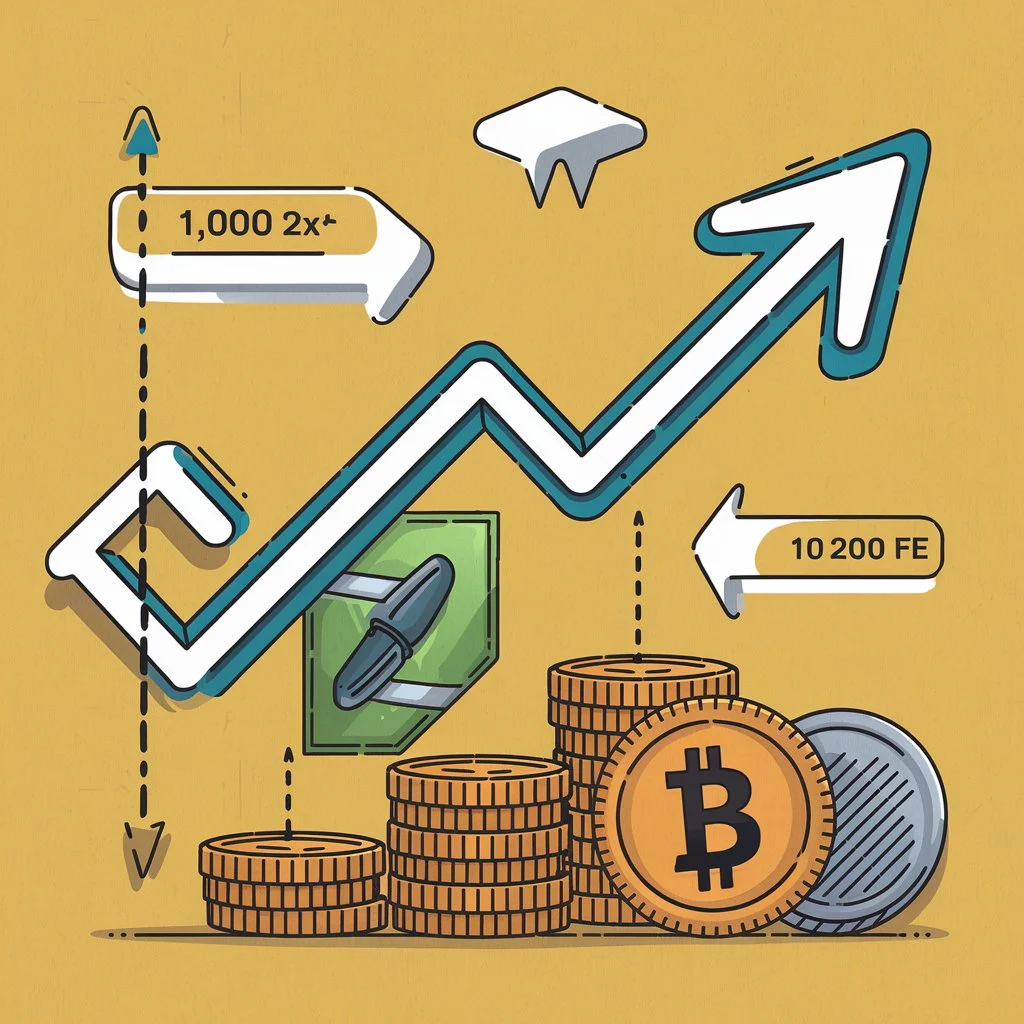
Example of a long position with leverage
Suppose a trader wants to open a long position on Bitcoin with 10x leverage. He provides collateral of $1,000, and the price of BTC is at $10,000. Since the collateral is $1,000 and the leverage is 10x, the position will open at a size of $10,000. In case the price of Bitcoin increases by 20%, the trader's profit will be $2,000, minus the trading commission.
If the price of Bitcoin decreases by 20%, the losses will be $2,000, which will be deducted specifically from the position's collateral. As we remember, the trader pledged collateral of $1,000, meaning a price decrease of 10% would be enough, after which his position would be forcibly closed or liquidated.
To avoid liquidation of a position, you need to increase its collateral. This can be done by topping up the account on the exchange and increasing the pledge or collateral. It is important to make sure that the account balance exceeds the maintenance margin: there must be more funds in the trader's account than needed to secure the position, otherwise the exchange will send him a margin call – the last warning before liquidation.
Example of a short position with leverage
To open a short position on BTC for $10,000 using 10x leverage, you can use margin trading. This means you borrow Bitcoins from the exchange for subsequent sale. With 10x leverage, you only need to contribute $1,000 of your own funds as collateral.
Suppose the current price of BTC is $10,000. You borrow 1 BTC and sell it for $10,000. If the rate decreases by 20% and Bitcoin starts to cost $8,000, you can buy back that same 1 BTC for only $8,000. After returning the debt to the exchange, you will be left with a profit of $2,000 (not including commissions).
But if the price of BTC rises to $12,000, meaning the profit would be 20%, to close the position you will need to buy back 1 BTC already for $12,000. This will lead to a loss of $2,000. Since you invested only $1,000, the exchange will start the liquidation process as soon as your balance approaches zero or reaches a critical level (maintenance margin). To avoid liquidation, it is necessary to top up the account in time and increase the collateral.
Risk management in leverage trading
Using leverage in cryptocurrency trading requires a smaller amount of collateral, however, the chances of liquidation increase manifold. Simple math: the more leverage, the more market volatility affects your position. With 100x leverage, even a 1% change in the price of the traded asset can be critical and lead to liquidation.
Conversely, using low leverage (3x-5x) allows a trader to make mistakes in trading and not pay for it with their deposit. In this regard, many cryptocurrency exchanges have introduced a restriction for new users: they cannot use high leverage for a certain period of time. This allows newcomers to the market to understand leverage trading in more detail, rather than blowing the entire deposit on a small drawdown.
When using leverage, it is mandatory to use protective orders such as stop-loss and take-profit. And while the first one is clear, why use the second? The thing is that the price of cryptocurrencies can change drastically. It is better to fix profit at some reasonable level by using take-profit than to wait for a price reversal and a stop-loss trigger.
You need to take into account that the use of leverage can both multiply potential profit and "eat" your entire deposit. This tool should be used with caution in crypto trading; otherwise, you will lose your own funds.
Leverage in the crypto market vs. traditional market
Leverage did not appear with the crypto market – it came from traditional markets where it has been used for quite some time. However, the principle of its use in different markets is fundamentally different:
- On the Forex market (currencies), it is common to use large leverage, about 100x and higher. The thing is that certain currencies on the market do not have such large price movements on which you can earn. Roughly speaking, if a trader opened a position for $10,000, then his earnings for a day of trading might be $10,001, which in annual equivalent is practically no earning – banks give higher returns on deposits. That is why it is customary to use high leverage in the Forex market;
- On the stock market, the situation is approximately the same as in cryptocurrencies, but here leverage can be set slightly higher – at about 10-20x, without fear of liquidation. Before the digital asset market appeared, stocks were considered the most volatile assets. However, today they yield this place but can still show impressive price movements;
- With the commodity market, everything is individual: when trading gold, you can use high leverage, as there are no rapid jumps or falls here. When trading oil, you should refrain from high leverage, as regular news related to its production can seriously affect its price.
As you can see, the method of using leverage on different markets varies, while remaining similar.

Where to trade cryptocurrencies with leverage?
Today, most major cryptocurrency exchanges provide the opportunity to trade using leverage. Here are some popular platforms:
- Binance – one of the largest exchanges in the world, offers leverage up to 125x on some futures contracts;
- Bybit – specializes in derivatives and offers up to 100x leverage;
- OKX – an exchange with advanced risk management tools and a large selection of assets;
- MEXC – an actively growing platform with the possibility of margin and futures trading;
- Huobi, Bitget, KuCoin – other authoritative platforms with various conditions for leverage;
It is important to note that each exchange has its own conditions, commissions, liquidity levels, and liquidation systems, so you should carefully study the platform before starting trading.
Frequently Asked Questions about leverage
Can I lose more than I invested?
On most exchanges – no. There is a liquidation system and protection against negative balance. But on some platforms or during sudden market spikes, a debt to the exchange may arise; however, this can be avoided by using various protective orders.
What leverage is best for beginners to use?
It is recommended to start with 1x-3x. Even a small leverage already increases potential profit but does not allow you to instantly "drain" the deposit.
Do I need to hold the asset in my balance to open a short?
No, in margin trading, you borrow the asset from the exchange. The main thing is to have a sufficient amount of collateral.
How to avoid liquidation?
Set stop-losses, monitor the margin, use small leverage, and if necessary – top up the account to maintain the required level of collateral.
Does it make sense to trade with leverage in the long term?
It all depends on the situation and the trader's experience. For example, if a newcomer to the market has opened a long position with 10x leverage, it is definitely not worth holding for long. If volatility starts in the market, they may not understand how to act correctly, which will lead to significant losses. At the same time, experienced traders can hold positions with leverage for months, clearly understanding how they need to act.
Conclusion and recommendations for leverage trading
Leverage is a powerful tool that, with a competent approach, can significantly accelerate capital growth. However, it is worth remembering: the higher the leverage, the higher the risk. This is not a way to "get rich in a day," but a lever that requires discipline, knowledge, and risk management.
Basic recommendations:
- Start small;
- Use stop orders;
- Always know where your liquidation level is;
- Do not bet the entire deposit;
- Emotions are the trader's main enemy. Stay cool-headed.
And remember: in the crypto market, the winner is not the one who risks more, but the one who risks consciously.
Want to learn more about crypto arbitrage?
Get a subscription and access the best tool on the market for arbitrage on Spot, Futures, CEX, and DEX exchanges.

You might be interested

Futures Trading: What They Are and How to Profit from Them
Futures Arbitrage: How to Profit from Price Differences?
What is DEX Arbitrage?
