


SUI Cryptocurrency: Complete Review of the Blockchain Project and its Token

with ArbitrageScanner!
SUI: What kind of cryptocurrency, forecast, and prospects for 2025-2026
Even during the testnet stage, the SUI project attracted the attention of major investors. As it turned out, this happened for a reason: the new blockchain is capable of improving existing decentralization and scalability – problems that are inherent in many current blockchains.
In this article, we will talk about the SUI cryptocurrency and its blockchain: the history of origin, how the blockchain works, and what is included in the project's ecosystem.

Introduction to SUI
Sui is a Layer 1 blockchain created to serve decentralized high-performance applications (dApps). The blockchain is implemented on the Proof of Stake consensus algorithm.
The idea of the project and its development began in 2021 by Mysten Labs. The founders are an experienced team from a Meta subsidiary, where they were involved in developing the Move programming language and creating the Diem blockchain.
In December 2021, SUI held closed funding rounds, which raised $336 million, and among the investors were such famous funds as Binance Labs, Franklin Templeton, and a16z crypto.
How the SUI cryptocurrency appeared
The process of the project's formation can be divided into four stages:
-
2021. The startup managed to attract $336 million in investments;
-
2022. After attracting an impressive amount of investment, Mysten Labs closely engaged with the Move programming language, thanks to which it would be possible to implement its own approach to smart contracts;
-
2023. The planned tasks were completed and in May 2023, the official launch of the SUI blockchain took place. Soon the first decentralized exchanges appeared: Cetus, Turbos, and Flow. By the end of the year, more than 50 dApps were already deployed on the SUI network, and cryptocurrency exchanges began to implement cryptocurrency staking;
-
2024-2025. The last two years can be characterized as explosive growth for the project. The SUI coin rose to 17th place in the cryptocurrency ranking, investment funds are adding it to their portfolios, and VanEck and Franklin Templeton announced plans to launch a SUI-ETF.
It is important to consider that the project is only 4 years old, and it became top-tier not just because of the support of the crypto community, but because of the product it offers.
What you need to know about SUI
How the SUI blockchain is structured
The SUI blockchain features a unique architecture that is not found among other cryptocurrencies. For example, if you compare it with Ethereum, transactions there are lined up one after another and checked in order. In SUI, there is no such "queue": transactions can pass parallel to each other without interfering with the blockchain's operation. At the same time, the project team is not "reaching for the stars": in 1 second, the SUI blockchain can process 60-80 transactions. For comparison: the Litecoin blockchain processes 56 transactions per second, and the project is almost 15 years old. SUI developers focused on the precise operation of the network rather than the number of processed transactions.

Consensus and Security
As already mentioned, the PoS consensus algorithm is implemented in the SUI network, though a more advanced version – Narwhal-Tusk. Everything happens as follows: initially, SUI blockchain validators collect transactions into groups, and only then reach an agreement on their order. This approach allows for increasing blockchain security, since transactions are not checked one by one, which means a validator will not be able to compromise information and confirm the operation they need.
Another security mechanism is the number of SUI coins needed to become a validator: 30 million SUI or $75 million at the current exchange rate, considering that the cryptocurrency is currently in a drawdown. But even such an amount can only be afforded by a few in the crypto community, which reduces the possibility of connecting validators with malicious intent.
At the same time, staking is pleasing, being available from 1 SUI: it doesn't compare with Ethereum, where at least 32 ETH is required for this.
Smart Contracts and Move
For interaction with smart contracts, SUI developers implemented the Move programming language. According to the project team's assurance, interaction with smart contracts occurs through it, making them impossible to hack.
Fees and Tokenomics
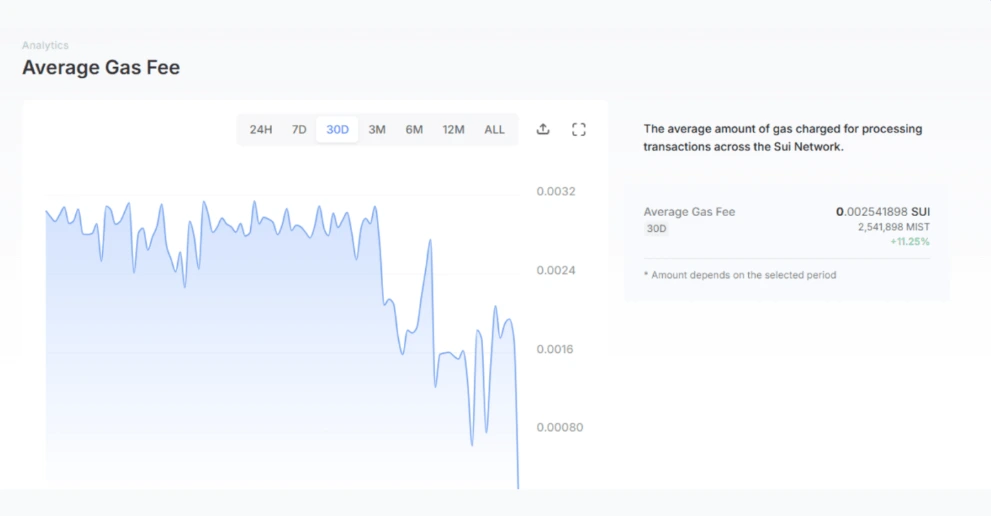
The number of SUI is limited to 10 billion tokens, of which 3 billion have already been released. Also pleasing are the fees in the SUI blockchain: the standard cost of a transaction is 0.002 SUI, and during periods of heavy network congestion 0.01 SUI or about $0.03 – practically free.
Applications
Mysten Labs has already launched the basic infrastructure for convenient interaction with the SUI blockchain: the Sui Explorer block explorer and the Sui Wallet – both tools are available as a Google Chrome extension. Sui Wallet allows not only storing tokens but also interacting with decentralized applications.
Technical Features
It will be useful for developers to learn the technical features of the new blockchain:
-
Object-Centric model: each token or NFT is a separate object with a unique ID. In other blockchains, this is used only for non-fungible tokens;
-
Horizontal scaling, thanks to which the launch of several node instances on one machine is implemented;
-
Original consensus search algorithm DAG-PBFT;
-
Built-in oracle for obtaining external data;
-
Native support for ZK-proofs.
At first, it may seem that the SUI blockchain is too complex. And so it is, but it is complex only for programmers, while for ordinary network users, it is quite easy to use.
SUI Ecosystem
Here we will talk about some applications that are implemented on the blockchain today.
DeFi Sector
-
Desig. A universal multi-sig solution for all decentralized applications. Expands the capabilities of DAOs, co-founders, and treasuries with MPC-TSS and ZK-security;
-
BUCK, programmable currency – this is an over-collateralized stablecoin supported by the Sui ecosystem;
-
NAVI Protocol – the first universal liquidity protocol built on Move chains. It offers lending/borrowing, yield farming with leverage, an isolated pool, and many other features;
-
Pyth Network – the first of its kind financial oracle network designed to securely and transparently provide real-world data with low latency to multiple blockchains.
NFT Sector
-
BlueMove – an application on the Sui blockchain offering an NFT launch platform, a marketplace, and a DEX with full functionality and a user-friendly interface for web and mobile devices;
-
Mentaport – a platform for creating location-aware digital assets. Provides developers the ability to customize smart contract rules tied to physical locations and ensure dynamic management of event triggers over time;
-
Keepsake – an NFT marketplace focusing on the utility and accessibility of NFTs in the context of Web3 games on the Sui blockchain. Keepsake aims to make the transition from Web2 to Web3 as smooth as possible and provides a convenient onboarding system for new users.
Gaming Sector
-
Sui 8192 – a game 100% based on the blockchain and created by the Ethos team. Combine tiles to score more points and get on the leaderboard. You can safely pre-approve transactions in Ethos for faster gameplay;
-
Cosmocadia – a community-based farming game from Lucky Kat Studios. Players can build their own utopia. Imagine Stardew Valley meets Animal Crossing, but with "play-to-earn" mechanics;
-
Arcade Champion – a hybrid casual mobile game with survival game elements and hero-based NFTs.
Wallets and Bridges
-
Splash – a non-custodial mobile wallet for Sui. Thanks to the built-in dApp browser and testnet bridge, users can easily access DeFi and gaming applications built on Sui;
-
Cede – a non-custodial browser extension that allows users to quickly access their assets on major centralized exchanges in any decentralized application using an interface comparable to MetaMask;
-
Wormhole – an open-source platform that simplifies cross-chain creation. Integration with the platform provides access to liquidity, applications, and users in more than 22 blockchains.
SUI Price Today and Forecast for 2025-2026
On March 5, 2025, the value of SUI is $2.51. In 2024, the value of SUI increased by 850%, which is an extremely good result for a relatively new project. Some analysts put SUI on par with Solana. Judging by this logic, SUI faces permanent growth for a couple more years. However, everything is not as rosy for SUI as it was for Solana.
For example, the SOL token took 12 months to cross the $1 billion capitalization mark, while SUI took 18 months to achieve the same goal. Moreover, despite widespread assumptions about SUI's potential to surpass Solana, historical performance data puts Solana ahead, though not by much.
There is one "but": historical data of some projects cannot affect the future of others in any way. Therefore, SUI could follow a completely different scenario, not similar to Solana. In any case, analysts give favorable forecasts regarding the token: in their opinion, the $9 mark will be passed by the end of the year.
Where to Buy SUI
There are three main ways to buy SUI tokens:
-
Through centralized exchanges. The project is extremely popular, with a working product, so listing on centralized exchanges was not long in coming. SUI is represented on most CEXs;
-
Through decentralized exchanges. On DEX platforms, you can find pools where SUI is exchanged for other cryptocurrencies. In this case, you need to be careful: the token may be disguised as a real one, so be sure to compare token contracts on the official SUI website and the pool before exchanging;
-
Through P2P exchange. On these platforms, cryptocurrencies are exchanged between users. Although SUI is not the most popular token for exchange, offers can be found. Or you can contact a cryptocurrency seller and ask them to buy SUI, and then exchange it.
The Future of SUI
Sponsored Transactions
A Sui-sponsored transaction is a transaction where a Sui address (the sponsor's address) pays the transaction fee initiated by another address (the user's address). App creators can use sponsored transactions to cover fees for users of your product so they don't have to pay for it.
A sponsored transaction completely solves the problem that Web 2.0 users face when moving to Web 3.0, as they often have to buy tokens to perform a transaction on the network. For example, you can sponsor the first transactions of gamers to increase the conversion rate.
Also, the mechanism simplifies asset management, as there is no need to have several accounts with SUI tokens to transfer funds.
Sui-sponsored transactions can be used for:
-
Paying the transaction fee initiated by the user;
-
Sponsoring a transaction initiated by the sponsor;
-
Opportunity for users not to worry about gas fees – a special GasData object will automatically pay it if there are enough funds in it.
Kiosk Standard
Kiosk is a decentralized system for commercial applications on Sui. It consists of Kiosk objects – shared objects owned by individual parties that store assets and allow them to be listed for sale, as well as use special features for trading, such as an auction. Being fully decentralized, Sui Kiosk provides a number of reliable protection methods:
-
Kiosk owners retain ownership of their assets until the moment of purchase;
-
Creators set their own policies – sets of rules applied to each transaction (for example, paying royalties or performing an arbitrary action);
-
Marketplaces can index events generated by a Kiosk object and subscribe to a single feed for trading assets on the network.
In essence, Kiosk is part of the Sui framework, built into the system and available to everyone without additional settings.
Comparison of SUI with other Blockchains
SUI stands out among competitors due to its high performance and innovative approach to transaction processing. Unlike Ethereum, where transactions are processed sequentially, in SUI they pass in parallel, which significantly speeds up the network. Compared to Solana, SUI emphasizes security and resistance to attacks, using the improved Narwhal-Tusk consensus algorithm. The blockchain also offers a developer-friendly environment based on the Move language, making it promising for creating decentralized applications.
Conclusion
SUI is a young but rapidly developing blockchain that has already established itself in the crypto industry. Its architecture is focused on high performance, security, and ease of use, making it attractive to both investors and developers. In the coming years, the SUI ecosystem is likely to continue expanding, and the token's value to grow if the project maintains its development pace and continues to innovate.
Frequently Asked Questions
What are the main advantages of SUI?
-
High transaction speed without a queue.
-
Unique Narwhal-Tusk consensus algorithm.
-
Support for the Move language for secure smart contracts.
Is it worth investing in SUI?
This is a promising project, but as with any cryptocurrency, investments involve risks. It is important to conduct your own analysis before investing.
Where can SUI be stored?
The official Sui Wallet, as well as third-party wallets with token support, such as Trust Wallet and Ledger.
Want to learn more about crypto arbitrage?
Get a subscription and access the best tool on the market for arbitrage on Spot, Futures, CEX, and DEX exchanges.

You might be interested
What is a Satoshi (SAT): Price in USD and Bitcoin Ratio
What is Litecoin (LTC): Cryptocurrency and Network Features

What is Solana (SOL): Project Overview and Future Prospects
