


Memecoin Listing Arbitrage: The DEX-to-CEX Spread Playbook for June 2026

with ArbitrageScanner!
When a memecoin moves from mainly being used on Decentralized Exchanges (DEXs) to being listed on a Tier-1 Centralized Exchange (CEX), the difference between the prices on the DEX and CEX can be as great as 2-7% for the first 30-90 minutes. In May and June 2026, for example, BEAT increased 65% within 24 hours of being listed on Bitget; HOME has had volatility cycles since being listed, and there has already been a steady number of tokens previously Pump.fun graduates being listed at MEXC and KuCoin. The way that this profit opportunity works is simple in theory (buy on the cheap side and sell on the expensive side) but extremely difficult to execute (network congestion, slippage, withdrawal freezes & 30-second time to make the decision). This article goes through how the difference in price is created, when the difference is closed, and the workflow for scanning to be able to take advantage of the price difference on a repeat basis rather than as a one-time lucky event.
How the Listing Price Spread is Created
Memecoins start off on DEXs - Pump.fun, Raydium, Uniswap, PancakeSwap - where there is initial price discovery for a token, sometimes weeks before any Tier-1 or Tier-2 CEX will be aware of a token. When the time comes for a Tier-1 or Tier-2 CEX to list a token, several things happen simultaneously:
- The CEX will announce the token's listing 12-48 hours ahead of the actual listing. The DEX price typically increases by an average of 30-200% from the listing announcement alone.
- The order book for the CEX opens, and there is typically no liquidity on the CEX at the time trading begins because the CEX market makers haven't built liquidity at the time that they open their order book yet.
- Retail traders pile on the CEX side because they are apprehensive about the DEX side. Therefore, the demand for tokens on the CEX side will greatly exceed the supply of tokens on the CEX for the initial 20-90 minutes post listing.
- Meanwhile, since there is the ability to take advantage of price arbitrage on the DEX side, most DEX traders will not be able to act quickly enough to arbitrage the price spread away before it is completely arbitraged away. In short, the CEX price will be priced 2-7% above the DEX pool during the first window. That is the arbitrage.
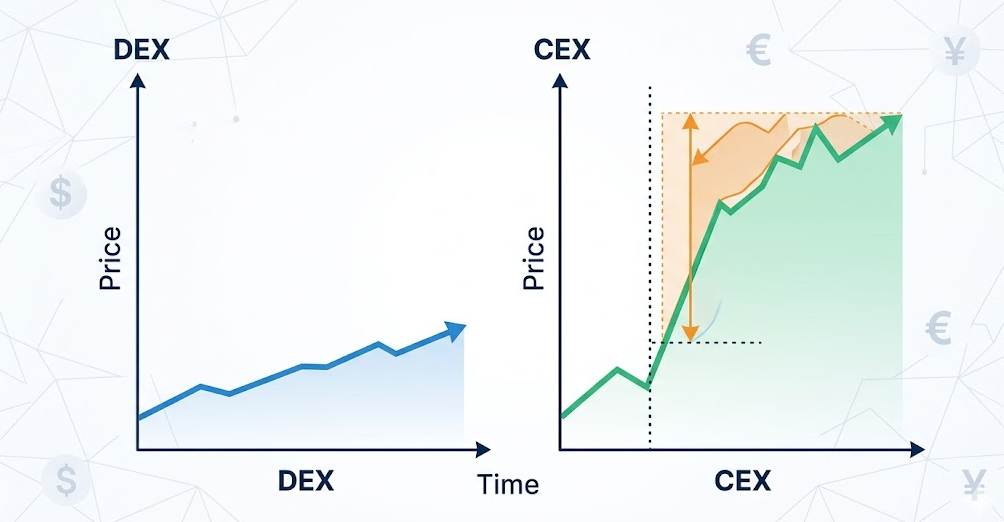
Here Is What Spreads Looked Like Between Mid-May and The End Of June 2026
The following data was pulled from public sources and the DexScreener/CoinMarketCap derivatives sections from the time frame in issue:
| Token | Exchange that listed it | Date listed | Peak DEX to CEX spread | Duration of time before closed |
|---|---|---|---|---|
| BEAT | Bitget | (End of May 2026) | 4.8% | ~42m |
| HOME | Multiple CEXs | (beg of June 2026) | 7.1% (Only KuCoin) | ~28m |
| DEXE | Multiple spot exchanges | (May 2026 Cycle) | 3.2% | ~60m |
| ALL Pumped.fun graduates | (i.e., MEXC) | Weekly basis | 2-5% | 15-90 m |
Pump.fun has created >5m tokens. Even if 1/1000 graduates to the CEX, that’s hundreds of contracts listed in a quarter. Most retail traders only see the tokens after the deadline.
Tips On How To Capture The Spread
There are two legit ways to participate, and one unethical way.
Method 1: Buy on DEX, immediately sell on CEX
- Identify the token and its listing both 12-24 hrs in advance through official CEX notification, Twitter or listing calendar.
- Prefund a wallet with tokens on their respective chains (use Ethereum, Solana, BSC or Base depending on what chain their individual contracts are on).
- Pre-Deposit the tokens before any CEX openings. Some will allow you to pre deposit, but they’ll freeze your withdrawals until the trading is activated.
- As soon as trading at that CEX opens and the spread reaches your target level +/-% (say, 3% in this example), quickly sell on the CEX.
- Then, immediately buy back through the DEX to replenish for your next potential trade.
Potential pitfall here is a CEX freezing their withdrawals. When a token has a listing freeze (meaning you can't move it) and you're left holding the frozen token until the unlock happens, you still have other options.
Method 2: Cross-chain Bridged Inventory
When you pre-position on both chains and trade the wrap token between the two chains through a bridge, this is called arbitraging the pool and the CEX wrapped token across chains. If the token is on the DEX but fails to land on the CEX, you need to be familiar with using the bridge and be able to wait 15-30 minutes on either end.
Method 3: The Dirty Way - Trade Volatility
Simply trade volatility by skipping over the spread. Instead of attempting to arbitrage the two chains, just trade the pump and dump of the token after it has already been listed using only the order book from the CEX and execute with a tight stop. This is directional trading and with odds closer to a coin flip, however I included it here just to complete your list as it doesn't meet the arbitrage criteria.
Why Retail Traders Miss It
There are three main reasons;
First, numerous fragmented listings. Different exchanges announce their listings at different times (e.g., Binance lists on Binance, OKX lists on OKX, etc.), creating confusion about where and when you need to watch these exchanges for new listings, while getting timely information depends on watching ten individual Twitter accounts for their exchanges, busy traders may not have time to be able to watch ten exchanges simultaneously. Without consolidated lists, this is simply not a viable strategy.
Second, you must have conviction about pre-funding your account with USDT or BNB or SOL and then move that to a DEX wallet 24 hrs before the listing. If the announcement fails to materialize (which does happen 5-10% of the time), you have incurred costs (gas fees) without having a token of value to hold.
Third, execution for DEX trading is very difficult due to simultaneous trading (typically 5-50 traders) trying to access the same token at approximately the same time within the same listing time. Gas prices surge and if you are attempting to complete a $5,000+ purchase, there is likely to be 1-3% of slippage associated with trading from the DEX. Without a protected route, you'll be beat to the punch by sandwich bots.
Risk factors:
- Fake listings: Scammers falsely claim that an asset is listed on an exchange, causing you to fund it, but once the rug pull occurs, the price drops 60% before being able to sell on a DEX. Check for validity with both verified sources of the exchange and verified media outlets.
- Frozen withdrawals: Common during the first days that an asset is listed. If you end up with inventory on the CEX and the spread flips (CEX below DEX), then you cannot move, and you need to keep at least 50% of your position in stable coins on each side as a buffer.
- Rug pulled DEX: Memecoins contracts help with minting, blacklisting, and transferring taxes, therefore, always check the contract on chain explorer prior to prefunding... unless the contract is renounced or verifiably immutable, expect the price to drop upon rug pull.
- Bridge delays: When trading across chains, 15 min bridges become 45 min bridges when congestion occurs, meaning by the time you have the funds on the receiving chain, the spreads will be closed.
Scanner stack:
In order to scale capturing listing spreads, the following will need to be in place before each of the above events occurs;
a. New listing calendar having aggregated New listing announcements from 80+ exchanges with verifiable timestamps, otherwise you will not be able to monitor manually and be able to capture the opportunity.
b. Cross-venue spread scanner will compare prices on DEX's pools against the available liquidity in the CEX's orderbook at the time of the comparison. A wallet intelligence layer helps track whether market makers and whales are buying prior to listing on a decentralized exchange (DEX). If smart money has made purchases for the 48 hours prior to listing, then the difference in price between two exchanges will be wider and remain open longer.
Through our products, ArbitrageScanner offers solutions for the three factors of listing arbitrage. With our new crypto listings calendar, you will receive notice anywhere from 12-48 hours in advance of new listings. Our DEX scanner tracks over 25 DEXs on over 40 different blockchains and identifies pool-to-CEX gaps every second. Our wallet AI analyzes wallets to determine if there is any evidence of insider accumulation prior to an announcement. This is one of the best signals to retail traders for determining if they should buy the token prior to the listing.
For sizing, we recommend that you use the futures spread calculator. The calculator incorporates the following fees: gas, slippage and exchange fees. As a result, you will no longer have to manually calculate the break-even price.
Capital Allocation
Even though listing arbitrage is capital efficient, it is also capital locked. To complete a listing arbitrage transaction, you will need to have the following capital on both sides of the trade. Your working capital can be sitting idly for 70-90 percent of the time while waiting on your next opportunity to list.
I'm using a $50,000 working capital pool as an example of a realistic allocation:
- $15,000-20,000 of USDT/USDC on a high volume Centralized Exchange (CEX) which is ready to be deposited anywhere.
- $10,000-15,000 of USDC (Ethereum), USDC (Solana), BUSD (BSC) on the DEX side.
- $5,000-10,000 of pre-funded gas tokens (ETH, SOL, BNB, BASE) across several chains.
- $10,000-15,000 reserved for speculative pre-buys that occur 12-24 hours before listings are announced or listed.
A trader who produces $20,000 of notional amount in a listing event with an average 2.5 percent spread and with 4-8 events per month, will be looking at a gross monthly profit of $1,600-6,400 prior to deducting any fees and gas expenses. There are three main factors that can affect the effectiveness of arbitrage trading strategies with newly listed tokens in the long term:
- Centralized Exchanges (CEXs) provide a marketplace for newly listed tokens upon launch (in some cases they have started to do this) which will compress the price differentials (spread) between CEXs and DEXs below 0.50%.
- Decentralized Exchanges (DEXs) have integrated price oracles based on the CEX price (i.e. the price listed for the token on the CEX at the time it is listed) that would cause the DEX to automatically adjust the price of the token listed on the DEX at the same time that the token is listed on the CEX. This would close the price/discrepancy gap to zero.
- Regulatory changes may enforce a standardized time for listing all newly issued tokens, giving participants in the retail market equal access to trade at the same time.
Based on our assessment we do not think that any of these three factors are likely to change prior to 2026. Thus, you have at least a 12-24 month (and probably more) period for arbitrage trading opportunities.
FAQ's:
Q. Do I need to keep the tokens in a self-custodied wallet in order to execute arbitrage trades?
A. No, in order to execute an arbitrage trade between a DEX and a CEX you need to have access to the token in your custody at the time of the trade. If you only utilize a custodial wallet at one exchange thru which to trade, you could lose your arbitrage trades if the exchange were to freeze.
Q. What is the probability of capturing arbitrage with newly listed tokens on a realistic basis?
A. When trading 100 token listings within 1 year, you can expect to be able to capture all of the spreads on approximately 35-50% of listings; the other trades will not be able to be captured due to the length of time it took to execute the trade, the exchange freezing or the trade being canceled. For successful trades, the profit generated will usually compensate for the expensive costs incurred from losing unsuccessful trades.
Q. Am I required to have a protective measure from MEV when executing arbitrage trades of new tokens?
A. Yes, if you want to protect against MEV when conducting arbitrage trades on Ethereum and Base for newly issued tokens, you will need to utilize Flash Bots Protect or another private mempool service. For Solana, you would need to utilize Jito or Remote Procedure Call (RPC) services that have tip-aware features. If you execute your trades on DEXs without MEV protection, you could be vulnerable to a sandwich attack, which could cause you to lose anywhere from 30-60% of your profits from arbitrage trading on the DEX.
Q. What about memecoins that drop after their initial listing?
A. More than 50% of token listings on a CEX will be less than the highest price on the 1st hour after listing within 6 hours after the initial listing on the CEX. If you have a long position on the CEX and do not have MEV protection on the DEX, you may suffer large losses due to the value of the token declining after the token’s CEX listing. Always ensure that you close the position in both the DEX and CEX or when the spread between DEX and CEX have closed or flipped.
Q. What are the typical gas fees associated with trading arbitrage?
A. Gas fees associated with executing arbitrage trades on Ethereum can range from $50-$200 per transaction when there is congestion for newly issued tokens. Gas fees on Solana, BSC, Base and other platforms are typically $0.05 or less when moving from liquidity pools.
If you would like a chance to see the New Listing Calendars for the following 1 day free of charge, visit: www.arbitragescanner.com/dex-scanner to view over 25 DEXs, over 80 CEXs and also wallet intelligence with 272 criteria to assist you in arbitrage.
Disclaimer, we are a Software Development company and do not give Investment advice nor are we responsible for the outcome of your Investment, we are only providing you with examples of past successful Trading and Arbitrage activity. Your Investment results will always depend upon your actions and many additional factors in the Market place.
Want to learn more about crypto arbitrage?
Get a subscription and access the best tool on the market for arbitrage on Spot, Futures, CEX, and DEX exchanges.

You might be interested
HYPE Funding Rate Arbitrage: Capturing the Hyperliquid vs Binance Spread in June 2026
CLARITY Act and Ethereum ePBS: What US Arbitrage Flows Look Like in H2 2026

Margex Review 2026: Leverage, Fees, Security & Copy Trading
