


What Is a Spread?
with ArbitrageScanner!
What Is a Spread?
Spread is a key concept in arbitrage. Every arbitrage trade is built on spreads, and revenue in any arbitrage situation is generated through them.
A spread is the difference between the buying and selling prices of the same asset within a specific arbitrage setup.
Types of Spread
Spreads can be divided into three types: nominal, actual, and net.
|
Nominal spread |
Actual spread |
Net spread |
|
The spread we calculate at the very beginning, before opening a position. |
The spread that is achieved in reality. It can be either smaller or larger than the nominal one. |
What remains after all costs: fees, slippage, funding, and other expenses. |
Main Factors Affecting the Spread
Important: only net spread is considered in this section.
-
trading volume
-
order book depth
-
volatility
-
market activity
-
network congestion
-
actions of other arbitrage traders
What Usually Causes Spreads
In general, a spread almost always arises due to a sharp price change of a coin on one or several exchanges.
Specific triggers include:
-
Token pumps and dumps
-
News
-
Listings
-
Other factors causing sharp price spikes
In practice, spreads are mainly caused by the exchange audience and the internal “settings” of each exchange. Each exchange has a unique user base, and because of this, every exchange reacts to price changes differently. Some exchanges have a large number of active traders who react quickly to price movements, while others are dominated by long-term holders. As a result, the price of a coin on these exchanges changes differently.
✎ Calculation of nominal and actual spread in arbitrage:
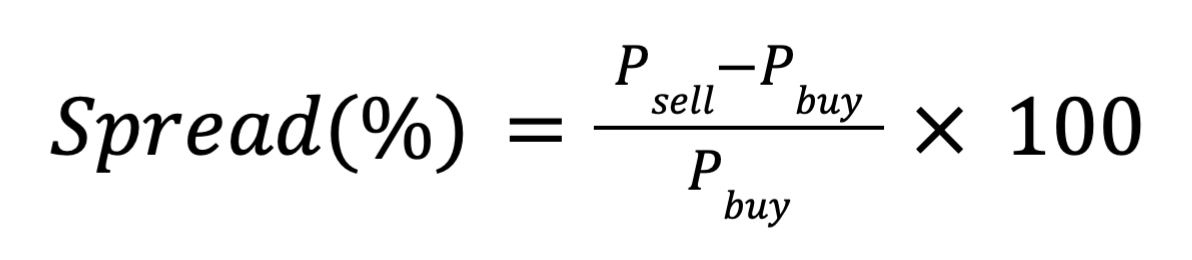
Pbuy — buy price
Psell — sell price
Want to learn more about crypto arbitrage?
Get a subscription and access the best tool on the market for arbitrage on Spot, Futures, CEX, and DEX exchanges.