


Binance-Bybit BTC Arbitrage: Spread Patterns, Fees and Execution Guide 2026

with ArbitrageScanner!
Currently, the Binance-Bybit BTC/USDT pair is one of the most frequently analyzed CEX (Centralized Exchange) arbitrage opportunities. This is due to both exchanges consistently being in the top five worldwide for spot volume, which means price discovery happens quickly (and not instantly). Historically, a spread between Binance & Bybit BTC/USDT has hit 0.3-0.5% during market volatility, allowing for fee recovery and generating real profits for traders that can act quickly. In this guide you will find: Specific spread patterns for this corridor, detailed fee breakdowns including withdrawal fees, as well as a step by step execution framework based on a 2026 trading environment.

Overview of BTC Arbitrage between Binance and Bybit
Arbitrage is the practice of profiting off temporary price discrepancies of the same asset, in this case BTC/USDT, between two different exchanges. The mechanics of BTC/USDT arbitrage are simple: Buy where the price is lower, simultaneously sell where the price is higher, and move the stablecoin capital back to each exchange to reset for the next cycle.
Binance and Bybit, in this instance, are natural counterparts for BTC/USDT arbitrage. Both exchanges have deep order books of BTC/USDT which generate hundreds of millions of dollars in daily trading volume. The movement of market orders on either exchange creates an opportunity to profit through BTC/USDT arbitrage.
Spread Patterns and Volatility in BTC/USDT
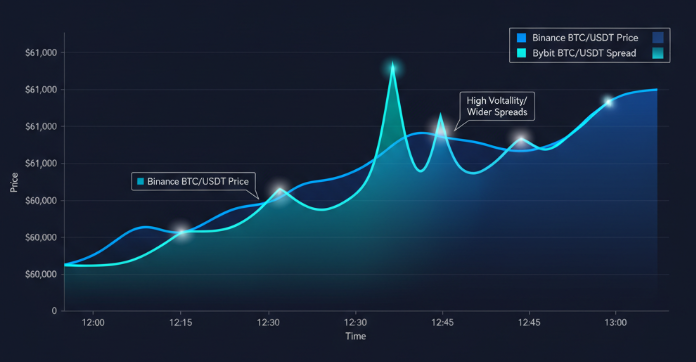
Typically, the spot spread on BTC/USDT between Binance and Bybit is within a 0.05 - 0.15% range most of the time, according to historical data. This means that most of the time the spreads between both exchanges are less than the combined round trip fee (0.20%), thus making this pair not tradeable under standard fee conditions. Spreads observed in Q3-Q4 2024 using ArbitrageScanner data followed recurring spikes based on the following drivers:
Major Economic Announcements (FOMC, CPI): The average spread ranged from 0.25% to 0.45% for 3 to 12 minutes when events occurred.
Bitcoin ETF Flow Days (Large Inflows & Outflows): The average spread ranged from 0.20% to 0.35% for 5 to 20 minutes following flows.
Liquidation Cascades: Spreads briefly reached a maximum of 0.40% to 0.60% when Bitcoin traded +/- 3% within 15 minutes, but trade execution slippage is quite significant under these circumstances.
Historical ranges are solely based on observed patterns from the past and do NOT predict future spread patterns.
Conclusion: There are no random spread patterns; they tend to group around certain catalysts. Traders who keep track of macro calendars and pay attention to funding rate divergence in perpetual contracts will have a structural edge in predicting when spreads will widen.
Key Variables Impacting Binance-Bybit BTC Pricing Discrepancies
Four primary variables that contribute to pricing discrepancies for Binance vs. Bybit BTC are:
- Perpetual Order Book Imbalance (ex: large orders put in at one exchange temporarily cause respective local pricing, until Arbitrage Traders move to fill the gap)
- Divergence in perpetual funding rates across Binance & Bybit (ex: as funding rates diverge significantly for long or short positions, the hedging strategies of traders create directional pressure on spot prices)
- Congestion in the Blockchain (ex: due to longer USDT withdrawal confirmations, the efficiency of the Arbing process will be substantially reduced, thus increasing the time it will take to close out trades to get back to coming in balance)
- Local to Each Exchange Planned Downtime (ex: both exchanges have either scheduled maintenance on their respective networks or will have planned interruptions to their respective networks)
Fee Structure Between Binance & Bybit for BTC/USDT Arbitrage An entire round-trip from take to maker - which includes both taker fees (both buy and sell), plus the cost to offer a node USDT to rebalance account - marks that point of profitability for a trade.
Spot Trading Fees for BTC/USDT
| Tier | Binance Maker | Binance Taker | Bybit Maker | Bybit Taker |
|---|---|---|---|---|
| Standard | 0.1% | 0.1% | 0.1% | 0.1% |
| VIP 1 | 0.09% | 0.1% | 0.08% | 0.1% |
Binance VIP 1 is $1,000,000 in trading volume over a 30-day period. Bybit VIP 1 is $250,000 in trading volume over a 30-day period. Verified current fees by looking up at exchange website posted fee structures.
USDT Withdraw Fee by Network
| Network | Binance | Bybit |
|---|---|---|
| TRC20 (Tron) | 1 USDT | 1 USDT |
| ERC20 (Ethereum) | ~4 USDT (variable) | ~3 USDT (variable) |
| BEP20 (BSC) | .8 USDT | 1 USDT |
ERC20 fees change due to fluctuating gas. Always verify charges on withdraw pages before proceeding. Source: Binance withdraw fee page, Bybit withdraw fee page.
Example of actual trading profits - (Assuming it is a 0.35% difference from buy and sell prices, a $50,000 trade, and using TRC20 to transfer USDT for rebalancing):
Purchase 0.5 BTC on Binance for $100,000 and incur $50 in taker fees. Sell 0.5 BTC on Bybit for $100,350 and incur $50.18 in taker fees. Transfer USDT to reconcile with an additional USDT transfer fee of $1 Total difference in value between buy and sell would be $175. After accounting for all fees (taker fees and USDT transfers) you would have a net profit of $73.82; or 0.015% profit on the original investment of $50,000.
In this scenario, current round-trip expenses (taker/unable to maker) would produce break even on the transaction at 0.20% difference from price at time of. Any spread below that is a losing trade after fees. Using both maker orders on each leg, lowers the floor but requires limit orders and queue risk; if the spread closes before the fills have executed, you will be at a loss on your trade.
Guide to Execute Binance-Bybit BTC Arbitrage
Prior to First Trade
- Must have verified accounts on exchanges with verified, and KYC accounts.
- Capital must be pre-positioned in USDT on Exchange A and BTC equivalent on Exchange B (or vice versa).
- If trading programatically, API keys must be configured; it would very difficult to execute manually for trades of $20,000.
Order Execution Steps:
- Step 1 - How to set up spread alerts? Use ArbitrageScanner or a custom data feed to retrieve both order books at the same time. Alerts should be setup to notify you when the Binance-Bybit BTC spread is greater than 0.25% (represents where there is positive expected spread trade on a typical trade at a normal tier, including anticipated execution slippage).
- Step 2 - How do I confirm both sides of my position size have enough available liquidity in the order book? You need to make sure your position size measured in dollars is within 0.05% of the mid-point price for the order book on both the Bid and Ask sides. For example, a $50,000 buy is not the same trade as the displayed spread if it consumed three price levels.
- Step 3 - Execute orders simultaneously. If executing manually have to place orders at the same time; if executing automatically have to place orders at the same time (within the same API batch). The most common cause of realized losses in this strategy is executing one side before the other after the market moves.
- Step 4 - Size conservatively. For manual traders, begin trading below $10,000 on a position size. When trading within this position size will be managed with little market impact. Do not scale up until you have consistent fills at or near the displayed price.
Step 5: Transfer USDT via TRC20 for Rebalancing - After your legs close, transfer USDT back to the original buy-side/exchange (step 3) from the exchange you sold from. Use TRC20 as it will only cost $1 and take approximately 1-3 minutes to confirm. Use ERC20 for transfers only if TRC20 is unavailable as ERC20 has variable gas costs, which creates uncertainty in your P&L.
Step 6: Log Each Trade - Keep a log of the entry price, fill price, fees, transfer cost, and time from signal until you are closed. The actual data from your filled trades will give you data to calibrate your thresholds and understand your trading pattern better than if you used external benchmarks.
Risks and Challenges Unique to Binance-Bybit Arbitrage
Slippage on Large Orders - The spread at the top of the order book is NOT the spread your order will get filled at and at scale. If you place a market buy for $200K of BTC on Binance, it will fill on several levels of prices, therefore reducing the effective spread once your order was completed. As part of your decision-making to scale, be sure to model for expected slippage.
Withdrawal Halt Risk - Both exchanges have periods when they stop (temporarily) processing withdrawals for certain networks due to maintenance and/or security reviews. For example, Binance was halting BEP20 withdrawals for approximately two hours in the 2nd quarter of 2024. Traders that finished one leg of the trade were unable to rebalance their accounts; therefore, locking up their working capital. This event happens on numerous occasions throughout the year across networks for each exchange.
Timing and Spread Reversal on Transfers - The 3 minutes it takes for TRC20 to confirm creates a timing/exposure risk. The price of BTC can fluctuate between the time you execute each leg of the trade and complete the transfer. Errors in Calculating Fees Systematically. All fees associated with being a 'taker' (the party taking liquidity) apply to the amount you receive from the 'sell' side ('order' side) and not the notional amount ($) when making an order. Failing to take this into consideration when calculating your fee expenses causes you to miscalculate your total fee expenses regularly. You should be using a fee calculation model in any spreadsheet/calculator used.
Capital Lockup. When using this strategy, the capital will need to be deployed onto both of the exchanges at the same time. An allocation of $100,000 would mean $50,000 is on Binance and $50,000 is on Bybit, no trades can occur while the cycle is open using that allocation (in other words, the capital is locked up). The amount of capital used will have an opportunity cost as well.
Best Pairs With the Widest Spreads on Each Corridor
The BTC/USD has the narrowest spreads of any pair on either exchange making it both a common pair for training and sometimes providing the lowest return; however, traders using this corridor can usually find wider spreads on other pairs, including:
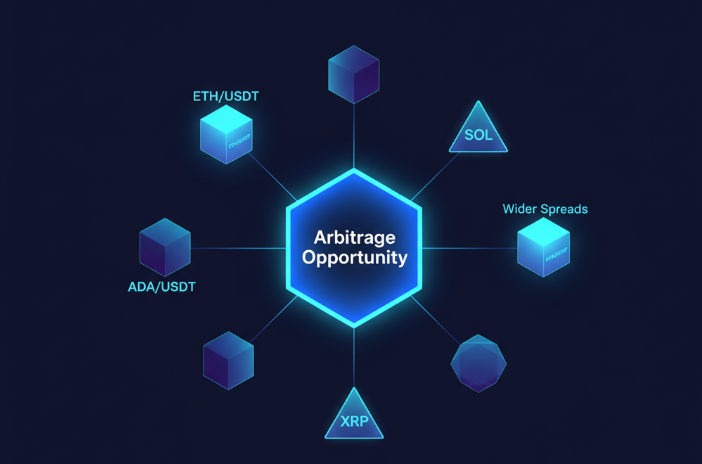
- ETH/USD: has a historical range of between 0.08-0.25% when there are higher levels of volatility. ETH does not have as much slippage for every dollar than BTC, as a rule of thumb, and therefore will have more slippage for the same size position than BTC.
- SOL/USD: is a much more volatile pair and often has a spread in the range of 0.30-0.60% at times of SOL specific events that cause large price movements; there is a greater execution risk associated with larger sizes as well.
- All Mid-Cap Altcoins (e.g., AVAX, INJ): there is a wider spread; however, the risk of slippage is elevated with mid-cap altcoins thus requiring smaller positions in comparison to depth in the order books.
- Stablecoin Pairs (USDC/USDT): extremely narrow spreads and very consistent (0.01%-0.05%) only workable at high volume using maker orders.
How to Use ArbitrageScanner For Binance - Bybit Arbitrage
ArbitrageScanner continuously monitors the Binance - Bybit corridor in real-time. In addition to displaying live spread percentages for BTC/USDT and other trading pairs, there is an estimated net profit after standard fees. Historical spread charts provide traders with a useful benchmark to set alert thresholds prior to risking any capital; traders can now establish the standards for what qualifies as a good overall return based on historical data, as opposed to trying to predict what a good return would be.
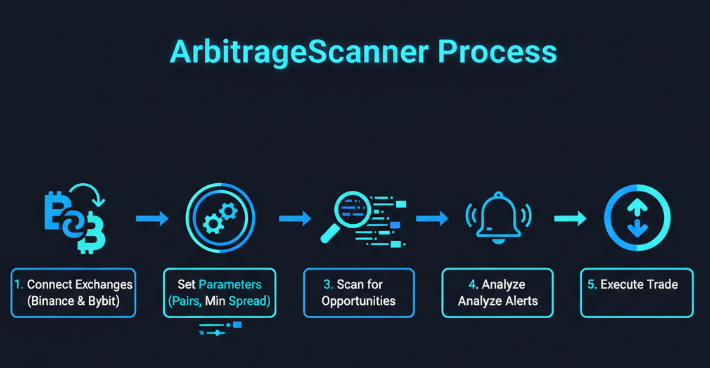
Once a trader has established his or her own breakeven point, ArbitrageScanner will create customizable alerts to inform when the market is moving in his or her favor by exceeding their predetermined threshold. This greatly reduces the amount of time required to manually monitor for opportunities.
Summary
Arbitrage opportunities exist between Binance - Bybit; however, arbitrage requires preparation, not luck. In order to successfully arbitrage between Binance - Bybit, one should:
- Know your breakeven spread before making your first trade; your breakeven point should be approximately 0.20% (a combination of the standard taker fee and the cost to rebalance TRC20) on a $50,000 position;
- Prepare your account prior to times of high volatility so that you are able to offset the profits from increased spreads in a matter of minutes instead of hours;
- Start with small trading positions (less than $10,000 on either side) in order to become familiar with the actual fill rate before scaling up to larger sizes;
- Always have macro catalysts (FOMC, CPI, ETF flow reports) using these as a guide for when spreads are most likely to expand beyond the breakeven point; and
- Use a real-time monitoring tool (i.e. ArbitrageScanner) to identify them at times you can not watch continuously.
FAQ
Is binance - bybit arbitrage still?
The way to make profit off of a strategy is to look for times when spreads spike greater than 0.20%, which is the typical fee threshold for performing a TRC20 rebalance on a $50,000 position. An example of when multiple spikes occur regularly is during major macro economic events or times when liquidations are occurring; however, they cannot be counted on being present at all times in the market. If a trader were to attempt to trade at every 0.10% of spread, they would lose money consistently. The only competitive edge somebody would have over others is picking trades and executing them as closely together as possible.
What are the risks associated to executing arbitrage trades between Bybit and Binance?
An arbitrageur can lose almost all their capital due to three reasons: Leg risk—if part A of the trade happens; however, the price moves before part B of the trade is completed; Delays withdrawing from the network; and Slippage—when the price paid for the order is less than what showed up on the order book because of different levels of orders requiring buying/selling multiple orders to offset one another. Any of those reasons being realized will change what initially would have resulted in a profitable arbitrage trade into a realized loss.
How do I calculate the total profit associated with an arbitrage trade executed between Bybit and Binance?
The total profit will equal (sell x quantity) – (buy x quantity) – (taker fee on sell x quantity) – (taker fee on buy x quantity) – (transfer cost). If a trader bought 0.5 BTC at $100k on Binance (taker fee $50) and then sold 0.5 BTC at $100.35k on Bybit (taker fee $50.18) and incurred a transfer fee of $1; therefore the total gross spread amount will equal $175. Now the calculation can take place to find the total profit: $175 - $50 - $50.18 - $1 = $73.82; thus for a $50k position you will have made 0.15% off a 0.35% gross spread.
Does ArbitrageScanner help identify potential arbitrage opportunities between Bybit and Binance?
ArbitrageScanner will monitor continuously within this market corridor, and display only the net spread (after fees have been deducted) allowing traders to determine quickly whether there exists an opportunity to arbitrage and what the break-even threshold would be for them. Also, the average spread over time for BTC/USDT on Binance & Bybit will be useful for back-testing alert criteria regarding thresholds reached before committing capital.
What is the minimum amount of capital required to execute this arbitrage strategy?
For effective execution of this arbitrage strategy, you will need at least $20k USD total ($10k USD on each exchange). When executing an investment of $20k USD, the TRC20 transfer cost ($1.00), represents only 0.01% of the total position invested, making it manageable. If total capital per side drops below $5k USD, the combination of fixed transfer costs and minimum fees will begin to eat into the profits from 'built-in' spreads. Therefore, this arbitrage trading strategy can effectively execute with capital of $50k – $200k USD—paying the same fixed % of fees and fixed transfer costs for each transaction on either platform enables maximum efficiency in executing this arbitrage trading strategy.
Want to learn more about crypto arbitrage?
Get a subscription and access the best tool on the market for arbitrage on Spot, Futures, CEX, and DEX exchanges.

You might be interested
Funding Rate Arbitrage Explained: Complete Strategy Guide 2026

Impermanent Loss Explained: What Every DeFi Liquidity Provider Must Know in 2026

Crypto Trading Bots Comparison: 20-Day Profit Challenge
