


Binance Leverage Trading

with ArbitrageScanner!
One of the most powerful tools available to a trader when trading in cryptocurrency is leverage trading. It allows a trader to control larger positions than what his or her limited amount of start-up money would allow him or her to control on his or her own. Leveraging enables you as a cryptocurrency trader to magnify the profit potential of your trades by controlling even larger amounts of capital.
As the largest site by volume, Binance is the leading site worldwide for trading cryptocurrencies, meaning that using leverage can help you make much higher profits than if you did not use any leverage for your particular trade.
While leverage has the ability to exceed your intended amount of profit by providing excess funds for trading, there is also a potential for a trader’s account to incur greater losses as a result of using leverage. The purpose of this information is to provide you with all that you need in order to set up your Binance account and apply advanced risk management strategies for both margin trading and futures contracts.
Leverage Fundamentals: Understanding the Mechanics
Before you can open a trade, you must first understand how leverage works and how it will impact your margin trading account after you place a trade using leverage.
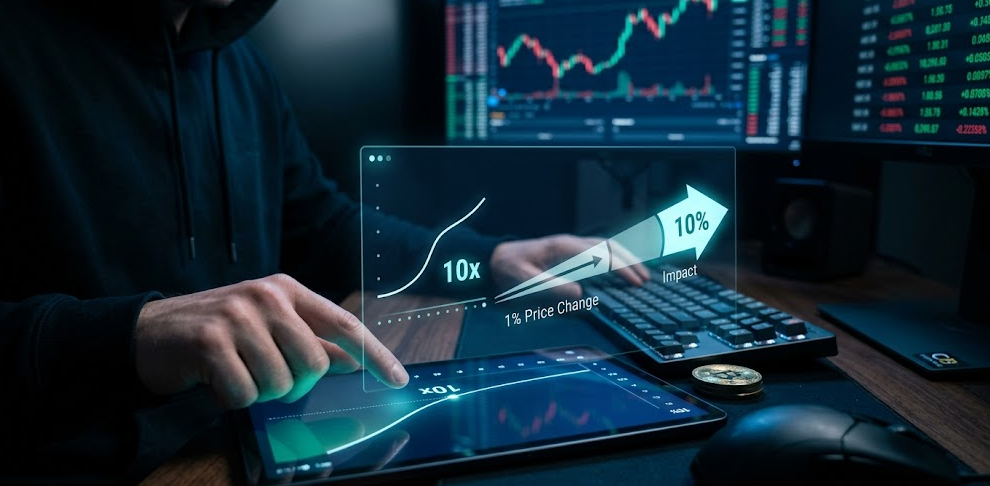
Leverage is simply the act of borrowing funds from an exchange in order to increase your buying or selling capabilities. Therefore, if you are using 10 times leverage on a position and that position changes 1% in price, you will experience an increase or decrease of 10% (your total margin account); you would experience no gain or loss if you did not use leverage.
Basic Principles of Borrowing
You must make a deposit into a margin account for the broker (Binance) in order to create your margin trading position with leverage. The broker will use the funds that you have deposited as your initial margin (the amount that you paid in). Your total position size will consist of your own funds (the initial margin you deposited to open your margin trading position) plus the amount of money you borrowed from the broker.
Depending on the futures pair you choose to trade with, you can trade between 2:1 (2 times) or 125:1 (125 times) in leverage.
Leverage Ratio and Impact
The way in which you can calculate your liquidation price for the futures contract you place is by determining the amount of leverage that you used for that future contract. Generally, the more leverage you use, the closer your liquidation price becomes closer to your entry point. For example, liquidating your position will occur automatically at 20x margin if the price declines by only 5% decline without covering your initial buy due to an increase on borrowed funds at that point.
Margin Requirements
There are two margins you would typically use on Binance as follows: Initial Margin is required for opening a trade, Maintenance margin is a minimum amount of equity left in the wallet and an insufficient amount would incur a margin call or liquidation immediately.
Account Setup Process
Once you have registered for an account on Binance, you will need to meet security and legal requirements before you can trade on margin. This will include identity verification as mandated by your country of residence. For example, USA-based users on Binance.us cannot trade on either platform without completing these requirements before being given access to do so.
Platform Navigation and Configuration
Ensure you are using the correct Binance platform as global users must use binance.com and USA residents must use binance.us, as they have different features per country regulations. Once logged into your account, find the "Futures" or "Margin" tab. Be prepared to take a short quiz by Binance to test your knowledge of the leverage created by trading on margin.
Fund Transfer and Margin Activation
Your Spot wallet cannot be used for leveraged trading. Instead, you must transfer your funds from USDT, Bitcoin or other collateral into a "Margin Wallet" or "Futures Wallet." You have two choices for how your margin funds can be used, "Cross Margin," which will allow you to use all available wallet balances for margin (collateral) trading or "Isolated Margin," which limits your risk to the pair you are trading.
Trading Implementation
Executing a leverage trade is more than just pressing the "Buy" or "Sell" button; however, it must also include accurately determining your position size and understanding where the market is headed.
Position Calculation and Leverage Selection
One of the biggest mistakes that beginner traders make is using the highest level of leverage (100X). Most professional traders will use significantly less leverage (3X – 10X) to allow the market to have room to move. Use Binance Calculators on the trading page to assist you with finding your estimated liquidation price and potential profit before entering a trade.
Order Placement
Your order can be placed as a Market, Limit, or Stop-Limit. Typically, it is preferred to use Limit Orders when trading with leverage due to slippage and price gaps as a result of increased volatility during volatile trading periods.
Management Strategies: Protecting Your Capital
The difference between a successful trader and a trader who has been liquidated is their management of risk. Always have an exit strategy before entering into a leveraged trade.
- Stop-Loss Orders: This is a must! A stop-loss order will automatically close your position at the designated level of your choosing before your entire account is lost.
- Take-Profit Orders: Have an established take-profit level; the cryptocurrency market is very volatile and waiting too long to take your profit may turn your winning trade into a significant loss.
- Funding Rates: In Futures Trading, the term "Funding Rates" means that there are periodic payments made from Long Traders to Short Traders. High funding rates when using leverage may chip away at your long term holding or success in the financial markets.
Risk Control and Portfolio Balance
Only risk 1-5% of your entire capital when using a leveraged trade of 10:1 or higher.
Success Framework: Best Practices
To be successful at using leverage in the Binance marketplace, you should mimic the Institutional investors' foundational approach, starting off with a demo account or very little money until you validate your strategies through testing.
Common Mistakes to Avoid
The #1 reason someone blows up their account is because of using too much leverage; New traders see 100x leverage as easy money; they get excited by the potential of making significant profits, but do not realize that a 1% market move against them could wipe them out instantly. Using increased leverage to try and recover your losses (also known as revenge trading) will ultimately lead to blown accounts.
Strategy Refinement
Track in a trading log your reason for entering the trade, what your leverage was and your final outcomes; over time you will start to notice market patterns and behaviours you possess which will allow you to identify what your edge is in trading. Utilize technical analysis such as RSI, MACD and Volume profiles to assist you in your investment decisions.
Conclusion: The Bottom Line
In conclusion, leverage trading offers great opportunity for growth, but will only be successful if you take the necessary precautions to get educated and develop a disciplined trading method in order to achieve true success. Once you've mastered your margins, executed your stops and have low leverage, you can confidently trade in cryptocurrency. Your goal is to remain in the game long enough to see consistent profit making decisions, not to become a billionaire from one trade!
Frequently Asked Questions (FAQs)
How do I determine the leverage that is safe for me based on current market conditions?
In extremely volatile markets, you may want to use lower leverage (2-5x) as there are very large price swings (wicks). In stable or trending markets where you have tight stops, you could use a higher leverage (10-50x ratio).
What are the minimum requirements for me to leverage trade on Binance?
To leverage trade on Binance, you must have a verified account, a margin account balance of at least $10-$50, and have successfully passed the Binance Risk Assessment Test.
What is the formula to calculate the size of your position when using leverage?
You can calculate the position size you wish to take with the formula: Position Size = Account Risk Amount / Distance to Stop Loss. You can reach this position size with less capital by using leverage, but it does not decrease how much money you should risk per trade.
What risk management tools are available on Binance?
The following Risk Management Tools are available to use on Binance: Margin Call Notification System, Auto-Deleveraging (ADL) protections, Insurance Funds, and Advanced Orders (e.g., Trailing Stop Orders, One-Cancels-the-Other (OCO) Orders).
How do I prevent myself from being liquidated when using leverage to trade?
You can use a Stop-Loss Order that is above your liquidation price and/or you can add margin to an existing position to lower the liquidation price if the market moves against you.
Disclaimer: Cryptocurrency trading can be very risky and speculative. This article is for educational purposes only and should not be used as investment advice. Always consult your financial advisor before making any investment decision.
Want to learn more about crypto arbitrage?
Get a subscription and access the best tool on the market for arbitrage on Spot, Futures, CEX, and DEX exchanges.

You might be interested

Morning Star Pattern

Inside Bar Trading Strategy for Cryptocurrency Markets
Setting Up Your First Crypto Arbitrage Bot
