


Morning Star Pattern

with ArbitrageScanner!
The morning star candlestick formation has a proven track record and high visual clarity, allowing the user to employ a systematic approach to identifying the change from a downtrend to an uptrend. The effectiveness of this pattern in cryptocurrency trading can provide additional incentive for traders to identify potential trade opportunities as well as provide a clearer understanding of how to apply it going forward.
Pattern Recognition: How to Identify a Morning Star
The morning star is a three-candle formation and tells us a story about shifting from bearish market sentiment to bullish market sentiment. To effectively trade the morning star, it is important for traders to identify the three components of the formation and understand what each of the candles tells us about the behavior of traders in the market.
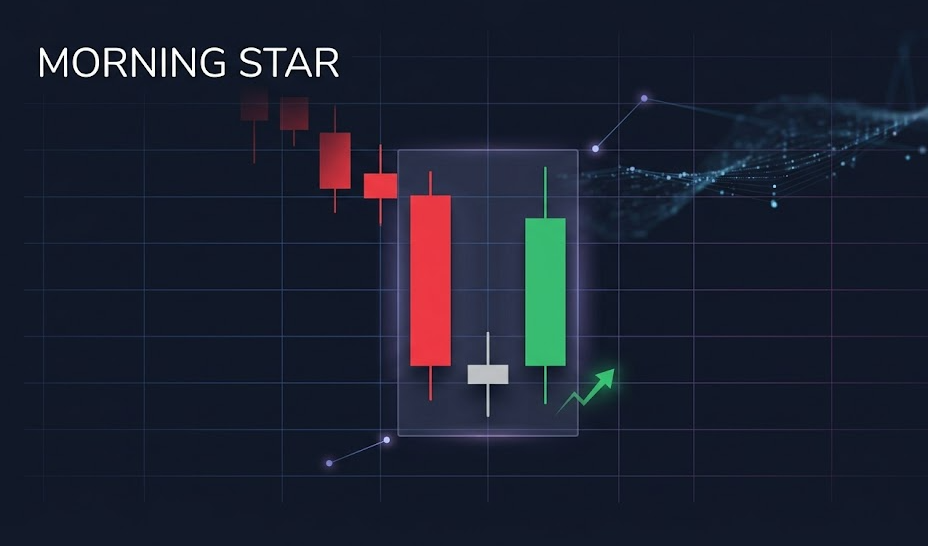
Key Components of the Morning Star
There are three unique candles that create the morning star:
- First Candle: Tall bear candle (black or red in crypto trading platforms) that shows that market participants are selling aggressively, which shows their continued bearishness.
- Second Candle: Small candle that gaps and closes below the first candle. The small candle is an indicator of market indecision, which is typically shown by a small red or doji candle.
- Third Candle: Bull candle (white or green) that closes near the mid-point of the first candle. This candle confirms to traders that market sentiment has shifted.
Formation Characteristics
In the perfect morning star setup, the second candle (the small candle) must gap below the closing price of the first candle. Compared to stocks, the gaps that occur in 24/7 crypto trading are less common, but there still must be identifiable 'stars' that show how the bears are losing the battle. A Morning Star must have the third candle closing at least halfway up the body of the first candle in order for it to be valid.
Market Psychology
As for the market's psyche, the Morning Star tells a strong story of trend exhaustion. The first candle shows that there are absolutely no bulls, only bears; the second candle indicates equilibrium between buyers and sellers, at which point, if a third candle forms, it means that the bulls have now taken control of the market and will subsequently establish an uptrend.
Trading Strategy: How to Execute
Executing the trade requires a structured approach beyond just visually identifying the pattern, as well as using an appropriate entry and exit strategy to achieve long-term profitability.
Entry Points and Confirmation Signals
When using the morning star pattern, one of the most common errors traders make is entering into a position too early (at the moment the second candle is completed). Instead, wait until the third candle closes before entering the trade as an entry confirmation; professional traders will enter a trade based on the third candle closing above the midpoint of the first candle's body. An aggressive entry is a trade entered after the third candle closes, while a conservative entry waits for a retest of the "star" level.
Volume Analysis
As such, volume is an important filter for star signals; we should look for decreasing volume on the first two candles and increasing volume on the third candle. The verification of an underlying bullish reversal pattern and significant level of institutional interest are confirmed by a significant increase in volume on the third candle.
Use of Stop Loss and Risk Management
To manage risk before entering a morning star pattern trade, ensure you use a stop-loss order. The most logical placement would be below the low point of the second candle (the star). If the price trades below this point, then the pattern has lost its validity. Use position size to protect against a significant loss due to just one pattern failing.
Utilization of Exit Strategies and Profit Targets
Prior resistance levels or Fibonacci retracements should be consulted when determining potential profit targets. You can also use one of these common methods: 1) Measure the height of the pattern and project said height up from the base, or 2) Target a reward to risk ratio of 2:1 from the stop loss placement relative to the entry point.
Implementation Guide: Step-by-Step
The first part of the buy decision is to find a morning star pattern, however the second part- execution of the pattern to produce profits, is equally important. Use the following template to assist with execution.
- Step 1: Look for clearly defined downward trending candlestick charts. An established morning star pattern will not be established in sideways or ranging markets.
- Step 2: Wait until after a long black candlestick confirms a bearish trend and produces a small range candlestick (the star).
- Step 3: Confirm that the third candle closes at least halfway up the first candle.
- Step 4: After your morning star pattern finished forming, make a trade and place your stop-loss one tick below the low of the formation.
Reliability and Success Factors
Although the morning star pattern is a trustworthy reversal pattern, the reliability of the morning star is heavily dependent on the specific market condition or environment. The morning star has the greatest probability of forming as an unexpected occurrence at a significant psychological/support level or an important long-term moving average. In order to thoroughly understand the scope of the reversal, it is important to compare the morning star to the opposing evening star formation.
You should also be aware that morning doji stars are more powerful than the typical morning star as the presence of a doji candle in the centre of the morning star signals a greater degree of indecision and increases the possibility of a large bullish breakout. However, keep an eye out for possible false breakouts when the price gapped up over a doji candle on the middle day, but then failed to maintain its upward momentum.
Best Practices
By enhancing your use of morning star formations with other technical indicators (such as RSI or Relative Strength Index), you will increase your chances of having a successful outcome. When you see a morning star pattern form and the RSI is in the oversold zone of under 30, your chances for a successful reversal will increase significantly. The morning star should never be traded alone; always confirm the morning star by comparing it to larger market trends.
Conclusion: The Bottom Line
The morning star is a three-candle pattern that creates a visual representation of a bullish reversal signal. By analysing how the first, second, and third candles relate to each other, traders will be able to find many more likely entry points into crypto markets. Although no single reversal signal can be 100% accurate, using the morning star plus strict risk management rules along with volume readings will provide you with an excellent edge when trading with the use of technical analysis as your major decision-making tool.
FAQs
How can I verify that a morning star reversal signal is valid?
A morning star is confirmed as a valid pattern when the third candle closes at least halfway up the first candle. In addition to this confirmation, if the last day has a significantly increased amount of volume compared to the previous day, the validity of the morning star is even more compelling.
On which charts or timeframes should I use morning star reversal signals?
Morning star signals can be effective on any timeframe but will be more so on the daily (1D) or four-hour (4H) charts as compared to the five-minute (5M) charts since fewer false signals will generally be presented than on shorter timeframes.
How do I use technical indicators along with the morning star pattern?
Combine morning star with oscillators, such as RSI or MACD, and watch for bullish divergences or oversold signals to assist you in determining the long-term reliability of the morning star.
What type of volume do morning star reversal formations use to confirm their validity?
The volume on the first bearish candle should be strong; the second candle should have an extremely low volume. The volume of the third bullish candle should be substantially higher than that of either of the two previous candles to verify the morning star reversal.
How do I manage my risk when trading a morning star reversal formation?
Your stop-loss should be approximately one tick below the extreme low of the second candle in the morning star formation; and your position size(s) must allow you to maintain at least a 2:1 risk-to-reward ratio to ensure you are maintaining a healthy account.
Want to learn more about crypto arbitrage?
Get a subscription and access the best tool on the market for arbitrage on Spot, Futures, CEX, and DEX exchanges.

You might be interested

Inside Bar Trading Strategy for Cryptocurrency Markets

Setting Up Your First Crypto Arbitrage Bot

How to Setup Trust Wallet for Binance Smart Chain
