


BTC vs. USDT as Quote Currency


with ArbitrageScanner!
No matter what type of assets you’re trading in, every decision you take — deciding what asset you want to purchase or sell as well as what exchange will be used — will affect how much actual money you end up with from these trades. One of the most basic, yet most frequently disregarded, decisions is actually what quote currency to use for your trade. By choosing to price your trades in either Bitcoin (BTC) or Tether (USDT), you can significantly impact your risk profile, your tax responsibilities, and your overall portfolio growth. This guide will assist you in understanding how a quote currency functions so that you can optimize your trading strategies using the appropriate quote currency.
Understanding Quote Currencies in Cryptocurrency Trading
The Definition of a Quote Currency and Its Importance
Every trading pair is composed of two pieces of currency — the base currency and the quote currency. For instance, in the ETH/USDT trading pair, Ethereum (ETH) is the base currency being bought/sold and Tether (USDT) is the quote currency used to evaluate how much you will earn or lose. The quote currency serves as the means by which to evaluate your overall profits or losses and should be carefully selected because it also determines how interested you are in accumulating wealth through that quote currency.
What to Consider When Trading Cryptocurrency Compared to Conventional Currency
Whereas you can evaluate the strength of the US dollar versus other international currencies when assessing a trading pair in traditional forex, the cryptocurrency market is unique. There are two types of currencies in the crypto market: hard currencies which have a limited supply (i.e., Bitcoin) and stable (i.e., USDT) currencies pegged to the US dollar. The unique way in which traders must choose quote versus base currency leads to a distortion whereby, although US dollars represent your stable profit/loss on every trade, the purchasing power of USD could appreciate. Do you want to increase your value in USD (US Dollar) or would you rather grow your holdings of Bitcoin (BTC)? Depending on which way you choose to answer this question, a trader’s view of the market will vary. When trading the BTC/USDT pair you focus on how much your Bitcoin is worth in dollars, while trading an altcoin/BTC pair allows you to evaluate the success of an altcoin in the marketplace, compared with a leader such as Bitcoin.
Bitcoin as a Quote Currency
Bitcoin's History and Current Position in the Market
In the early history of crypto, the majority (if not all) of the altcoins were listed against BTC and it was considered the base or benchmark for pricing all other cryptocurrencies. Because BTC was the first coin and by far the most liquid coin in the marketplace, it is commonly viewed as the reserve currency of crypto exchanges. Virtually all crypto investors would agree that BTC is the only legitimate unit of value within a decentralized economy.
Benefits of Trading in BTC vs. an Alternate Base Currency Pair
- Compounding Gains: If both the altcoin and BTC have been increasing in value, then both of your investments will have multiplied your return on investment as a result.
- Early Adoption of New Coins: When new projects are listed on exchanges, they are typically listed against BTC first and then more frequently against USDT.
- Increasing Holdings of BTC: If you have a bullish long-term view of BTC, trading in altcoin/BTC pairs provides you with the fastest and most effective means of accumulating BTC without having to use fiat cash to do so.
Disadvantages and Risks
The most significant risk factor when trading in altcoin/BTC currency pairs is the potential market conditions affecting the price of BTC. If BTC should greatly decline in value, your entire portfolio is in jeopardy of devaluing in dollars regardless of whether or not you've successfully traded an altcoin. This will make it very difficult to hedge against a systemic market downturn if you are primarily trading using BTC as your quote currency.
Timing Your Use Of BTC
BTC (Bitcoin) can provide the best opportunities to use it as the currency of choice and a long-term store of wealth, during Bitcoin's 'season' or mature market condition when Bitcoin is either stable or consistently rising in value.
Using Tether for Trading
Development of Stablecoins within the Cryptocurrency Market
Stablecoins were created to mitigate the issue of volatility. The initial development of Tether was to create a means of being able to ‘cash out’ without having to leave the blockchain. Since then, Tether continues to be the most extensively used stablecoin and provides an avenue for bridging fiat to crypto.
Benefits to Trading with Tether/USDT
- Pricing Stability: Users can benefit from using a stable form of currency (Tether) and will have profits calculated in stablecoin without concerns for external price fluctuations, thereby removing their risk of external price decline due to changes in the greater market.
- Psychological Clarity: The majority of users use US dollars (USD) and can easily relate to the Tether USDT price vs the BTC price; therefore Tether provides a much more reliably perceived measurement.
- Liquidity: Trades executed using Tether will normally have the highest volume traded through trading platforms such as Binance and Kraken.
Limitations and Concerns
The major concern surrounding the use of Tether is the centralization and risk of regulatory issues. Although Tether does provide a stabilizing mechanism, users must rely on the creator/vendor to provide proof of the Tether to US dollar ratio of 1-to-1. Additionally, those who only hold Tether will incur an opportunity cost during a major bull market versus holding BTC.
Optimal Situations For Trading Using Tether
Tether is used extensively during a bear market (during a time of high volatility) and establishes much better mechanisms for using stop-loss orders within the parameters of the US dollar for the protection of capital through Tether.
Effect of Currency Pair on Trading Results
Considerations of Bull Market
In a bullish market, all crypto assets will appreciate in value. The only way to benefit from trading an altcoin/BTC pair will be for the altcoin to outperform the BTC pairing. If BTC adds 20% and your altcoin only adds 10% you have effectively lost 10% of BTC value by not simply holding BTC.
Bear Market Trading Strategy
Throughout a market crash, USDT has continued to act as a safe haven for capital. Most of the crypto markets continue to decline in value, so moving into a USD-pegged (anchored) stablecoin can help to avoid losing value from your overall portfolio due to the decline in value of cryptocurrencies.
Managing Volatility
Technical indicators such as the RSI or MACD provide a different picture when applied to BTC or USDT price charts. They refer to the activity of trading versus the US dollar (USDT) versus the true value (intrinsic strength) of an altcoin relative to the overall market trend (BTC).
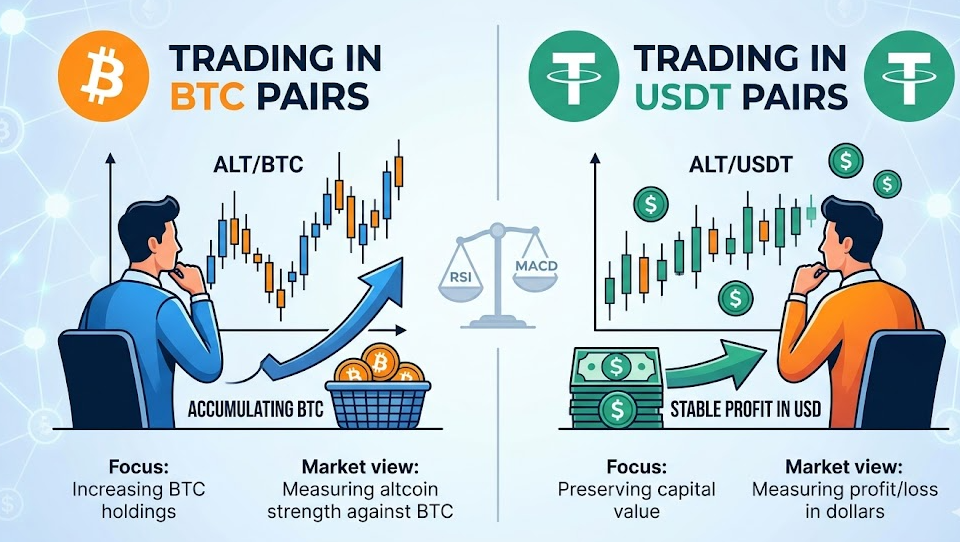
Consider Priorities when Choosing Quote Currency
Other Quote Currencies
While Bitcoin and USDT represent the majority of the market, there are various other alternatives to consider including USDC, BUSD and GUSD for regulatory purposes. If you are trading in specific markets or regions look for USDT pairings to trade in GBP, HKD (Hong Kong) and CAD (Canada) on exchanges that provide you a local market connection.
The technical factors involved in selecting a quote currency
When putting together your currency strategy, there are other considerations beyond strategy that have technical limitations. The availability of trading pairs can also differ between exchanges. For instance, on some smaller cryptocurrency exchanges, most volume would come from four different trading pairs. Further, the lack of decimal places in BTC trading pairs (in terms of "sats") compared to more traditional USDT trading pairs may also affect your ability to identify when a trend is reversing for low-cost "penny" alts.
How to implement a quote currency strategy
Virtually all of the more recent crypto trading platforms offer a way of setting "favorite" trading pairs. You may find yourself strategically cashing in on the most opportune trend by monitoring and reviewing your selections every week. For example, if BTC Dominance Index is increasing, you may want to consider moving your quote selection from BTC to USDT in order to avoid "bleeding" against BTC.
To sum up
The decision to use BTC versus USDT as a quote currency extends far beyond simply choosing a preferred technical quote currency — it's actually an important strategy. USDT provides a stable, dollar-denominated benchmark, making it better for preserving capital while providing a better sense of navigating a bear market. Conversely, BTC pairs can provide more value for someone who is looking to maximize their exposure to the world's largest digital asset. Understanding how BTC and USDT work will help you better align your crypto trading activities with your long-term financial goals.
FAQs
Using BTC pairings as a quote currency, how does that relate to portfolio performance when looking at the different market phases?
In a bullish market, your ALTCOINS that are quoted in BTC will need to outperform BTC in order for you to maintain a profitable position. In a bear market, using BTC as a quote currency can be more dangerous because of the fact both BTC as a quote currency and your altcoin as a base currency can lose value relative to the dollar.
Is there a taxation difference between using BTC as a quote currency versus USDT?
In many areas of the world, trading an altcoin for BTC is considered a crypto-to-crypto taxable event. In contrast, trading an altcoin for USDT will also incur taxable gains; however calculating capital gains tax when trading for USDT is typically easier since USDT is pegged to the dollar.
How can a trader effectively mitigate their exposure to volatility when using BTC?
Traders can turn to advanced order types and stop-loss orders as a method of increasing exposure to BTC's current volatility by tightly managing their risk. Alternatively, during periods of significant volatility, traders can temporarily exchange their BTC quoted holdings for stablecoins, such as USDC or USDT.
Which quote currency typically has the highest liquidity?
Currently, USDT pairs provide the highest level of trading volume and have the tightest spreads on major exchanges like Binance — particularly for cryptocurrency assets with a sizeable market capitalization.
How do long-term investors manage their BTC quoted assets, compared with active traders?
Long-term investors typically prefer to use BTC quoted trading pairs in order to accumulate more "satoshis" over the long-term. However, active traders typically desire to utilize USDT quoted trading pairs in order to take predictable profit in dollars along with limiting their risk exposure to the fluctuations of BTC during the day.
Want to learn more about crypto arbitrage?
Get a subscription and access the best tool on the market for arbitrage on Spot, Futures, CEX, and DEX exchanges.

You might be interested

Bitcoin Rainbow Chart Guide

The Inverted Hammer Candlestick Pattern

Understanding Cryptocurrency Trading
