


Cryptocurrency Day Trading


with ArbitrageScanner!
The rapid development of cryptocurrency as a digital asset class has made day-trading in these digital assets one of the most exciting ways to grow your financial portfolio. Unlike the traditional stock market, which follows a set trading schedule of 9:30–4:00 PM, the cryptocurrency market is open 24/7. Because of the constant ability to trade and the volatility of cryptocurrencies, a disciplined day trader is in a position to make profits on quick price movements. Whether you’re looking to supplement your income day trading or make day trading your full time career in 2026, understanding how to execute your day trades is important for your success and continued profitability.
Understanding Day Trading
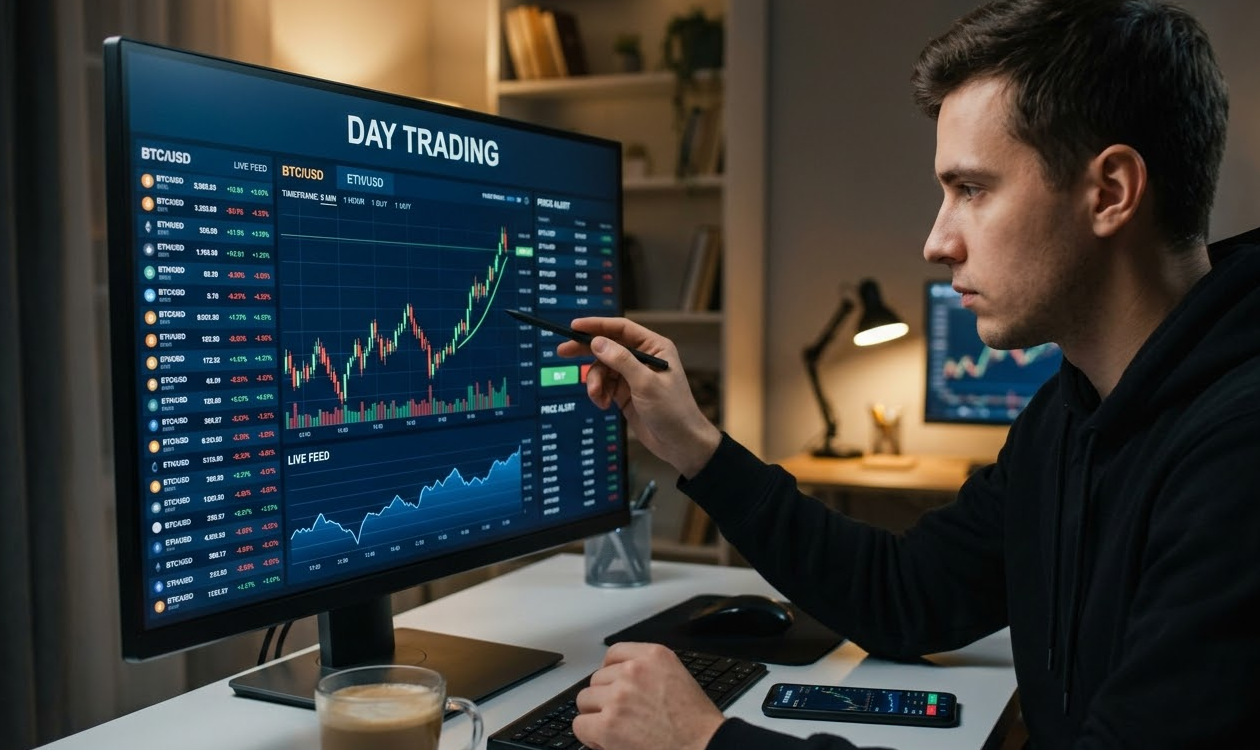
Day-trading crypto involves both opening and closing trades all within the same day (24 hour period). The day trader profits from small changes in the price of a cryptocurrency like Bitcoin, Ethereum or any number of different tokens. Day-traders typically have no interest in what prices will be over the next five years like long term investors (HODLers do), they want to know what the price will be in 5 minutes and hopefully in 5 hours from now.
Basic principles
The primary goal of a day trader is to limit their risk by buying and selling a cryptocurrency (intraday) and exiting that trade before the end of the trading day without any exposure to "overnight" price movement. Of course, "overnight" price movement in crypto is a little subjective, however; it is still a day trader's goal to use risk management and separate themselves emotionally from the trading process, in order to be successful in this crypto space.
Market requirements
To day trade cryptocurrencies successfully; there needs to be both high liquidity and low slippage. High liquidity will enable you to enter and exit large volumes of a cryptocurrency, with very little effect on the pricing you just transacted. The volatility in the cryptocurrency market allows traders to exploit big price changes (or swings) during the same trading day and earn substantial profits on those trades. A "day trader" will take advantage of short-term pricing variations in the market due to the volatility and movement through the day to be able to make their trades (or buy/sell). So if there is a lot of flux and up-and-down movements in the price of Bitcoin throughout the day, there is an opportunity to make money whether you buy it or sell it.
Trading framework
The first step in your journey to becoming a professional trader is selecting a good exchange to trade on. There are numerous exchanges, including Coinbase, Binance, Kraken, etc., that provide you with the tools needed to trade effectively over a short period (e.g., "active traders"). In addition to choosing a good exchange, it is critical that you have a history of transaction security so that your private information is protected while you trade, a solid understanding of how the market works (such as news, trading signals, etc.), and a demo account (simulated trading) to allow you to practice before trading live.
Core Trading Strategies
All successful traders today will need a combination of many strategies in order to succeed in 2026. These strategies will range from the following:
Scalping approach
Scalping refers to the most aggressive of the Day Trading strategies. Scalping will involve executing many trades each day (i.e. dozens, hundreds), with each trade generally only experiencing slight (or "tiny") price movements. Scalpers typically trade at high volume and require high-speed/quick execution to participate in all of the trading opportunities presented. Scalpers use very short-timeframe charts (e.g. one-minute and five-minute charts) to find an advantage over other traders by analyzing the order-book.
Range trading method
Range Trading uses technical analysis based on support and resistance, to find ranges of prices in which a particular cryptocurrency (e.g., Bitcoin) trades numerous times. In order to effectively implement this strategy, Traders will purchase Bitcoin at the support level of the range and then sell at the resistance level of the range. This method works best when the Bitcoin market is flat and continues to move in a predictable horizontal manner.
Arbitrage trading
Arbitrage trading involves simultaneously purchasing a cryptocurrency on one exchange and selling it on another where the price is higher. Since price discrepancies between exchanges are typically small and short-lived, this strategy requires fast execution and is often paired with automated trading tools to be effective.
Automated trading
Automated Trading Methods have become very popular among day traders in recent years. Automated trading programs allow day traders to execute every trade based on defined rules and/or the performance of the market based on pre-established criteria, which eliminates emotional aspects from the process of executing trades and allows for a more consistent performance. This technique is especially useful for active traders who need to monitor multiple markets simultaneously or who may be away from their trading desk for some time.
Implementation techniques
There are a few implementation techniques that can assist you with cryptocurrency day trading. Focus your efforts on using technical analysis to help you identify trends through the use of moving averages, and execute trades using market orders to obtain immediate execution of trades. Note, however, that immediate fill orders typically carry higher "taker" fees, so trading smaller amounts using limit orders will generally preserve your margin.
Technical Considerations
To trade cryptocurrencies at a professional level, you must become proficient and skilled in the tools of the trade. Cryptocurrencies are notoriously known for their technical nature; therefore, if you possess a high level of proficiency in technical analysis, it will become your key to achieving a trading edge.
Analysis tools
Most crypto exchanges provide built-in charts, but many traders use external resources such as TradingView for charting and analysis in order to utilize advanced charting functions and display market data in a manner that allows them to see an inevitable direction of the trends through the use of disproportionately high trading volume compared to previous periods. To properly trade using supportive volume, traders must also evaluate the legitimacy of a price movement based on the relative trading volume that occurred during that same time frame to confirm its validity.
Chart patterns
Chart patterns are a representation of trader psychology toward the market. Therefore, recognizing specific chart patterns such as the "Head and Shoulders," "Double Bottom" and "Flag" patterns will allow you to better identify whether or not you are trading with the trend rather than against it. For example; if you see a "Bull Flag" pattern develop in a chart, there is a high probability that the current crypto trend will continue to rise.
Indicator usage
Indicators are mathematical calculations that are based on price and volume. For example, the Relative Strength Index (RSI) tells you whether or not a cryptocurrency has been subjected to excessive buying (overbought) or excessive selling (oversold). Moving averages serve as smoothing tools to eliminate extreme short-term price volatility in order to provide the user with an overall trend indicator of where the market is trending toward.
Risk Management
If there is one thing that separates professional cryptocurrency traders from amateur ones, it is their ability to manage risks. The volatility of the crypto market makes it very dangerous to put your entire capital at risk during a single trading session.
Stop-loss placement
Stop-loss orders allow traders to limit potential losses by automatically closing out trades when they hit a specific price level. Any trader who is anticipating potential losses must utilize a stop-loss order every time they make a trade. A simple way to implement risk management is to never risk more than 1% of your total account balance on a single trade.
Position sizing
How much cryptocurrency you buy is known as position sizing. When you are day trading with a capital of $10,000, position sizing will depend upon the distance to your stop-loss to help ensure that a string of losing trades will not wipe out your account.
Liquidity assessment
Prior to looking for trading opportunities, you should assess the liquidity of the token in order to determine the availability of a sufficient number of buyers or sellers for that token at the time of the trade. If you place your order on a low-volume token, you may be unable to sell your token without experiencing extremely large price fluctuations. If you want to avoid trading in low-volume tokens, you must have a trading account established with a reputable cryptocurrency exchange.
Fee management
Trading fees can significantly cut into your profit margins, especially on days you make several trades. Many exchanges offer discounted fee schedules based on a trader’s 30-day trading volume, so it’s important to keep track of your daily activity to see how you fall into their pricing schedule. When day trading, always account for potential capital gains taxes because most jurisdictions treat day trading as a taxable event.
Success Framework
Profitable day trading doesn’t happen overnight. Most unsuccessful day traders do not approach their trading as a business and treat it more as a hobby.
Research methods
Know why the market is moving instead of just knowing that you want to trade. For example, you should closely monitor daily or weekly inflows of exchange-traded funds (ETFs) for bitcoin or other large changes happening to the ethereum network. Having adequate research will also keep you out of moments when the market is extremely unpredictable.
Practice techniques
Before risking real assets in day trading, test your strategies on "Paper Trading." Paper Trading is an opportunity to develop into a profitable trader by validating your strategies with no risk to you or your account. Analyze your trading history and how you have performed over time in a risk-free environment before depending on your validated trading strategies.
Strategy development
To be successful long-term in your day trading business, develop a niche area. Are you better at swing trading than you are short-term scalping? Use the data to continually refine the way you implement your strategies based on what your data shows you—the data is always more reliable than what your gut may feel.
Performance monitoring
Maintain a trading journal. Document each trade you have between when you enter, why you are entering, the outcome of the trade, and how you are feeling emotionally about the trade afterwards. This performance monitoring will allow you to see how well your risk management strategies have worked over time.
Conclusion
Trading cryptocurrencies during the day provides many opportunities to earn a high reward; however, it is also high risk. You need to be proficient with technical analysis, have strict risk management strategies, and the right cryptocurrency exchange to give yourself the best chance of surviving and being successful in the cryptocurrency trading market. Building a successful day trading career takes time and requires consistent trading, continuous learning, and the discipline to only day trade when you know your odds of being successful are in your favor.
FAQs
What minimum capital is needed to start day trading cryptocurrency?
Some exchanges will allow you to start day trading with an investment of $10, but professionals recommend you should have a minimum of $500 to $1,000 to offset your trading fees and position sizes correctly.
How to choose the best cryptocurrencies for day trading?
To choose the best cryptocurrencies to day trade, look at bitcoin and ethereum for the most price stability, you may also use mid-cap tokens that have the highest price liquidity while maintaining a low trading spread using websites like CoinMarketCap and/or Coingecko.
What technical indicators work best for crypto day trading?
The best technical indicators to use when day trading are the Moving Averages (EMA), Relative Strength Index (RSI), and Bollinger Bands, in combination with analyzing trade volume.
How to manage risk effectively in daily trading sessions?
You should never risk more than 1% of your total investment on any one trade, use a stop-loss order every time you trade, and until you have been consistently profitable, do not trade on margin.
When is the best time to day trade cryptocurrencies?
The cryptocurrency market is most active during the US and Asian market overlap, as well as when major news stories involving large-scale movements in bitcoin are published.
Want to learn more about crypto arbitrage?
Get a subscription and access the best tool on the market for arbitrage on Spot, Futures, CEX, and DEX exchanges.

You might be interested

Top 6 Security Vulnerabilities in Blockchain

Essential Crypto Tools for Traders and Investors

Technical Analysis Mistakes to Avoid in Crypto Trading
