


DeFi Portfolio Trackers

with ArbitrageScanner!
In today's market, managing a portfolio in decentralized finance (DeFi) is comparable to putting together a complex multi-dimensional jigsaw puzzle, with many pieces on different blockchain networks, in various liquidity pools and with different staking protocols. Attempting to manually calculate your total net worth using traditional financial accounting methods is virtually impossible. A DeFi Portfolio Tracker will aggregate a variety (or all) of your on-chain data from connected wallets to provide you with up-to-date digital asset totals, performance metrics, and risk assessments.
The Challenges of Managing a DeFi Portfolio
The decentralized nature of cryptocurrency gives you incredible flexibility but creates a significant challenge for most investors.
The Complexity of Managing Multiple Digital Assets
Most modern investors do not invest in just one token or on one blockchain network. You may have Bitcoin on a cold wallet, Ethereum in your web3 wallet and various altcoins on Binance Smart Chain or Polygon. If you do not have access to a DeFi portfolio tracker, calculating your total net worth will require you to sign into dozens of different dApps.
The Need for Real-Time Performance Monitoring in a Volatile Market
The volatility and speed at which the cryptocurrency markets operate means that prices can change within seconds and liquidity can change very quickly. In order to track your performance precisely, you need to use a DeFi portfolio tracker that provides real-time updates through blockchain nodes, so you can track your performance even if there is a significant drop in the cryptocurrency market.
The Transaction Complexity Across Multiple Platforms
Both transactions with DEXs (decentralized exchanges) like Uniswap and transactions with lending protocols like MakerDAO create a significant number of transactions and will make auditing these transactions and calculating your cost basis and yield farming returns a logistical nightmare. A DeFi portfolio tracker tool simplifies the complexities involved with auditing and managing multiple transactions.
What is a DeFi Portfolio Tracker?
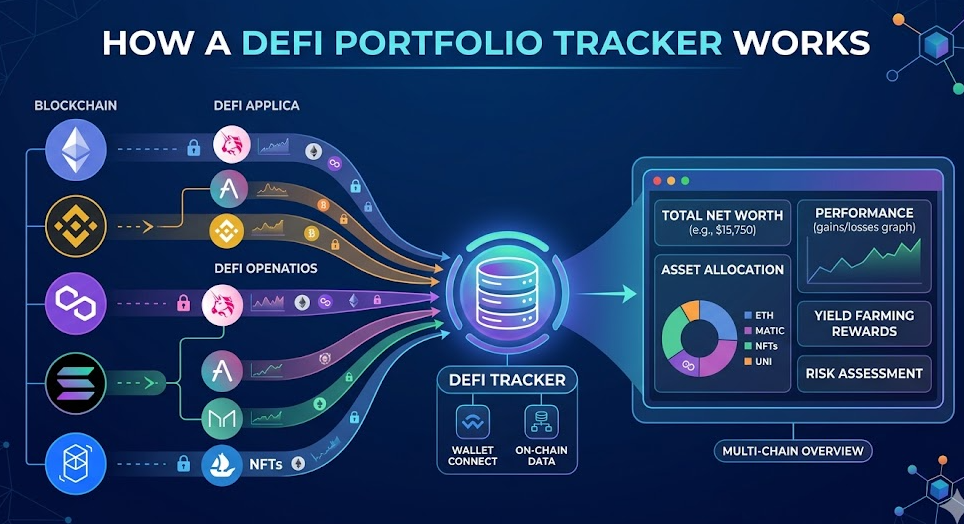
A DeFi portfolio tracker is a software application that connects to your cryptowallet addresses to collate and provide information related to your holdings based on the activities recorded into or stored on-chain from the various smart contracts within the DeFi ecosystem.
Main Purpose
The primary objective of portfolio trackers is to provide complete visibility to the end-user. By entering your public wallet address, the aggregator will read the on-chain data associated with your wallet and display what you own (the assets), where they are stored (where you placed them within the ecosystem), and what their worth is relative to your selected fiat currency.
How Portfolio Trackers Work with DeFi Platforms
These applications operate by using APIs and Blockchain Indexers to retrieve, process, and read the interactions between users and the blockchain's smart contracts. In addition to identifying the user's defi positions (ex: collateral in Aave, tokens locked in a liquidity pool, etc.) the aggregators will display the user's overall DeFi holdings in a single user interface without requiring the end-user to provide their private keys.
The Differences Between DeFi Trackers and Traditional Financial Tools
Traditional financial applications that rely on centralized databases and bank synchronisation (bank account linkage) will only provide the user with their assets as recorded in the bank's database. Therefore, traditional financial applications will only have the user's assets within their respective centralized database. In contrast, DeFi Portfolio Trackers are permissionless; they interact directly with the blockchain. As a result, DeFi Portfolio Trackers provide complete transparency and source their data from non-custodial or decentralized sources (blockchain) vs a closed centralized banking system.
Benefits of Using DeFi Portfolio Trackers
For any serious investor, utilising a Defi Portfolio Tracker will provide transparency within a very chaotic environment.
- Complete Overview of All Your Crypto Assets, including NFTs, on One Screen: You shall see all your crypto assets (that would include NFTs) and staked crypto assets with their current valuation on a single screen.
- Real-Time Valuation on Your Crypto Assets: Be updated instantly with any change in market caps and be able to determine your Total Value Locked (TVL) in the DeFi ecosystem.
- Managing Risk: Identify overexposure to a single asset or infrastructure and ease DeFi risk.
- Filing Taxes: Most trackers give automated transaction logs that are needed to work out capital gains/losses.
Critical Qualities of a DeFi Tracker
Not all DeFi trackers are made equal. When selecting your #1 DeFi tracker to assist in managing your assets today, you should search for the following sophisticated characteristics:
Analysis of Performance Metrics / Profit & Loss
An excellent DeFi tracker not only tells you how much cryptocurrency is in your wallet, but also how much profit ("P/L") you have made or lost on each cryptocurrency, and will take into account gas costs and APY to give you an accurate ROI of each cryptocurrency.
Security & Privacy
Security is of the utmost importance. DeFi protocols have advanced security solutions. DeFi protocols such as De.fi provide their own proprietary security services. They have a De.fi Scanner and a De.fi Shield, which act as an antivirus program for your cryptocurrency wallet, and make it easy for you to scan for known vulnerabilities in smart contracts that you have approved.
Market Insights / Trend Analysis
First-rate DeFi tools provide DeFi TVL aggregators to show which are the most popular DeFi protocols that are on the rise. Access to a Rekt Database or Audit Database may also mitigate the chances of falling for scams or “rug pulls.”
Different Types of DeFi Assets
A modern portfolio will contain more than just Bitcoin or Ethereum.
Tracking NFT Investments and Collections
Your wallet should support NFTs and indicate the floor price and the attributes of the entire collection as well as your liquid tokens.
Multi-Chain Support
A viable DeFi Portfolio Tracker will provide for maximum efficiency by providing for concurrent support for Fantom, Polygon, Binance Smart Chain, and Ethereum. The ecosystem is experiencing tremendous growth; therefore, a multi-chain solution will be required.
DeFi Portfolio Tracker Comparison
The leading crypto portfolios of 2024 are:
- CoinStats: Best option for a mid-tier Global Crypto Exchange as compared to a Forex or Centralized Exchange.
- Zerion: Renowned for the most straightforward wallet interface for DeFi and the easiest way to access DeFi-related features.
- DeBank: An industry model for on-chain DeFi tracking and social ranking.
- Zapper: A liquidity provider-focused DeFi visualization solution.
How to Set Up DeFi Portfolio Tracker
Establishing an account is very easy:
- Wallet Connection: Either your public address or via Wallet Connect.
- Auditing Permissions: Utilise De.fi Shield to greatly reduce your DeFi risks through revocation of dangerous contracts.
- Customisation: Set price alerts for your most important cryptos.
Conclusion
As DeFi continues to evolve and provide more precise tracking – the ability to monitor your investments is not optional; it is essential. A complete DeFi Portfolio Tracker will provide the transparency and information needed to be an informed investor. Once you have incorporated these tools into your everyday interaction with cryptocurrencies, you will protect your digital assets, optimise your yield and be proactive in the constantly changing crypto economy.
Frequently Asked Questions
Do portfolio trackers have access to my private key?
No. By using only your Public Wallet Address to read on-chain data (blockchain), legitimate portfolio trackers will not be able to transfer your crypto.
How Do Trackers Work with Yield Farming?
Trackers examine the Smart Contract Addresses of the various DeFi Protocols to identify your percentage of ownership of the liquidity pools and to compute the pending rewards* from staking.
Is There a Fee for These Services?
Most DeFi Portfolio Trackers provide a free version for basic tracking, while advanced audit/security features may be available with assessment subscription fees.
Want to learn more about crypto arbitrage?
Get a subscription and access the best tool on the market for arbitrage on Spot, Futures, CEX, and DEX exchanges.
You might be interested

Dollar-Cost Averaging in Cryptocurrency

The 3 Line Strike Candlestick Pattern
RSI Divergence in Cryptocurrency Trading
