


Dollar Cost Averaging (DCA)

with ArbitrageScanner!
With frequent fluctuations in cryptocurrency prices, investors new to the market may experience confusion when determining whether to buy or sell assets like Bitcoin or Ethereum. Many people will experience indecision when attempting to buy or sell cryptocurrencies, some because they are uncertain about the best way to do it, and others due to fear of missing out on increased prices (also known as "FOMO"). By utilizing Dollar-Cost Averaging (DCA), investors can develop their digital-assets portfolio in a systematic way without the pressures of "timing the market" or being subject to an emotional roller coaster.
Understanding Dollar Cost Averaging
What is DCA?
"Dollar Cost Averaging" (DCA) is a common practice used by investors, allowing them to invest their total amount of funds over several purchases of a cryptocurrency over a number of time periods. Instead of making all your cryptocurrency purchases at once with one large investment, you pay for each cryptocurrency with the same dollar amount (e.g., $100) during the same period (e.g., every week or every month). By applying DCA to the purchase price of a single cryptocurrency (rather than making one large purchase), you will blend the average purchase price (e.g., by averaging over many transactions) for your total investment and decrease the potential impact of the extreme volatility of the cryptocurrency market.
DCA vs. Lump Sum Investing
When using a lump sum of capital to purchase a cryptocurrency, you are essentially purchasing the entire cryptocurrency without regard for timing or the duration of your holding that cryptocurrency to either exit or hold the same cryptocurrency. For example, if you were to invest $1,000 in Bitcoin at the current low price of that market, you would create a very good profit (assuming you sold before the market again drops). Alternatively, if you made your Bitcoin investment and the price of Bitcoin started to go down immediately after you placed your buy order, then you could suffer from a longer recovery period (until you have recovered all of your investment dollars) than if you had dollar-cost-averaged your Bitcoin purchases. From the DCA perspective, using a lump sum of money to purchase crypto represents a longer time period for holding crypto (and all that time is subject to price risk regardless of overall market conditions at any point during that time).
Why Volatility Makes DCA Ideal
Because the volatility of the cryptocurrency market is much more extreme than that of traditional stocks and bonds, it is important to invest in Bitcoin using DCA. Price fluctuations can be very steep on a daily basis. Using a dollar-cost-average (DCA) method, you have the ability to reduce impacts from these market swings. When you are investing at a price higher than what you’re used to, your fixed investment will buy fewer units; conversely, if you are investing at a lower-than-normal price, you will be able to purchase more units. Therefore, over the course of years, this strategy can bring down the average cost per unit of your investment over time.
The Mechanics of Dollar Cost Averaging
Creating Your Investment Schedule
Your first action towards having a successful DCA method is to determine how often you will be making investments. Most investors prefer to regularly purchase either weekly or monthly amounts. Whatever method you decide on, make sure it stays the course over time and that you don’t start interfering with future schedules because of how you “feel” the market may perform. Making use of the systems provided through exchanges, such as Kraken and Coinbase (for cryptocurrency), or most types of stock brokerage accounts (for equities) can also put your timed DCA activities on auto-pilot, making for a successful DCA method without requiring much time on your part to implement.
Choosing Your Investment Amounts
Prior to implementing a DCA strategy, each individual will need to do a self-assessment regarding their individual risk tolerance. You should only invest funds that you would not need to access immediately. Because there is a high level of inherent risk involved with investing, the portion you allocate towards your investment accounts should be based on how much risk and how much money you have budgeted to consistently invest. Whether you are able to DCA using $50/month or $5,000/month is not what determines your success when utilizing a DCA strategy; your success depends on continuously investing over the long term and ignoring short-term price volatility.
When to Allocate Your Investments: Weekly or Monthly
In terms of average contribution amounts in the market, would you rather have $400 invested once a month or $100 each week? Based upon what historical results show in regards to high levels of volatility in an asset class, DCA could lead to lower average costs per unit when the price is dropping quickly by making more frequent contributions. However, don’t forget about the transaction fees that you would incur by buying multiple coins through smaller amounts frequently may give rise to higher premium amounts than one larger monthly transaction, depending on which trading platform you decide to use.
DCA Asset Selection
You can implement a dollar-cost average strategy on any coin, but it is typically best suited to long-term assets. Most individuals will typically choose Bitcoin or Ethereum to be their main asset for any long-term strategy because historically these coins have demonstrated consistent value through all market cycles. An additional factor in dollar-cost averaging into a low-cap “altcoin” is that should that investment not recover from a market downturn (bear market), it may render the dollar-cost averaging strategy useless.
DCA in Action: A Practical Example
Example of Testing DCA
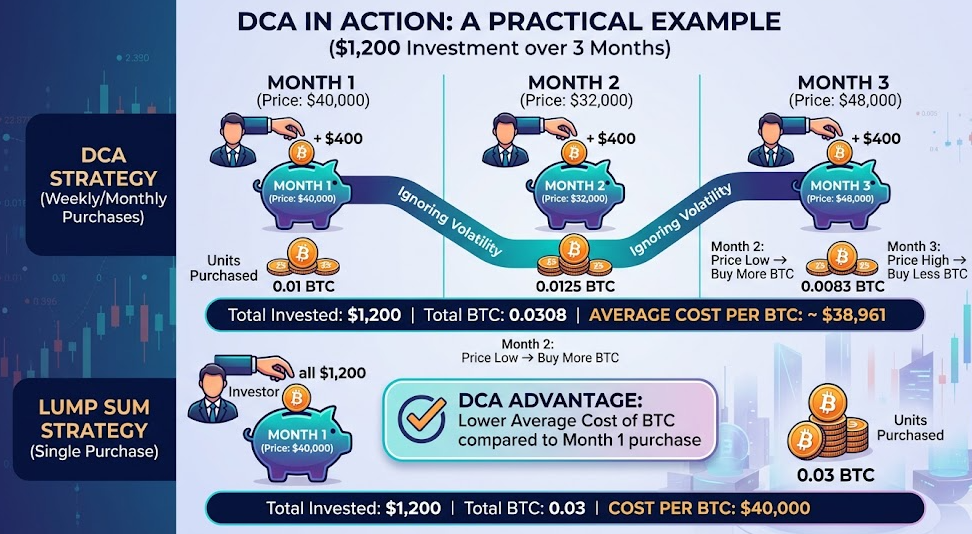
The following is a three-month period of Testing DCA with $1,200 in Bitcoin:
- For the first month you buy BTC at $40,000 – 0.01 BTC, with your total investment was $400.
- For the second month you buy BTC at $32,000 – 0.0125 BTC, with your total investment $400.
- For the third month you buy BTC at $48,000 – 0.0083 BTC, with your total investment $400.
How Buying Via DCA Works
As we see from the above examples, the second month had a lower dollar price per coin and therefore you purchased more coins compared to a month where the price was higher. These averages show investors how not to overspend on the highest of prices when purchasing.
Average Cost Per Coin Based On Average BTC Dollar Amount
The above example shows your total investment of $1,200 for a total of 0.0308 BTC for an approximate average. If you had initially invested the whole thing ($1200) in the first month (Month 1) at a cost per unit of $40,000, then your average cost (by using the method of dollar cost averaging) would be less than the price you paid to enter in the first month.
Long-Term Performance Comparison
When you use dollar cost averaging for a long period of time, it will often outperform making lump sum purchases at periods of hype. According to dcaBTC's research of Bitcoin DCA / timing the market at the ATH of 2017 gave significant improvement on average purchased price compared to an all-in purchase.
Key Benefits to Dollar Cost Averaging
Market Timing Risk Mitigation
Even experienced traders can not accurately predict when the market has turned, and most average investors who attempt to time the market, lose money. DCA negates the risk of market timing by allowing you to purchase in both poor and good environments; therefore, ensuring that you have established a better long-term cost basis.
Emotional Decision Making Reduction
DCA has a psychological advantage, as the market sentiment swings between extreme fear and extreme greed. By purchasing on a regular schedule, you will eliminate the stress of the decision-making process when to make a purchase. DCA also creates an automation, thus creating discipline in your investment approach, which will produce long-term investment success.
Accessibility for All Investment Budgets
DCA provides access to cryptocurrencies for all investors due to not needing $60,000 to purchase one whole bitcoin. By investing small fixed amounts on a regular basis, you can build your assets over time from small purchases. The democratization of financial assets is one of the main tenets of crypto.
Possible Disadvantages of Dollar Cost Averaging
Impact on Performance in Long-Lasting Bull Markets
Dollar-cost average (DCA) is the best investment strategy in a long-term bear market; however, in a vertical bull market, DCA will usually perform poorly due to increasing costs to average down your purchase price for each successive purchase. A lump sum would have produced a higher average return.
Transaction Fee Impact
Each time you use a DCA method to make a purchase, there is a transaction fee associated with that purchase. If you want to invest $10 in cryptocurrencies and incur a transaction fee of $1, you have lost 10% of your investment value. Therefore, it is critical that you research and identify a platform that minimal or no transaction fees so you retain as much of your purchase price in the event of price appreciation.
Tax Implications from Frequent Purchases
Purchasing a bitcoin or other cryptocurrency creates a new cost basis for the purpose of calculating taxes on your future gains/losses; therefore, purchasing on a weekly basis for 3 years will create 156 separate lot histories for tax purposes. This or a similar record-keeping system will require a comprehensive portfolio management software program through which you can adequately track your various cost basis at the time of transaction.
Implementing a DCA Strategy
The following are a few steps you should take to facilitate a DCA strategy:
- Find a reputable cryptocurrency exchange that has low fees (e.g., Binance, Kraken, or Coinbase).
- Determine an investment amount for the current month to purchase digital currency.
- Determine which cryptocurrencies you plan to include in your portfolio (stick to those with high trading volume).
- Ensure the recurring purchase is enabled on the platform (e.g., “Recurring Purchase”, “Auto-Invest”).
- Periodically check your average price for each share (or unit of digital currency).
Automation Tools and Platforms
There are many ways that investors can use advanced methods like CryptoHopper and 3Commas to dollar-cost average better. Utilizing these automated bots provides you with the ability to purchase more of a certain asset when the price has dropped a certain percentage of the way – effectively creating something called "Dynamic DCA."
Building Wealth With Regular Investments
Success in cryptocurrency doesn't happen overnight through finding the next "100x" coin. Rather, it's about acquiring assets that have potential over the long term. For this reason, using dollar-cost averaging to build your portfolio, a strategy based on patience and peace of mind, rewards you for ignoring volatility in the short term and helps you establish a strong foundation for all of your future investments.
Conclusion
Dollar-cost-averaging may be the most effective technique for group investing in cryptocurrencies while eliminating market timing risks. The use of DCA is a simplified approach that lowers your average cost per unit and creates disciplined investment strategies. Although there is no adrenaline rush when compared to day-trading, using DCA effectively mitigates the effects of market swings on an investor and is regarded by many as the "best" way to grow wealth long-term.
FAQ
How does DCA perform with respect to lump-sum investing in large crypto bull and bear runs?
In bear markets, DCA provides a much lower average cost per unit as prices continue to decrease than does lump-sum. In a parabolic bull market, lump-sum becomes the better-performing option as it captures the low point for entry.
What is the best frequency for DCA in the crypto market?
Many investors suggest weekly or bi-weekly for establishing projects using bitcoin dollar-cost-averaging as this allows for enough time to capture price volatility while at the same time avoids being cost-prohibitive as result of too much trading.
What are some advanced strategies to modify your DCA when market sentiment is extreme?
Advanced traders will generally utilize something referred to as "Value Averaging" where they adjust their DCA amount to be higher when the Fear and Greed index is in an "Extreme Fear" state and lower when it is in an "Extreme Greed" state.
Which platforms provide low-cost automated DCA solutions?
Many exchange platforms such as Kraken and Binance offer features called "Auto Invest." Swan and Strike are two of the more popular U.S.-based platforms that offer low-fee bitcoin-only DCA trading for U.S. residents.
How can DCA be coupled with tax-loss harvesting?
When any DCA "lots" are trading at a loss, selling those portions to use as offsets against other capital gains, then quickly purchasing back the same or similar dollar-amount to your original purchase price (if applicable in your local tax guidelines) will provide the investor with the benefits of capital loss, while continuing to hold the underlying asset in order to qualify the long-term benefits of the investment.
Want to learn more about crypto arbitrage?
Get a subscription and access the best tool on the market for arbitrage on Spot, Futures, CEX, and DEX exchanges.
You might be interested
Crypto Arbitrage Trading

Cryptocurrency Order Books
Bull Flag Chart Patterns
