


Cryptocurrency Order Books


with ArbitrageScanner!
The order book functions as an essential electronic resource for each crypto exchange, recording in real-time both buy and sell orders for any trading pair in a single place (e.g., BTC/USDT). While learning how to interpret order book data is crucial for professional traders, it also provides everyone who participates in the cryptocurrency marketplace with valuable insight into the current supply and demand as well as investor sentiment, all of which will enable them to make informed decisions when trading cryptocurrencies.
Order Book Composition
Each cryptocurrency’s order book contains two distinct parts, representing opposing sides of the market – supply and demand, thus providing an overview of market conditions at any price.
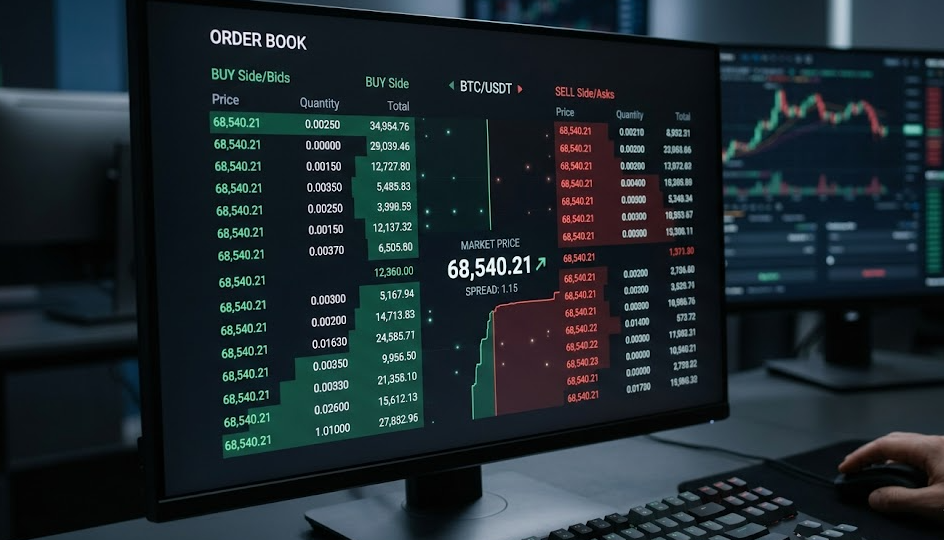
Buy Side – What is a Bid?
The buy side of an order book, usually displayed in green, is where all buy (bid) orders are located. Each buy (bid) order shows the maximum amount of money a trader wants to pay for an asset. The buy side of the order book displays each buy (bid) order from the highest to the lowest, with the highest buy (bid) order being the best available price for sellers in relation to the other buy (bid) orders. By reviewing the buy side of an order book, a trader can identify levels of current support and resistance based on selling interest.
Sell Side – What is an Ask?
The sell side of an order book, usually shown in red, is where all sell (ask) orders are located. Each sell (ask) order represents the minimum price a trader will accept for an asset. Unlike demand (buy/bid) orders, all supply (sell/ask) orders are displayed from the lowest to the highest price, with the lowest sell (ask) order being the price at which a buyer will enter the market. The ability for traders to monitor both the buy and sell request lists provides an insight into the quantity of bitcoin or the number of other assets being sold for a particular amount.
The Spread – What Does It Mean and Why Is It Important?
The "bid-ask spread" is the difference between the highest bid and the lowest ask price. A narrow spread usually indicates a high degree of liquidity and a deep order book, which is often found on a major exchange like Binance. A wide spread usually indicates a lower degree of liquidity coupled with increased volatility while executing trades on the order book.
Order Book Visualisation of Market Depth
Many platforms provide something known as a depth chart, which is a graphical representation (or plot) of the order book. It plots cumulative buy orders versus cumulative sell orders in a graphical format. This insight allows cryptocurrency traders to quickly identify where there is a significant amount of liquidity held within the order book and will assist them in determining potential market reversal points.
Order Types and How They Impact the Order Book
Whether or not an order will take effect or have an effect on the order book and/or the liquidity will depend on the order type and what the trader's strategy is for using the order type to access the available market data.
Market Orders versus Limit Orders
A market order is an order to buy or sell an asset immediately once it is executed at the best available price. A market order is not placed in the order book but rather someone who has placed a limit order will have their limit order fulfilled or "consumed" when a market order is executed. A limit order is placed in the order book as a limit order and remains open until fulfilled or canceled. This is how liquidity is added to the order book (via limit orders) and removed from the order book (via market orders).
The Hidden Presence of Stop Orders
Stop orders are generally "invisible" until the price is reached at which time they turn into either market or limit orders. While stop orders may not be visually present in the raw data, their sudden execution will have a significant impact on order book liquidity, especially during periods of high volatility.
How Orders are Matched and Executed on Exchanges
When a buyer's bid matches a seller's ask, a trade occurs. An order matching engine exists at all cryptocurrency exchanges and continually matches buy and sell orders. Once a buy order is matched with a sell order, the corresponding order will be removed from the Order Book. The collective action of all orders across all exchanges establishes the current market price of a cryptocurrency.
Order Book Information – Changes in Real-Time
The Order Book is a dynamic and real-time entity. As new limit order entries are submitted or market orders are executed, the price data in the Order Book will be altered. Given that high-volume exchanges such as Binance generate thousands of real-time updates every second, accurate Order Book data is essential for automated trading systems to function correctly.
Interpreting and Analyzing Order Book Information
Order Book data is valuable to traders because it indicates the strength of a price movement. The use of Order Book signals will assist traders in predicting where the price of the underlying asset may experience a pause in momentum (stall) or exhibit a change in trend (breakout).
Support and Resistance Levels
A large order placed at a certain price (or several smaller orders clustered at the same price point) has the potential to act as both a psychological barrier to price movement and a financial barrier. These points are generally recognized as key market levels. If there is an enormous amount of buying at a certain price point, this large amount could stop the price from dropping by acting as a "floor."
Identifying an Imbalance in the Order Book
An imbalance occurs when the number of buy orders is much greater than the number of sell orders, or vice versa. The presence of this type of market imbalance can allow traders to get a very good idea of where the price is likely to move in the short term. A significant majority of buy orders at a given price level generally indicate a near-term price increase.
Identifying Large Orders & Walls
Large orders can create "buy walls," or "sell walls." The existence of these walls can often affect how other traders react and often cause the price to bounce off the wall or consolidate until the wall is "eaten" by market orders.
Price Volume Clusters and Significance
It is common for traders to use volume clusters to identify high levels of interest in the market at particular price points. By comparing the order book across multiple exchanges, it is also possible to confirm the strength of any particular signal associated with a cluster.
Order Book Strategies
Professional traders use both historical order book data as well as real-time market data to carry out specialized, proprietary trading strategies based exclusively on the order flow of the market.
Using the Order Book to Initiate & Exit Trades
When reviewing the present order book snapshot to see where the market's supply is located, traders can place limit orders just in front of a large "wall" to provide the highest probability of execution. The order book also helps traders to stay away from situations where their liquidity would not be sufficient to exit their open position.
Scalping with the Order Book
Scalpers typically use the order book over very short intervals. Traders use unfilled orders (open orders) in pre-trade anticipation of market movement to find price levels where there is high probability that an order will be executed prior to entry into the order book.
Avoiding Slippage with Order Book Analysis
In other words, a trader will analyze the order book to estimate the potential slippage caused by executing an order across multiple price levels before placing a market order. Before placing a trade, a trader can evaluate the market liquidity to split orders into smaller parts (or use limit orders) in order to execute their orders at the best available price.
Liquidity and How It Relates to Trading in Cryptocurrency
Without liquidity, the cryptocurrency market cannot exist. Liquidity is defined as the ability to exchange an asset for either cash or another cryptocurrency with minimal price impact.
Evaluating Liquidity in Cryptocurrency
In evaluating liquidity of an asset using order book data, a trader should analyze total volume of orders near the middle of the market. Some of the best ways to graphically represent liquidity in the cryptocurrency market are to utilize third party aggregators of order book data because they aggregate and normalize order data across many exchanges and provide a more realistic measure of true global liquidity.
Relationship of Volatility to Order Book Depth
Order book depth greatly impacts market volatility. A thinly filled order book has less liquidity, and thus, a significantly increased chance of experiencing a larger price variation with either a small purchase or sale than a well-filled order book. There is also generally much more depth of liquidity in the Ethereum and Solana order books than in any of the other top-tier cryptocurrency order books, typically resulting in the least volatility as compared to other cryptocurrencies.
Order Book Analysis and Their Use by Institutional Traders
In order to completely understand the market, one must go beyond just the buy/sell side of orders and also understand how institutional traders acquire their order book data.
Manipulating Orders by Spoofing
Spoofing creates the illusion that there is significant buying and selling pressure in the market by entering large orders (bids/asks) in order for them to be withdrawn from the order book shortly before the market price reaches them—this process creates "fake-outs”.
Visualizing Market Depth Through Heatmaps
Heatmaps provide real-time order book depth changes so that users can visually see how much liquidity is (has been) available over time based on a given number of price levels. Users of a heatmap have a “screenshot” of all price levels to assess whether or not they represent long-term support or resistance points.
Understanding Market Data by Levels of Transparency
Level 2 (market depth) and Level 3 (individual orders) are both types of market data that are accessible from professional platforms (typically API-based applications) that use standardized formats. Standardized data enables developers to build sophisticated algorithms that aggregate order data from multiple exchanges to facilitate high-frequency trading.
Utilizing Order Book Data for Practical Uses
Integrating order book data into your trading routines will significantly increase your accuracy for executing trades. Most successful crypto-traders will combine technical indicators such as RSI/VWAP with order book data to maximize profitability.
- Developing Tools for Using Order Book Data: Utilize third-party data providers to obtain order book data across several exchanges, creating a simplified ordering experience when collecting order book data.
- Risk Management: When determining stop-losses in regions of low liquidity, the use of order book data to avoid "stop-hunting" is vital.
- Consistency: The order book data used to collect information from APIs has to be timely and monitored for rate limits to ensure consistency.
The Bottom Line
The Order Book is an essential part of the cryptocurrency exchange ecosystem that provides a vision into the battle between buyers and sellers on an open and transparent basis. By understanding the order book as well as using it to go beyond basic price charts, traders will understand the supply and demand in the market that drives prices in cryptocurrency. Whether you are looking at Binance order book data or aggregating data from multiple exchanges, the ability to read order flow will give you an advantage in the cryptocurrency market regardless of the source of the order book data.
FAQs
How do cryptocurrency order books differ from traditional stock market order books?
While there are similarities between the two, order book data for cryptocurrencies is often available to retail investors via public APIs and is therefore more widely available throughout the day and night period than traditional stock market order book data which is often only available during trading hours and at a significant cost to one investor or another.
Can order book data be used to predict short-term price movements?
Yes, by looking at imbalances in the market and at significant buy or sell orders, traders will be able to see how supply and demand will affect the price of cryptocurrency in the short term; however, it should not be relied upon solely.
What indicators of potential market manipulation should traders look for?
Traders should watch for large buy or sell orders that suddenly appear and disappear (commonly referred to as "spoofing") and for walls of orders in the order book that change frequently but are never filled.
How does liquidity in the order book affect large trade execution?
Large order books with liquidity allow for buying or selling large amounts with little slippage and retaining the accuracy of price quoted from the order book to the price at which the trade will actually take place.
What tools are available to assist traders in visualizing order book data?
Common tools that traders use to visualize order book data include order book heatmaps, depth charts and aggregated data platforms such as TensorCharts or Coinalyze.
Want to learn more about crypto arbitrage?
Get a subscription and access the best tool on the market for arbitrage on Spot, Futures, CEX, and DEX exchanges.

You might be interested
Bull Flag Chart Patterns
NFT Games

BTC vs. USDT as Quote Currency
