


Grid Trading in Cryptocurrency

with ArbitrageScanner!
Grid trading has developed as an automated trading approach to capture smaller movements associated with price action throughout a range. It provides consistent profits without having to constantly monitor the markets for trades.
For professional traders, understanding grid trading is important regardless of whether the market is moving up or sideways.
General Overview of Grid Trading
Grid Trading Definition and Strategy
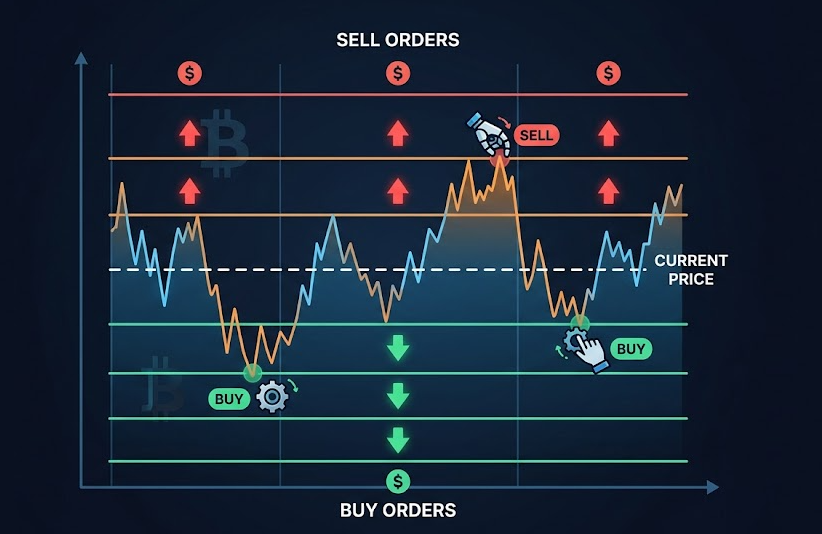
Grid trading is an order-placement strategy whereby multiple buy and sell orders are placed at equal spacing above and below the current market price. Grid trading establishes a grid of trades that capture price fluctuations. As an example, once you place a buy order at a specific price and it gets filled, your trading bot will immediately place a sell order at the next price level on your grid.
How Grid Orders Work
The grids work automatically to create limit orders based on market prices and when price changes occur. This is typically considered an automated way of executing the buy-low, sell-high strategies in a loop. With crypto futures, you would have the buying options to go long or short based on the direction of the market as anticipated by you.
Best Markets for Grid Trading
Grid trading strategies will do best when the market is trading within a range, while many other types of profitable trading strategies will struggle during consolidation. Market volatility means there can be a lot of price movements in the markets without any real long term direction in price. This type of market is the best kind for grid trading (an example of range trading) since you can use the volatility in the market to create income.
Making Money from Price Movement
When a price crosses a grid price level, a trade gets executed. This type of high frequency trading logic allows you to take advantage of the price movement to create incremental gains that accumulate over time without having to predict where the price will be in the future.
Grid Trading Math
Finding the Right Price Range
The effectiveness of grid trading largely depends on correctly setting the upper and lower control limits for the grid. If the price goes outside of the upper or lower limit, the entire grid will close or become inactive. Using technical analysis can help you to find the historical range of a security and therefore set the appropriate grid limits. Common indicators used to determine the historical range of price movement include Bollinger Bands or Average True Range (ATR).
Finding the Grid Density and Grid Intervals
Grid density is defined as the number of price levels within your defined price range. The smaller your next grid interval, the greater the frequency of trade execution; however, it is also likely to have a smaller average profit per order executed. Conversely, when using a larger grid interval, you will execute fewer trades but likely make a much larger average profit per execution. Achieving the proper balance between the number of executions and the average profits over the course of time of execution is the main goal of a professional trader.
Balancing Trade Execution Frequency and Average Profit Per Execution
Traders must analyze the minimum price movement per execution necessary to recover commissions and/or fees for trade execution to make an informed trading decision. To effectively use grid trading, traders must create a grid trading setup with a high volume of transactions while ensuring that the profit earned from each grid level is significantly greater than the exchange commission incurred on transactions.
How To Setup Your First Grid Trading Bot
First Step - Selecting The Correct Contract
While you're trading cryptocurrencies, there are two ways you can go about doing this using the grid trading platform: you can either trade on the spot market or use futures contracts. If you use your own money to purchase the cryptocurrency on the spot market, this is known as a ‘spot grid’, whereas if you’re able to trade with margin (leverage), you would be considered to be trading on a futures contract.
The most important factor when choosing a cryptocurrency pair to trade is to find a market that has sufficient liquidity to ensure that your trade can be filled at a reasonable price. In addition, you should also ensure that the market is volatile but remains within a range.
Second Step - Isolated Vs. Cross Margin
In futures trading, it is critical to apply proper risk management principles. If you open up a position using isolated margin, then you can only lose the amount of your investment; however, if you trade with a margin using your entire account balance, you could potentially experience huge losses.
Therefore, if you are using grid trading as your trading strategy, it is advisable to use isolated margin in order to minimize large losses across your entire account if there is a dramatic decline in price.
Third Step - Setting Appropriate Leverage Levels
Using grid trading can lead to excessive risk if you have excessive risk as a result of using too much leverage in your strategy. Since the grid trading bot continuously adds positions as the market moves against your position, you could easily incur massive losses if you use too much leverage. Proper risk management suggests not to use excessive leverage; especially when trading in a trending market.
Fourth Step - Grid Trading Configuration & Optimization
If you intend to use the arithmetic grid, each order will be placed with the same distance between orders; e.g., $50 in between each order; if you use the geometric grid, then each order will be placed at a fixed percentage apart from one another; e.g., every 1%. Geometric grids are generally designed to accommodate a wider spectrum of movement through compounding characteristics of the price movements.
Initial Margin Requirement Calculations and Requirements of a Trader
If a trader intends to utilize a grid that is fairly dense, it is possible that they will need a substantial amount of capital to cover all of their limit orders. Most types of grid trading bots usually display what is known as the "Initial Margin" that is going to be required to activate the grid before it's opened. It is critical that you have enough data available in the market to support your management strategy.
Advanced Features of Grid Trading
Utilization of Trigger Prices and Implementing Stop Losses for Protection
You may choose to activate the grid bot in advance of getting the order filled at the market price by using a trigger price that would only activate the bot when your specified conditions are met in the market place. The utilization of stops is another function that you will want to implement so that if your market conditions indicate that you are entering a reversal with the price moving outside of the grid range, this will protect you from further potential losses by having your grid execute the stop order that is set to trigger.
Benefits of Grid Trading and Risks
- Grid trading eliminates the need for directional forecasting, allowing you to take advantage of price movements across various price levels as opposed to lower price levels.
- You will have a much lower cost associated with the execution of your limit order because when you place a limit order you have just become a liquidity provider and therefore you will generally incur the lower "maker" fees.
- It provides a systematic approach to trading and eliminates many emotional trader errors as well as the need to constantly monitor your position.
Grid trading, however, presents its own type of risk. If the market is trending outside of the grid program, the price can run away from you, leaving you positioned at a significant loss on the next grid order. Market news can create sudden price increases and/or price decreases that make it difficult to follow a predetermined trading strategy or cause significant losses if you do not follow a proper risk management strategy.
The Bottom Line
Using grid trading for cryptocurrency will give you a means of automating your range trading and taking advantage of volatility. By understanding how grid trading functions and carefully calibrating your grid with appropriate levels of leverage and price range, you can develop a consistent automated trading system. However, you must understand that appropriate risk management is key to being profitable over time in the crypto markets.
Frequently Asked Questions
How well does grid trading perform in trending vs. ranging cryptocurrency markets?
Grid trading works best in a ranging (sideways) market where the price is moving up and down between predetermined price levels. When in a strongly trending market, the grid trader could end up "holding the bag" or getting liquidated if the price moves too far in one direction without retracing back towards the other side of the grid.
What is the minimum amount of capital that I need to effectively implement a grid trading strategy?
The answer to this question is driven by the number of levels you have in your grid and the minimum order size of the exchange. Generally speaking, you will want to have between $100 and $500 in order to create an effective grid with sufficient levels to produce positive results.
How can I adjust my grid parameters to take into account the risk of extreme volatility?
When there is extreme volatility in the market, it would be prudent to increase your grid's price range and lower your leverage in order to avoid being shut out by temporary pricing spikes.
What is the tax implication of grid trading?
Because a grid trading bot will place hundreds of buy and sell orders, there are a large number of taxable events that will occur. Therefore, it would be very beneficial to utilize crypto tax software that can record your tax obligations.
How do grid strategies perform with various trading pairs?
Major trading pairs such as BTC/USDT are more stable and best suited for the classic grid strategy. On the other hand, trading altcoins will provide much more volatility and larger profit potential, but can also expose the trader to a much greater risk of "crashing" through the lower end of the grid.
Want to learn more about crypto arbitrage?
Get a subscription and access the best tool on the market for arbitrage on Spot, Futures, CEX, and DEX exchanges.

You might be interested
Dollar Cost Averaging (DCA)

Crypto Arbitrage Trading

Cryptocurrency Order Books
