


Solana MEV in 2026: The Retail Arbitrageur's Survival Guide


with ArbitrageScanner!
On a monthly basis, Solana generates approximately $45M in "MEV" (Maximal Extractable Value), significantly less than Ethereum which generates approximately $180M; however, Solana's MEV is growing very quickly. There is currently approximately 22% of all validator rewards (i.e., rewards paid out to Solana validators) distributed via "Jito Bundles," and there continues to be a high prevalence of "sandwich attacks" being used for DEX (decentralized exchange) swap transactions. To retail arbitrageurs (e.g., individuals who are seeking to benefit from price discrepancies between centralized and decentralized exchanges) making CEX-to-DEX (i.e., price difference between a Centralized Exchange to a DECENTRALIZED Exchange) trades via Raydium, Orca, or Meteora, the real concern is not only that MEV Bots will see an individual’s transaction; rather, it is whether the individual is providing an MEV bot with anything of value.
In 2026, this guide overviews the current "live" view of the MEV landscape on Solana in June of 2026; outlines the types of defenses that are operational (e.g., Jito tips, usage of private RPC (remote procedure call) routes, setting of non "theoretically" defined slippage limits); and identifies remaining opportunities for individuals to still extract value prior to the closing of their sandwiches.
What is Happening on Solana in 2026? & Substantial Changes:
The Solana MEV picture has made radical changes over the last 18 months; three key structural MEV changes include:
- Jito Labs is operating the predominant Block Engine for Solana; validators are currently auctioning their transaction inclusion to Jito via a tip mechanism; the "searchers" (i.e., the bot operators that compete to hunt for the MEV value of a transaction) are paying Jito tips to be successful in getting their desired transaction placement for their transaction.
- Solana Has A Base of Consolidated Validators with "MEV Aware" Infrastructure. Users may still send Vanilla TPU (Transaction Processing Unit) transactions to the Solana network but are going to receive a much lower priority to that transaction in congested environments.
- The majority of the category of MEV is comprised of "sandwich attacks" (which is how MEV Bots typically obtain their value); the next category of MEV is "arbitrage" (which is a beneficial form of MEV since it is eliminating price difference) – and the final category of MEV is comprised of liquidated transactions.
The honest assessment of the Solana MEV market is that it is “sophisticated” and “well-capitalized.” If an individual makes a $10,000.00+ swap execution in a Raydium pool with "default" slippage values while utilizing a "public" RPC, an individual WILL be subject to a “sandwiched” target execution. The main concern now is how individuals can conduct their business in this type of market environment.
How Sandwich Attacks Work in Practice on Solana
A sandwich consists of three transaction types that occur in the same block:
- The purchasing transaction that the bot creates prior to your swap in order to increase the pool’s price
- Your swap transaction, which will now be executed at a worse price due to the bot’s purchase between your transaction
- The bot's sold transaction where they use the price increase you made at the pool and dump their tokens into the pool; they then capture the difference between the bot's sell price and your swap price.
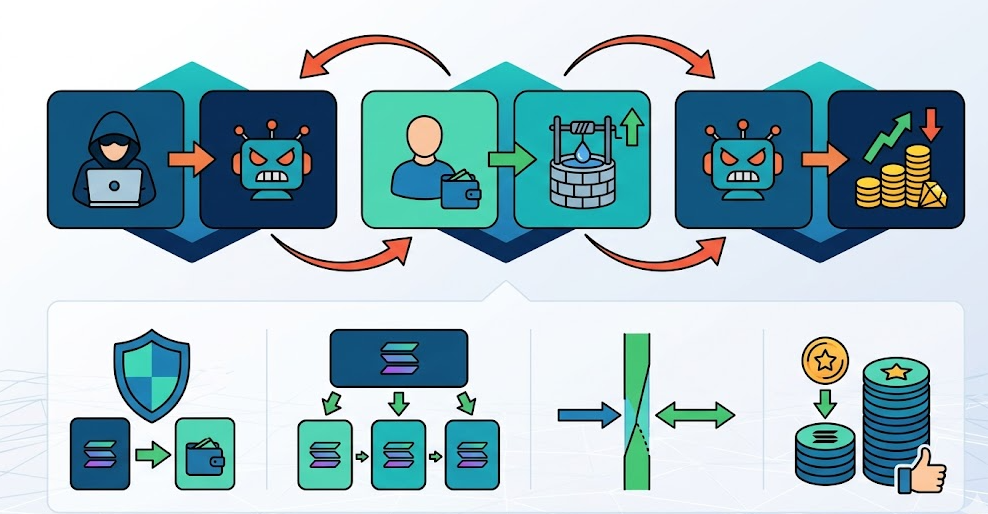
On Ethereum, bot operators have upfront visibility to the public mempool; on Solana, there is no public or shared mempool; however, Jito's block creation engine effectively acts as a private auction where searchers are able to submit bundles (in groups) to the auction. RPC providers are also able to leak transactions from the mempool to searchers.
Defensive Measures against Sandwich Attacks Include:
- Using a Jito-aware RPC provider (Helius, Triton or Public Jito RPCs) - Helius, Triton and Public Jito RPCs route transactions through the bundle auction, thus preventing naive front-running of transactions that were submitted to the public mempool. Either, your transaction is included in a bundle without adversarial participants or your transaction is not included in a bundle at all.
- Using tight slippage limits - Default Raydium slippage is 0.50%, which makes the user a target for sandwich transactions. For large pools of liquidity, your slippage should be set to 0.10% to 0.20%. For smaller pools of liquidity, there is a much smaller pool of liquidity, thus you would want to reduce the order size, not increase the slippage.
- Splitting large order quantities into smaller orders - If you create a single large $50,000 order, you have effectively created a target for a sandwich. If you do ten $5,000 orders split evenly over a 4-minute period, it is much more difficult for anyone to recognize and create a sandwich attack using the previous example in which they identified a target order at midnight.
- Adding a small Jito tip - If you add a Jito tip of 0.001 SOL (~$0.20), then you will get preferential inclusion of your transaction to the block without bidding against experienced searchers. While this is not a guarantee, it still raises the bar.
Where Retail Arbitrageurs Will Still be Able to Find an Edge
Even with the considerations provided above, retail arbitrageurs can continue to capture value provided by Solana DEX-CEX arbitrage. There are three separate zones where opportunity exists concurrently:
- Raydium and Pump.fun listings that are newly listed are opportunities for many people to take advantage of. When a new memecoin goes from Pump.fun to Raydium, the CEX will pick it up within 6 hours to 72 hours. When the CEX picks up the memecoin, you are able to get 3-12% DEX-CEX spread, due to volume-based moving parts. MEV Bots target the swap within the spread, but if you are moving inventory between the two different venues, you are not in the original attack vector; you are outside their original target area.
- Cross-chain arbitrage with a Solana ending point has become very relevant, as you can purchase from ETH or Base and bridge to Solana via Wormhole or Allbridge and then sell your asset on a CEX for Solana. During the bridging process, you will not have any MEV associated with the ETH or Base transaction because that occurs outside of the block related to the Solana transaction, you will only have MEV associated with the swap performed on the CEX Solana, during the CEX transaction.
- You can take advantage of funding arbitrage with the use of perps in Solana. To calculate funding rates of Drift, Zeta, and Hyperliquid with regards to the other CEX perps, you will need to identify that the funding leg is an actual position not a transaction, therefore MEV does not apply.
- Stablecoin de-pegging / re-pegging events are very relevant, especially when a USDC or USDT moves off-peg (30-50 basis points) in connection with a Solana pool. The fact that the asset is liquid allows the spread from the CEX to be relatively tight when entering the position.
The Truth is That Retail Cannot Compete With What I Just Said:
An example of that would be a DEX-to-DEX atomic Solana arbitrage between Raydium, Orca, and Meteora in a single block. This opportunity will be executed/captured/claimed in real time by searchers with custom infrastructure and direct relationships with validators. Retail's latency makes it impossible to compete with doing this on a retail basis.
Liquidation cascades on the Solana ecosystem occur with regards to the lending protocols (Kamino, MarginFi, Solend). In connection with this, as a condition of being liquidated, multiple bots will be competing to claim one specific transaction in that particular slot. Retail cannot compete with Jito's competitive tipping for winning entrants into Jito contests.
Bots run the show on pre-launch token sniping (Raydium only) by monitoring the blockchain for pool creation events that they can trigger at lightning speed. Retail cannot keep up with the speed of execution from web wallets.
Retailers need to look outside of these “normal” zones to find good opportunities using either:
- A better information advantage (e.g., which Centralized Exchange (CEX) will be listing this Raydium token soon?)
- Greater capital efficiency (e.g., cross-chain inventory, funding from multiple venues) compared to latency (increased execution time from retail wallets).
Key Tools for Arbitraging on Solana
Because Solana arbitrage requires special tools beyond any other chain, below is a list of the necessary tools for successful arbitraging on Solana:
- Private or semi-private RPC (e.g., Helius and Triton) as free public RPCs are not a viable option due to leaking transactions and leading to delays due to congestion.
- A real-time monitoring scanner that will compare prices on Solana DEXs (Raydium, Orca, Meteora, Phoenix) with prices on centralized exchanges (CEX) and issue buy/sell signals based on price discrepancies. Monitoring pools manually (even 20+) is not possible; therefore, a DEX scanner covering a minimum of 25 DEXs across 40+ chains, including Solana, with updates every second is needed. ArbitrageScanner's DEX scanner covers this need.
- An analytics tool for wallet activity. Because Solana wallets are public, it is possible to see which addresses are accumulating tokens (pre-listing) before they are listed on CEXs 24 hours later. ArbitrageScanner's AI-based wallet analysis tool tracks 272 characteristics of wallet transactions (purchasing behavior) to identify wallets as a potential source of pre-listing accumulation signals on Solana.
- A scanner for Solana perpetual DEX funding rates (Drift and Zeta) that cover up to 30%-80% APR spreads (before fees) between DEXs and centralized venues. The perp screener contains this information.
- An alternative listing calendar -- the pump.fun daily listing calendar means that there are 100s of DEX graduates. Knowing which tokens will hit a Tier 1 CEX within 24 hours before their initial listing is how you establish your spread.
Example: BEAT on Raydium
In mid-May 2026, BEAT transitioned from Pump.fun to Raydium. It rose about 65% in the 24 hours leading up to its Bitget listing.
Before/After Listing
- -48 hours prior to the Bitget listing: BEAT was trading at $2.40 on Raydium. Whale wallets were accumulating in advance according to public Solana data.
- -24 hours before the deposit listing: The Bitget listing announcement was released while BEAT rallied to $3.80 on Raydium.
- -At Listing: The Bitget listing price was $4.20, while the Raydium pool was $4.05, establishing a spread of 3.7%
- -First 42 minutes post-listing: The spread increased to a peak of 4.8% with a rush of retail traders into Bitget, and the DEX side experienced insufficient trading volume as users didn’t trust the new token contract.
- -Post 42 minutes: Market makers began entering Bitget, causing the spread to drop to less than 1%.
If your retail arb desk had a pre-funded inventory of BEAT ($20,000) on Bitget, you could use the listing surge to sell into the $4.20 price while purchasing BEAT on Raydium at the peak of the spread to capture between 3 and 4% of gross profit. After consideration of Solana gas fees, withdrawal fees, and slippage, your actual net profit would be between 1.8 and 2.5%, for a total of $360-$500 in profit for approximately 50 minutes of focused work. This process can be done for each token listed by every listing.
You will need the following to capitalize on this strategy: (1) knowledge of the listing calendar, (2) pre-funded inventory on both exchanges, and (3) a scanner to capture and monitor spreads in real time. If you have done all of this you can spend most of your time in front of the charts and not have to make trades.
Risk Notes
- Chain halts on Solana are rare but do happen, which means that if you have DEX and CEX inventory split, you will not be able to rebalance when a chain halt does occur.
- Bridges used for cross-chain trades like Wormhole, Allbridge, and Mayan have had issues in the past. You should not keep too much of your capital on the bridge side, as you probably will not get it back if one of those bridges halts.
- The Raydium DEX has many tests to prove that their contracts work, however, new DEX pools that are running on Raydium's CPMM and by random deployers have not been tested. Always check to see who owns the pool before you pre-fund it.
- The ESMA 2025 classification of sandwich attacks as potential market abuse is a good warning. Running a sandwich bot is different than running an arbitrage bot. Regulators are starting to differentiate between the two.
FAQ
In 2026 will Solana DEX arbitrage trades be worth doing for retail?
Yes, cross-venue (DEX to CEX, cross-chain) will make money for you. No, pure intra-DEX atomic arbitrage will not be profitable. The line is where you are competing with latency (losing) or with information or capital efficiency (winning).
What do I need to get started?
About $10,000-$15,000 of working capital, which will create a "break-even point" after taking into account your gas, slippage, and CEX fees. Under that amount your fee drag will inhibit your ability to be profitable.
Do I need to run my own validator or node to trade?
No, you can use a paid RPC such as Helius, Triton, Quicknode. The need for someone to run the infrastructure for a searcher that works for atomic MEV and not someone that works for an arbitrageur that trades between venues.
Realistically, how much net monthly income can I earn with $50,000 of capital?
The realistic net income for a well-executed Solana arbitrage strategy (listing arb + funding arb + sporadic cross-chain) is 3%-7% per month on a capital of $50,000. Anything more than that entails a certain degree of directional risk.
How do I avoid being on the bad side of a sandwich?
You can have minimal slippage (0.1%-0.2% on liquid pools), you can use Jito-aware RPCs, you can split orders, and you can use small Jito tips in your order, however, you are not guaranteed these will work absolutely – they do reduce your chances of being on the bad side of the sandwich.
You can try the ArbitrageScanner for free for one day – solana DEX scanner, CEX perp scanner, AI analysis of your wallet based on 272 criteria, and an idea for the next listing.
IMPORTANT! We are software developers and have no way of letting you know what to invest in or guaranteeing how much money you will make, also all of our software is 100% manual, therefore, you will have control of all of your funds at all times. We may give you examples of how our clients have made money on arbitrage in the past, but we do not suggest that you repeat their processes one-to-one. Your earnings depend only on your actions and market conditions.
Want to learn more about crypto arbitrage?
Get a subscription and access the best tool on the market for arbitrage on Spot, Futures, CEX, and DEX exchanges.

You might be interested
Memecoin Listing Arbitrage: The DEX-to-CEX Spread Playbook for June 2026
HYPE Funding Rate Arbitrage: Capturing the Hyperliquid vs Binance Spread in June 2026
CLARITY Act and Ethereum ePBS: What US Arbitrage Flows Look Like in H2 2026
