


Delisting Risk in Crypto Arbitrage: How to Spot a Coin About to Be Removed Before You Get Stuck

with ArbitrageScanner!
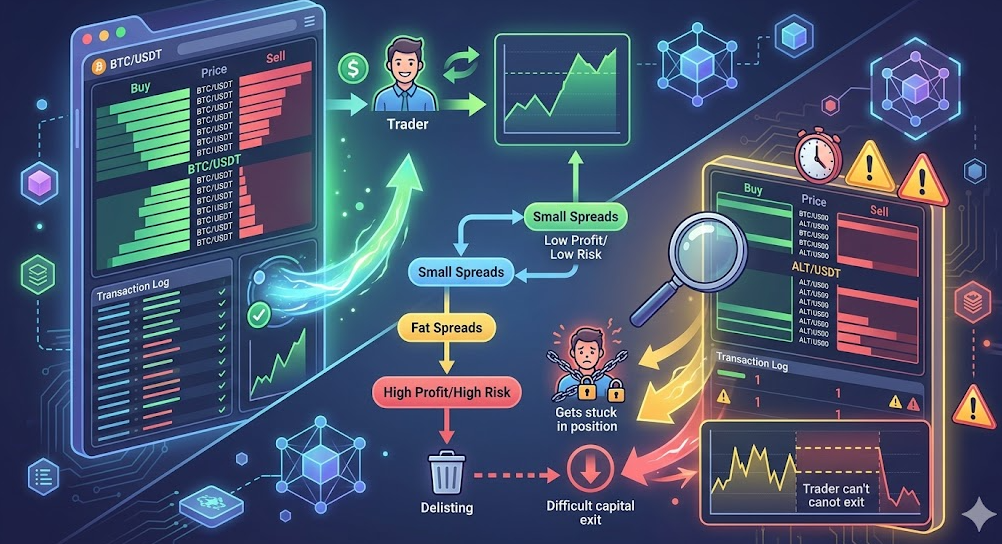
When a coin is no longer traded it is most likely because liquidity has failed to meet the minimum requirements necessary for continued trading (low volume, wide spreads, thin order books). Those are also the types of pairs that many arbitrage traders will be looking at for spreads to trade so the spread you are trying to trade could lead to you being stuck in a position where you can't exit. In the days leading up to a delisting notice, be aware of volume declining, spreads widening, and order book depth shrinking and ensure that you have verified that you can get out of the position before you take a larger position.
For example, in mid-June 2026, Gate.io suddenly announced the delisting of 33 altcoins along with the pairs to USDT after reviewing the platform and finding that the altcoins did not meet exchange requirements for continued trading. While that may not be a monumental, embarrassing moment for many traders, as an arbitrage trader it signals to you that the type of pair you are trading could be facing the same fate as those 33 coins.
The harsh realization is that the same wide spread that allows you to make a profit from small-cap arbitrage and the liquidity failures that result in a coin being delisted are the same events that happen from different perspectives. Most of the best CEX-CEX and CEX-DEX spreads can typically be found within the long tail of low-liquidity coins. Low-liquidity coins are typically the ones that a review committee at an exchange uses to identify which coins should be delisted from the exchange. The better you are at identifying opportunities to take advantage of fat spreads, the more likely it is that you will identify coins that are at risk of being removed from trading.
This article will include details about how to avoid getting stuck in a position after a delisting occurs. We will cover why coins are delisted, ways that you can identify coins are at risk of delisting, a checklist for trading before a delisting occurs, and how to respond after a delisting occurs when you have a position.
Why do exchanges remove coins from their platforms (considering the very real possibility that these coins can again be listed on the same exchange at some time in the future)?
Generally, when an exchange issues a delisting, the official language will often indicate the following — "This project no longer meets our standards for listing." By stripping away the language and getting down to the underlying causes for a delisting, there is often a similar line of causation:
- Volume is too low or declining — The amount of activity generated by a currency pair is inadequate to justify the exchange's operational and compliance costs.
- Very large gaps between bid and ask prices — When the gap between the best bid and best ask price remains very large, this indicates that no one is making active markets at the moment.
- Very sparse trading activity on order books — An order book that resembles a staircase missing most of its steps indicates that even a small order will have a significant influence on the price of the currency.
- Volatile liquidity — Liquidity that frequently disappears and reappears indicates either a market maker that has ceased interest in making markets or a particular project whose tokenomics are stalled and unable to generate liquidity.
- Problems with the project itself — Abandoned development, hacking incidents, regulatory pressure, and removal of support by the exchange for contract migrations can all cause a coin to be delisted.
The first four reasons are attributed to a failure of liquidity and can be identified well in advance. This is good news for an astute arbitrageur — a delisting is seldom sudden or unexpected. Rather, it results from a long-term downward trend that leaves behind a footprint on the order book and the volume chart, which can be seen by anyone who cares to look.
Structural risk occurs when liquidity does not remain constant, until it suddenly ceases to exist at the time of the announcement. Rather, it continues to diminish in the few days prior to the delisting, while also accelerating in the days following the announcement, due to market-makers exiting the market and other traders rushing to exit. Arbitrage strategies that entail manually closing positions quickly do not work well when the market already knows that you’ll be closing a position. Therefore, if you are trying to manually close an arbitrage position using a thin price for that closing price, it will become increasingly more expensive as time advances from when you received your initial notification.
The early warning signs
The issues listed below will not assure you that your position is going to be closed successfully; they are meant to serve as a risk assessment for the cumulative risk involved in executing the arbitrage strategy over time.
The list of issues is shown in the table below; you should review them prior to opening a new arbitrage position and at least intermittently throughout each position when it is open.
| Warning sign | What to look for | Why it matters for arbitrage |
|---|---|---|
| Volume decay | 7-day and 30-day volume trending down on one or both exchanges | Falling volume is the single most common precursor to an unsettling review |
| Widening spread | The "normal" spread for the pair keeps getting wider week over week | A widening spread due to flighty liquidity could quickly become detrimental |
| Shrinking book depth | Less size resting within 1-2% of mid-price | You may get in fine and find there is nothing against which to trade on the way out |
| One-sided books | Bids or asks consistently missing on one side | Signals a single market maker pulling back; the exit you are counting on may not exist |
| Listing only on minor venues | The coin trades on few, mostly smaller exchanges | Concentration risk: if one venue delists, the price can collapse with nowhere to route |
| Stale or migrating contract | Token contract changes, bridge issues, or paused deposits/withdrawals | Frozen transfers make CEX-DEX and cross-exchange arbitration impossible to settle |
| Deposit/withdrawal pauses | "Temporarily suspended" notices on the asset | Often the first concrete public step before a full delisting |
| Project silence | No releases, social activity, or roadmap progress for months | Exchanges weigh project health heavily in periodic reviews |
That red flag that squares many of the above-mentioned concerning signs is when declining volume, a widening spread rather than a tightening one, and depth that gets thinner every week hits an exceedingly traded coin. The aforementioned will warn the market that sellers and buyers are going to be heading for the exit. When the market's gone against you in the next 30 minutes, there will be many sellers that did this in the preceding 30 minutes who are now saying "I'm going to just switch this cash to an illiquid pair too".
A pre-trade checklist for small-cap arbitrage
This means that an arbitrage trader needs to do the above pre-trade checklist whenever they are about to take a position in a pair with an illiquid leg before making a decision to act on that trade.
- Verify each leg can genuinely move: Both custody accounts on every exchange are open to process deposits and withdrawals into both legs; otherwise, transferring cross-exchange arbitrage will become a one way trade (spending more than your initially planned leg).
- Before you execute your entry: Exit check that the exchange you intend on selling into has an adequate amount of liquidity available at an acceptable amount of slippage. If you're unable to sell your intended size for an acceptable amount of slippage at this location, then you're trading into a theoretical spread.
- Determine the reason for the spread's gap: Is the gap between your two legs' prices due to a real dislocation within the last several minutes, or are both of your legs simply experiencing significant reductions in liquidity over the past several days?
- Search the exchange's announcement page: For all public notices regarding the assets you are considering trading. The two types of announcements you will find printed on these pages that are important for your investigation are delisting and suspension announcements. Avoid massively incurring losses by spending just a few minutes verifying both legs are still viable trades.
- Always assess whether or not you'll close your exit: At a price lower than you opened — if so, then do you still believe you're capable of closing your exit position in the pair. If your legs will only be trading well within their respective quoted bid/ask prices, then there will be additional risk of your legs delisting as well.
- Establish a specific time/delivery period: You expect to remain exposed to that spread. Based on average increases in the frequency and number of trades per second that a thin/narrow pair experiences during longer time frames, you'll want to create/calculate how likely it is that you'll have realized your price spread within the predetermined time delivery period before entering into that position. Determine ahead of time how long you'll put up with the risk of exposure to the market.
- Be considerate to respect limitations in position size relative to the available depth: A quick way to check if your size is acceptable compared to book depth is whether you could unwind it without moving the market.
What You Can Do When a Notice of Delisting Comes and You're Long
Most exchanges have a period between when they announce the delisting and when it occurs. A common occurrence is that there will be a separate, later date by which you must remove the asset that you currently hold from the delisting exchange to access those funds. It's critical to read the delisting notice carefully and have a plan for how to proceed.
- Prefer to exit rather than for the perfect price. After the announcement, liquidity will leave with remarkable speed. The early hours generally have the best remaining depth. Even a trade that returns less than you are willing to accept is often better than chasing an order to buy an asset that you needed to exit but couldn't and is unavailable at a return.
- Verify that all legs of your trade can still be settled (i.e., all withdrawals are still open) before attempting to sell on a different exchange than the delisting exchange, this could provide you more opportunities for an exit than wait for the withdrawal.
- If your previous long position on exchange has been completely wiped out, then you need to consider how to manage your future holdings (asset), and not your past trades (transaction). Once your position's on-exchange liquidity has vanished, you'll need to do one of the following: transfer your token into self-custody before the withdrawal deadline, or accept utilizing whatever remaining residual liquidity there is. If you miss the withdrawal deadline, you may no longer have access to your asset.
- Provide documentation of the incident. A basic postmortem of the warning signs present before the event will help you improve your checklist next time you find yourself in the situation of receiving an unusual or unexpected notice.
How to Use a Screener to Identify Liquidity Drainage
Monitoring liquidity drainage across multiple trading pairs and exchanges can be very difficult. You cannot look at multiple exchanges or dozens of trading pairs and manually assess any volume decrease in each trading pair, with varying levels of market depth. The right tools are therefore critical at this point in the process.
When you use a screener that provides extensive coverage across multiple exchanges, you can look at the same trading pair on multiple exchanges at the same time. Thus, if the spread on one exchange is showing increased widening as a result of a liquidity exit from the market, and it is significantly different from the "average" spread of the trading pair on other exchanges with larger amounts of liquidity, this indicates to you that the trading pair may be disconnected from the other exchanges.
Additionally, a spread history chart is extremely helpful. You cannot determine if the 4% spread you see on a trading pair is a result of stable price behavior or whether it is increasing in size due to market selloff. If the 4% spread has been stable for multiple weeks, it indicates that you may have a trading opportunity, whereas if the 4% spread is increasing, then you are probably trading a trading pair that the market is no longer supporting, and which will likely end up on a delisting list. Being able to retrospectively evaluate trading pairs is how you know whether you should invest capital or not.
Our resources available
If you trade in the long tail of low liquidity pairs, there are a few items available in our ecosystem which map straight onto the above risks.
- Our arbitrage screener displays 80+ CEX and 25+ DEX with up-to-the-second updates along with a spread history chart that enables you to determine if a spread is either a legit dislocation or the slow decay of liquidity.
- Our DEX scanner provides the same visibility over the on-chain side of liquidity which is important when a CEX leg has gone unreliable and you need to view the DEX leg pertaining to your cross-venue trade.
- Our supported exchanges overview allows you to view where a given asset continues to trade with real depth, and where it has thinned to a single precarious venue.
Would you like to see if your own checklist holds up to actual data? Start a trial through our Telegram bot or check out our plans.
Q&A
What kind of notice do you typically get from when a coin gets delisted?
Every exchange will give notice in their own way, with most having two different types of notices: One typically with the last day an asset can be traded and a second which is usually a later date when the underlying asset can be withdrawn from that exchange.
Can I profit arbitraging a coin that has been delisted?
Sometimes, but your risk profile is drastically changed. Typically when an announcement is made, liquidity drains quickly, slippage tends to increase after the announcement, and, if it appears there is a paper gain when you sell, there is a good chance you will lose that paper gain when you go to sell. With that said, you should expect to close your position before attempting to capture any additional basis points outside of that.
Why do arbitrageurs get hit the hardest with delisting on the exact pairs they want?
Spreads tend to be widest in trades with long-tail, low liquidity currency pairs, with low liquidity being the primary reason an exchange would de-list a coin. Thus, it follows that the most profitable-looking spreads with the greatest risk of de-listing typically have significant overlap.
So, what is the most reliable indication of what could lead to a de-listing?
The most reliable indicator will be sustained volume decline (combined with a widening of the spread). A widening spread means that liquidity is decreasing, and a widening spread will not snap back into a tight spread, which has historically been seen in the majority of coins that have been de-listed.
Should you withdraw the coin if you have no ability to liquidate the coin at the exchange?
If there is no liquidity available to sell your asset at the exchange and the withdrawal of funds is still an option, your best option would be to move the asset into self-storage or to a deeper market or another exchange prior to the withdrawal deadline, rather than miss the withdrawal deadline entirely and no longer have access to the asset at the exchange. Always confirm the actual deadline in the official announcement by the exchange.
Will having multiple exchanges for an asset effectively reduce the risk of a de-listing?
Having many exchanges does not guarantee you will not experience a de-listing, but it will allow for early identification of these events. You will be able to identify a situation where liquidity is increasingly concentrated on fewer exchanges as an early warning of an impending de-listing by monitoring the pairs across numerous exchanges.
Try ArbitrageScanner free for up to 1 day and get full access to the crypto arbitrage toolset — this includes the historical spread chart to differentiate between a true market dislocation versus a long term liquidity decline.
We are software developers, not financial advisers and therefore nothing provided by us should ever be considered as investment advice. ArbitrageScanner is a manual tool, it does not have any access via an API to your exchange accounts and therefore will never move your funds; you have total control of your funds as always. The risks associated with crypto arbitrage are significant and include risks of de-listing, slippage, and complete loss of capital. Also, the historical performance of any customer is no guarantee that your future performance will be the same. Always do your own research and only trade with capital that you can afford to lose.
Want to learn more about crypto arbitrage?
Get a subscription and access the best tool on the market for arbitrage on Spot, Futures, CEX, and DEX exchanges.

You might be interested
Negative Funding Rates Explained: How to Get Paid to Hold a Delta-Neutral Position

Reading Whale Wallets Before a Token Unlock: An On-Chain Pre-Unlock Checklist
Triangular Arbitrage Explained: Profiting from Price Gaps Within One Exchange
