


Negative Funding Rates Explained: How to Get Paid to Hold a Delta-Neutral Position

with ArbitrageScanner!
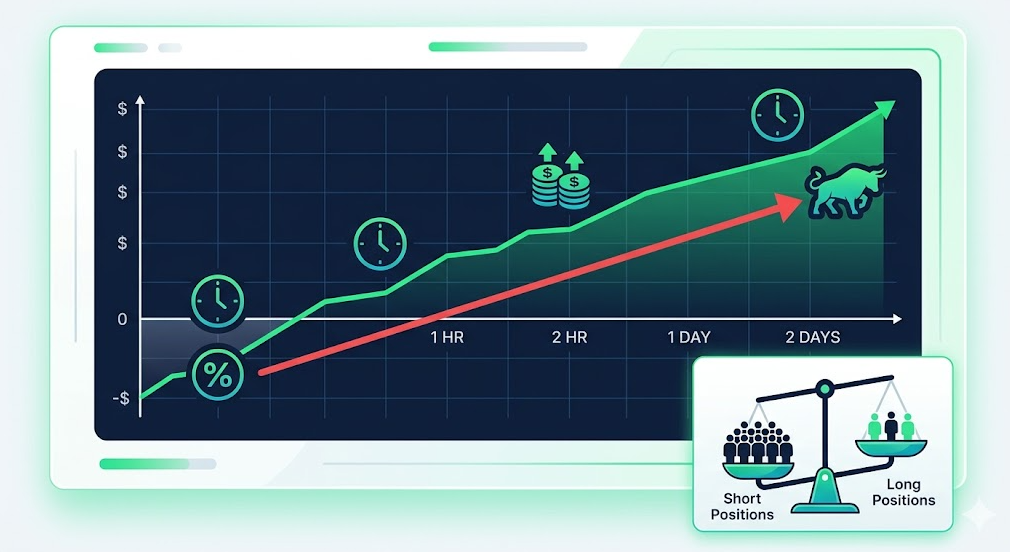
When the funding rate is negative, it means that shorts make payments to longs to help keep the perpetual price close to the spot. As a trader, you can take advantage of this payment by entering a long position in the perp and selling an equivalent amount of the underlying asset in the spot market in order to hedge against changes in price. This will allow you to earn a spread across the two funding rates, rather than speculating on the direction of the price change.
In June 2026 specifically, something kind of interesting happened on Hyperliquid - the funding rate for HYPE perps was negative around -0.014 percent per hour. Sentiment had turned bearish and open interest was declining (which normally leads to lots of short positions) and short positions were paying longs to continue their short positions. Therefore, for that short period of time, having a long HYPE perp position allowed you to receive payments each hour rather than make them.
This is contrary to the general expectation of how a funding rate works - generally speaking, "longs pay shorts in an upward trending market." However, funding rates can work two different ways, and the negative side provides a viable, well-understood, market neutral trade.
This article will break down the negative funding rate, explain why they happen, and explain a step-by-step process to execute a delta-neutral funding capture trade. To do this, we will annualize an actual hourly funding rate, go through a simple worked example, and then objectively assess the costs and risks associated with this trade to determine whether it is worthwhile. This is more of an educational walkthrough than it is an investment recommendation.
A quick primer: what is a funding rate?
To help clarify, here's a brief definition of funding rates as they relate to perpetual futures ("perps"). As stated above, perps have no expiration. A futures contract's price converges with the price of a physical commodity at the point of settlement; however, perpetual contracts don't have a settlement date, and, therefore, a different mechanism must be used by the exchange to correlate the price of a perpetual contract to the price of a commodity. That mechanism is funding.
Funding describes a periodic transfer of payment between the two types of traders in a perpetual contract; the long position and short position. It is intermediary to the exchange but is not a fee to be paid by the trader to the exchange. Instead, the exchange calculates the funding value and facilitates the transaction between the two accounts.
- When the perpetual trades at a higher price than the spot price (i.e., where long traders are more aggressive), the funding is said to be positive; thus, the long side pays the short.
- Conversely, when the perpetual trades at a lower price than the spot (i.e., where short traders are more aggressive), funding is negative; thus, the short side pays the long.
The funding rate consists of going forward and historical data. The forward funding rate is based on a premium pricing element influenced by the current difference between the price at which the perpetual contract is priced compared to the Oracle/Index price (which is an average of all actual trades), together with a very small fixed interest rate component. Hyperliquid measures and averages the premium component frequently throughout the hour. The funding is settled hourly, which means funding occurs eight times more often than traditional exchanges, which often settle once every eight hours. Generally, the funding rate varies between approximately -0.01% and +0.01% per hour; however, in extreme market conditions, the funding rate can be up to 4% per hour.
Some context: Over the majority of exchanges, the funding for Bitcoin (BTC) settles on average at +0.01% every eight hours; thus, this number by itself does not produce sufficient volume when reported (i.e., low/noise). Therefore, if the funding for a liquid alternative perpetual is consistently negative on an hourly basis, this is NOT noise (i.e., noise would have volume that would not follow an established pattern).
What a negative funding rate actually means
The definition of a negative funding is as follows: There are too many short traders in the market who are willing to pay for the privilege of being short. When the price of a perpetual swap (perp) is lower than the spot market price, sellers are willing to sell at these prices and most likely do so for more than one reason: to ensure that they have a fair price or that there is enough collateral backing the trade, to help support their trading strategy.
This happens during:
- A large move down in price (risk-off), when a high number of buyers have moved to the perp market and the sellers have not moved to the perp market.
- When open interest decreases, like the HYPE situation in June 2026; this is very similar to the way in which a trader would position themselves for a larger decline in an asset price (bearish) because of too many traders being positioned in one direction only.
- When traders agree to keep or enjoy the benefit of shorting at a high market rate on borrowed funds.
An important point to remember about being an owner of a long perp position during a period of negative funding is that you receive the benefit of the negative amount of interest paid to your long position on an hourly basis. Conversely, if you are an owner of a long naked perp position during a subsequent decrease in the perp market, you will not only have lost money on the purchase of the perp when the market continues to fall, but this decline in the perp market will also offset the funding income you receive from being a long owner of this same perp. Therefore, your options are limited on maintaining the funding benefit of being a long perp without taking a bet against the price of the perp.
The delta-neutral funding-capture trade, step by step
To hedge against both the risk of price changes (by holding both a long and short position) and the risk of losing funding from not being a long owner of perpetual contracts, a trader must set up the delta-neutral funding-capturing transaction as follows:
- Go long the perpetual. This is the leg that will allow them to earn a funding benefit until the market price increases.
- Open an offsetting short on the spot/underlying. Match the value (by borrowing and selling the same quantity of the underlying market) that is equal in value to the long perp position.
- Match the sizes. By creating offsets, it becomes impossible for either the long or short position to have any significant exposure to market movement. Align sizes such that the long perpetual and short spot offset each other. If HYPE increases, the perpetual will increase in value as the short will decrease in value by approximately the same amount and vice versa for HYPE decreases. Therefore, overall price P&L will be approximately 0.
- Collect the hourly funding that accrues on the long perpetual position hourly so long as the rate is negative.
- Monitor and unwind. Watch the rate to take off when it returns to positive or, when the cost of carrying the hedge exceeds the income derived from the hedge.
The older and more popular mechanism of receiving "positive funding" would be to go short perpetual for purposes of collecting the funding while holding a long spot position for hedging (classic cash-and-carry basis trade). The mechanics of these operations are symmetric; however, the negative funding side of the trade is less frequently discussed because it is operationally more difficult to go short or borrow the spot than to hold it.
Practical considerations:
- Hourly settlements are an inherent part of this trade. Therefore, with eight payments during the day, you can take advantage of short-lived price dislocations as they occur and still generate funding, rather than waiting for the market to settle over an extended period of time (the average wait time is around eight hours).
- Funding is path-independent and not based on the actual price after the hourly settlement, but the funding rate on a per hour basis can change. Therefore, you need to assume that the funding rate will remain negative long enough to cover the costs associated with executing this strategy.
- Both legs need collateral. There is collateral required to execute both legs of trade. Therefore in order to maximize your expected return over the long run, a capital-efficient solution is required.
A worked example: annualizing the rate
To give you some Eliot Spitzer-esque benchmark to use in determining whether this strategy will work, let's convert the hourly funding rate into an annualized indicator similar to how consumer finance companies use an APR for determining whether purchases qualify for financing. To determine the annualized amount for an hourly funding rate is quite simple; just multiply by 24 hours in a day and then by 365 days in a year, and you will get a nominal figure of what the annualized amount of the hourly rate is.
hourly rate × 24 hours × 365 days = nominal annualized rateIn the case of an hourly funding rate of -0.014%:
0.014% × 24 hours × 365 days = 122.6% nominal annualized amountA funding capture of ~122% annualized is why so much of the funding is captured and looked at; however, there are three main caveats to that amount:
- The above scenario would only happen if the -0.014%/hour funding rate (negative) stayed constant for an entire year when it will not; negative funding will only last hours or days, so you really will be looking at "what is the average for the days you hold the funding."
- The above number is a gross figure and does not take into account any fees that exist for both the trading of your position with maker (limit) and taker (market), as you pay a fee both ways (i.e., $0.0003 to enter and exit) and the cost to hedge your position.
- The above number is a gross figure across two legs of a trade as you will only earn capital in one leg of the trade. Therefore, the return on capital will always be lower than the return on notional.
As an example of what the gross figure means, if you were able to capture a -0.014% rate over, say, 48 hours, then you would have captured:
-0.014% × 48 = -0.672% over a 2-day period before you pay the above costs.Once you account for the above costs charged to you, you will be to determine if you will make money on your funding capture.
Costs and risks: what eats the spread
| Item | What it is | Why it matters |
|---|---|---|
| Maker/Taker Fees | Trading fees on both perpetual and cash at entry/exit (4 fills) | Round trip could equate to several hours of funding. Use maker (limit) fills where possible. |
| Cost to cover short | Financing/borrowing cost on the short | This is a large part of the negative funding side; borrow costs can be high for a falling alternative and may spike. |
| Rate flipping positive | Funding normative or inverse as you hold | You cease or switched to pay funding and are still incurring hedge costs while on both sides. |
| Liquidation risk | Price moves sharply enough to liquidate one side | You are naked and directional. Use moderate leverage and maintain reasonable margin buffers. |
| Slippage & spread | Execution costs at entry/exit | Typically higher on thin alternative books. Per order is small but multiple by four and any rebalancing. |
| Basis / tracking risk | Perp and spot prices not moving in lockstep | Due to sharp dislocation, you will have a temporary P&L to offset the funding that you will incur with your hedge. |
| Operational risk | Two venues, collateral pools and manual monitoring | Funding can flip in a couple of minutes and an unmonitored position will be an unhedged betting opportunity. |
In Summary - This trade is only attractive if the negative rate is large and continuous enough to offset the above with a reasonable margin to spare. A -0.014% / hr print will be very attractive; however, a -0.002% / hr print will probably not be attractive once you consider borrowing and fees associated with your position.
Finding these setups in the first place
Finding these set ups will be very fast and the limiting factor will be visibility. There are numerous negative funding occurrences on multiple exchanges and within different perps, that they can change rapidly, and you need to see them when they are occurring and monitor whether or not you can make a profit within the costs to be able to react to them.
It is a two-part math and monitoring problem: you need to have a funding rates monitor that checks multiple exchanges simultaneously to flag where there are funding rates with significant negatives (or positives), and you need a spread calculator that you will use to enter your transaction fees, leverage, and funding rate so that you can calculate the net profit before putting in your capital. You also need to have an established spread history chart to indicate if the negative rates are just short-term spikes, or if they represent a repeatable opportunity.
Our tools
The Arbitrage Scanner is a complete ecosystem of pro-level tools for crypto arbitrage and on-chain analysis, tracking 80+ centralized exchanges, 25+ decentralized exchanges, and 40+ blockchains with second-by-second updates. For the strategy in this article, the following three pages of tools are most relevant:
- Funding Rates Monitor — Track multiple exchanges funding rates in one view and find negative flips in funding rates.
- Futures Spread Calculator — Estimate the net profit of a funding capture trade using your transaction fees and leverage before you trade.
- Perpetual Futures Arbitrage Screener — Provide you with access to current perpetual-futures spreads and funding-driven opportunities, along with a corresponding spread-history chart, to assist in backtesting.
All the above tools associated with the Arbitrage Scanner are fully manual tools; they do not provide any API access to your exchange accounts and cannot move your funds. Signals are generated by surfacing information for you to make choices and put them into effect.
FAQ
How does a negative funding rate function?
A negative funding rate basically means that shorts pay longs. When the perpetual market is trading at a greater discount to the underlying asset than the risk-free rate, typically due to overcrowded shorts, the funding rate serves to redress this mispricing by providing an adjustment (sourced from the shorts) to the long position in order to pull the perp price back to the indexed value.
How do you receive money from negative funding?
You take a long position in perpetual contracts. As long as the funding rate remains negative, you will receive a payment for holding that position every period. To avoid holding an open position long and being exposed to price risk, you would equally hedge that long position by establishing a short position in the underlying or spot market, to leave your overall position delta-neutral and receive only the funding spread and not directionally based upon any delta change.
What is the annualization of the hourly funding rate?
To annualize an hourly funding rate, simply multiply the funding rate by 24 and then by 365. For example, if the hourly funding rate is negative (i.e., -0.014%/hour), multiplying it by 24, and then by 365 will yield a nominal annual figure of approximately 122% (this assumes that the funding rate would remain unchanged, which is unlikely, and does not account for any borrowing or hedging costs).
Is there any risk to capturing funding rates?
A properly hedged position will eliminate directional price risk, but still leaves you exposed to an increase in funding and to the cost to borrow/finance your hedge, to trading fees for all four legs of your trade, to liquidating one of your hedge legs if you are under-margined, and to the basis/tracking risk between the perp and the spot.
Why is the fact that Hyperliquid settles funding on an hourly basis significant?
Since Hyperliquid settles its funding on an hourly basis, payments accrue at a greater frequency than if they were settled on an 8-hourly cycle. Therefore, you can more easily monetize short-term negative funding windows since you don't have to hold through an extended settlement period to capture any profit.
How frequently does funding actually go negative?
With larger caps, such as BTC, negative funding is rare and generally small (e.g., funding usually floats to approximately +0.01% per 8 hours). However, with more volatile alt-perpetual futures, negative funding is much more common during risk-off capital flight and/or a decline in the open interest of the perpetual future (as was observed in the HYPE futures during June 2026). Therefore, the alt-perpetual futures are generally where this strategy operates on a regular basis.
Try ArbitrageScanner for one day free — gain access to the complete crypto arbitrage suite of tools, including funding rate monitor and spread calculator.
This piece is intended for educational use only, and is not financial, investment, or trading advice. ArbitrageScanner is a software development company, and does not manage any funds or provide advise. All of our tools are a manual screening and analysis tool, and do not provide any access to your own exchange accounts via API. You maintain complete control of your own funds throughout any trading activities. Crypto derivatives present a high risk of loss of all your capital; funding rates, spreads, and costs of borrow change frequently, and past performance does not guarantee future performance of a cryptographic asset. You should do your own due diligence on any trading activities and invest only capital that you can afford to lose.
Want to learn more about crypto arbitrage?
Get a subscription and access the best tool on the market for arbitrage on Spot, Futures, CEX, and DEX exchanges.

You might be interested

Reading Whale Wallets Before a Token Unlock: An On-Chain Pre-Unlock Checklist
Triangular Arbitrage Explained: Profiting from Price Gaps Within One Exchange
ENA Catalyst Rally: Reading On-Chain Signals Before the 20% Move
