


Essential Cryptocurrency Trading Tools: Complete Guide


with ArbitrageScanner!
In the rapidly changing landscape of digital assets, the tools you have at your disposal can be just as important as the strategy you use to trade. As we move through 2026, crypto has developed into a more advanced ecosystem where manual execution of trades will no longer allow you to compete. This comprehensive guide describes the different types of essential trading tools that will help manage your crypto portfolio, provide analysis of bitcoin price movements, and ultimately improve your chance of maximizing profits while trading.
Understanding Trading Tools
Purpose and Function
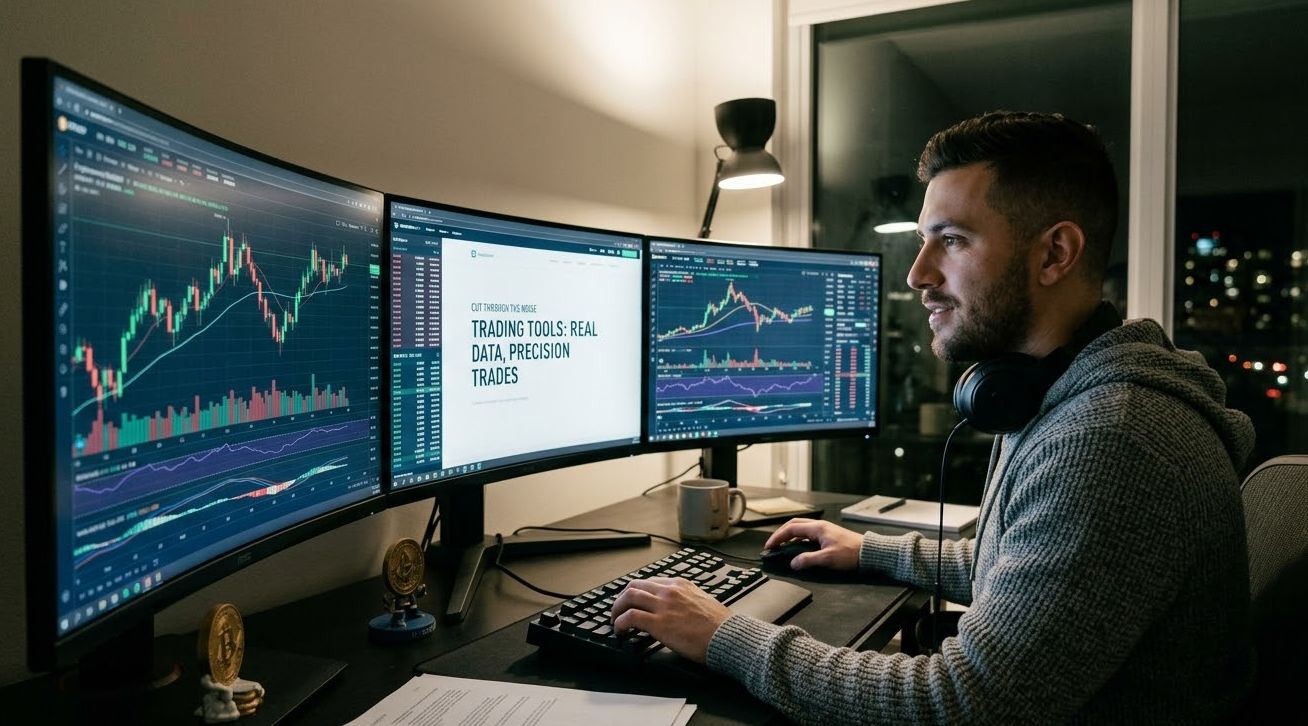
Trading tools provide traders the ability to cut through the noise of the cryptocurrency marketplace. The primary purpose of these tools is to automate the collection of data, present large volumes of complex market behavior, and to place trades with precision. Both novice and seasoned traders will find that these tools serve as a multiplier in terms of their ability to make trading decisions based upon real data instead of feelings.
Tool Categories
Modern traders utilize what is called a "stack" of software. This includes cryptocurrency exchanges used for executing trades, charting software for executing technical analysis, crypto tax calculators for compliance purposes, and trading bots for automation. Each of these types of tools helps create unique value within the overall lifecycle of trading and investing.
Selection Criteria
When choosing tools, the most important points to consider are security, latency, and trading fees. The best crypto tools should have robust API support, user-friendly desktop and mobile interfaces, and offer advanced features associated with trading and investing. Always confirm the tools will support all of the trade pair combinations you plan to use.
Implementation Approach
Do not overwhelm yourself trying to implement 10 new tools in one shot for your crypto-related objectives. When starting, choose a reputable crypto exchange and quality charting software. Set yourself up for success by starting with these two tools. As you become more experienced at trading you can start to use automated trading solutions and blockchain data to help refine your best trading strategies.
Integration Benefits
Integrated crypto tools allow for a seamless exchange of information across various platforms. For example, when connecting your cryptocurrency wallets with a portfolio management tool, all of your transactions that are made with cryptocurrencies will be seen in real-time. The holistic view of your transactions is one of the main differentiators between successful traders and those who have trouble keeping up with the ever-changing crypto market.
Portfolio Management Solutions
Tracking Capabilities
You must have a good cryptocurrency portfolio tracking tool to effectively manage your holdings. A good portfolio tracking tool will aggregate data from many popular exchanges and private wallets into one place, giving you the ability to determine your complete net worth from all of your holdings. This is particularly important for crypto investors who own a large variety of crypto assets on many different chains.
Performance Monitoring
Using the right tools enables you to evaluate your gains and losses over time and therefore helps with your historical trading analysis. In addition to allowing you to analyze your historical trading data, volume data, and performance data for various crypto projects will allow you to determine whether the crypto projects that are currently in your portfolio are either hurting you or benefiting you.
Asset Allocation
Measuring how all of your cryptocurrency assets are allocated correctly is essential to effectively manage your portfolio and tax obligations. Do you hold too much Bitcoin? Have you diversified enough across potential new cryptocurrencies? With tools such as Delta and CoinStats, you can visually measure your exposure to the cryptocurrency market.
Risk Assessment
Sophisticated crypto investors use risk assessment tools to calculate their "Value at Risk" (VaR). By understanding the volatility of your crypto assets, you can maintain appropriate stop-loss levels and manage margin positions without the risk of being liquidated.
Optimization Tools
To maintain your desired risk levels, you should rebalance your portfolio on a regular basis. It is possible to use advanced trading tools to help you automate the process of buying and selling in order to keep your allocation in line with your long-term trading plan. These tools often include many different features, but one of the main categories of functionality offered by most of these platforms is the ability to analyze market activity through technical indicators.
Market Analysis Platforms
Technical Analysis Tools
Technical analysis-based trading systems and strategies form the foundation of successful swing trading and day-trading systems and strategies. The charting and technical-analysis tools provided by platforms like TradingView are recognized around the world by both traders and investors as industry-best practice.
Charting Capabilities
The various charting functionalities that modern charting platforms will provide traders allow traders to perform multi-timeframe analysis and include the ability for traders to create their own technical indicators to trade with, and traders should make use of these capabilities to their full potential before entering or exiting trades. To properly target entry and exit positions, traders must have access to high-resolution charts and technical indicator signals.
Indicator Integration
Using technical indicators such as Moving Averages or the Relative Strength Index (RSI) allow all traders and investors to identify when a particular asset is in oversold or overbought territory. Software designed specifically to analyze cryptocurrency markets provides you with the ability to overlay technical indicators across the price action of any cryptocurrency.
Pattern Recognition
AI tools can automatically identify fixed patterns like Head and Shoulders, Bull Flags, etc. The ability for cryptocurrency traders to identify these patterns automatically will ultimately save them countless hours of searching manually for patterns across hundreds of crypto-currency pairs and help ensure that they will not miss out on potentially lucrative trading opportunities.
Trading Signals
Some of the best crypto trading tools on the market today now provide their users with access to the social-trade of the top-performing traders in their respective marketplaces as well as the ability to obtain trading signals from those traders. However, regardless of which trading signals you receive, you should always independently verify these signals yourself by performing your own analysis of the crypto market and only to produce your own analysis of the crypto market before establishing a commitment of capital to a trade.
Research and Intelligence Tools
Market Data Analysis
Market data analysis is essential for successful cryptocurrency trading. Traders should be able to gain an understanding of the trends and price movement of the assets that they are interested in trading by conducting market research. There are a lot of tools available for you to analyse the market data so that you can get a better insight into how healthy the crypto market is. An example of one of these tools is Messari or Glassnode.
Social Sentiment Tracking
The majority of people trading within the crypto space are heavily influenced by social sentiment. LunarCrush, for example, tracks the news surrounding crypto, Twitter (X) mentions of the crypto, and Reddit activity for different cryptocurrencies. This information is used to determine how much "hype" there is surrounding a particular cryptocurrency; this serves as a leading indicator to many crypto traders.
On-chain Metrics
Unlike traditional financial transactions where transactions go through a clearing house, with cryptocurrency transactions everything can be verified by looking at the blockchain. On-chain metrics enable all participants in crypto to see what large traders ("whales") are doing with their bitcoin, specifically if these large traders are moving their bitcoin to a cryptocurrency exchange (likely to sell) or moving them to their own wallets (likely to hold).
Project Evaluation
Before you decide to invest in a cryptocurrency long-term, it's important to do due diligence on the coin you're considering by researching the project through its white paper, how active its development team is (using GitHub) and their Tokenomics, as these three factors contribute to successful investing.
Trend Analysis
Knowing whether we are in a "DeFi Summer" or "AI Narrative" (whatever that may be) is crucial when trading. Using trend analysis tools will help you identify trend changes prior to their occurring; resulting in capturing trades in the same direction as the momentum of the market.
Trading Automation Platforms
Bot Functionality
By using a trading bot you are able to trade the crypto markets 24/7 without needing to be there. Whether you opt to use a simple grid bot or a complex algorithmic trading system, with automated trading you do not have to worry about losing a trade while you sleep; therefore, eliminating any emotional biases associated with trading.
Strategy Implementation
Bots operate with pre-defined trading rules established by the person trading; you can specify the parameters around when you want to trade (i.e., buying/selling) based on the technical analysis that you have established; therefore, resulting in consistent results when trading in volatile situations.
Risk Management
Trading bots can also help you manage all of your trading across multiple popular cryptocurrency exchanges all at the same time by placing trailing stop-loss orders to protect your profits when the price of bitcoin rises during an increasing price rally.
Performance Tracking
Most automated trading platforms keep detailed logs of trades that are executed (for the automated trading plan), which give you an insight into why one trade was executed, how not only how you were affected... but also how it will affect. Being able to see such detailed information from an automated trade is required for refining your trading strategy.
Optimization Features
Back-testing is a very strong optimization feature, whereby you can test your trading plan or trading strategy against 'past' data, thus allowing you to see whether or not your plan or strategy would have worked in the 'real-world' before you risk any of your own actual assets.
Essential Tool Categories
Analytics and Research
(e.g., Glassnode, Messari, Dune Analytics), to conduct analysis of current cryptocurrency market activities and evaluate on-chain (blockchain) metrics.
Trading and Execution
(i.e., use the largest cryptocurrency (Binance, Coinbase, Bybit) as well as any reputable trading platform with reliable trade execution (i.e., 3Commas, Altrady).
Portfolio and Tax Management
(e.g, CoinTracker, Koinly), will assist with calculating taxes associated with your cryptocurrency and gathering data necessary for monitoring millions of cryptocurrency investors around the world.
Implementation Strategy
Tool Selection
Use TradingView for charting and Koinly for calculating and reporting cryptocurrency tax. Select a cryptocurrency exchange to use based on volume. Use the exchange with the largest amount of volume possible to ensure you are able to execute at the lowest price and with the greatest amount of execution certainty (to minimize slippage).
Integration Process
Use API keys to connect to your exchange accounts securely (Read-Only or Trade-Only). Do not, under any circumstances, ever enable third-party trading tools to withdraw your funds from your exchange account. That is the only way to ensure maximum level of security possible.
Strategy Development
Developing a trading strategy requires you to integrate the indicators from both types of analysis (technical and fundamental) into a coherent and repeatable methodology for generating trade signals (buy and/or sell). If you are just getting started with cryptocurrencies and do not yet have any capital to invest, you may want to consider using Copy Trading. Copy Trading enables you to learn from the experiences of other successful traders without having to risk your own funds while increasing your potential returns.
Performance Monitoring
Performing weekly checks of your portfolio tracker against your trades will ensure that your strategy is generating consistent profits. If you have not been successful, it may indicate that it is time to either modify your existing strategy or find alternative methods for analyzing cryptocurrencies.
Optimization Methods
The tools used by the crypto industry will continue to evolve as the industry itself does. In 2026, be sure to regularly evaluate the costs associated with trading or crypto exchange services in order to maintain your "crypto trading arsenal".
Future Considerations
Tool Evolution
The evolution of tools will reshape the future of trading by continuing to include artificial intelligence with sophisticated market analytics capabilities. As the process of trading becomes more dynamic, traders must embrace the changes in technology to remain competitive in the ongoing development of the crypto ecosystem.
Market Adaptation
As the crypto ecosystem continues to evolve, there are going to be increasing numbers of tools that concentrate on developing DeFi capabilities and Cross-Chain Trading, while at the same time becoming less reliant on Centralized Exchanges for as many transactions as possible.
Technology Development
Greater access to advanced trading techniques and zero-knowledge proof-through technologies will provide retail crypto traders with increased access to sophisticated trading methodologies that deliver an even greater degree of privacy and security over their trades.
Integration Possibilities
The possibility of consolidating all aspects of research, execution, and tax reporting through one "All-Inclusive Platform" will provide convenience for traders who use multiple platforms for their trading activities.
Strategy Refinement
There is only one constant in the crypto market, and that is continuous improvement through learning. You may discover successful trading strategies through your experiences with other traders, but you must also be open to adapting those strategies to fit your unique risk tolerance and trading experiences.
Conclusion – The Bottom Line: To be a successful crypto trader by 2026, you need to have the right tools and have a disciplined approach to trading. Utilizing technical analysis tools, automated trading bots, and a robust portfolio management system will assist you in successfully trading cryptocurrencies, including, at a minimum, Bitcoin and other cryptocurrencies, without suffering through the volatility associated with them. In addition, the right trading tools will give you accurate data and provide you with clarity to succeed as a trader operating in an ever-changing and dynamic crypto ecosystem.
FAQs
How do you choose the right combination of tools?
You should focus on your trading style. If you are a beginning trader, you should look for a user-friendly trading platform and a portfolio management tool. If you are a more experienced trader, you should be looking into on-chain metrics and automated trading systems.
What security measures should traders consider?
Always use a Hardware Security Key (2FA) to access any crypto exchange where you have a cryptocurrency wallet, never share your API secret key, and always ensure that your wallets are not connected to trading platforms when you are not taking actions on them. You should always prioritize security and privacy of your trades.
How can tools improve trading performance?
By reducing human error in trading and providing 24/7 access to the markets, tools will improve the execution of buy/sell based on technical breakouts.
What role should automation play in trading?
The use of automation should complement your strategy but should never replace your decision-making process. Use of automated systems and tools for executing trades and managing risk should complement your due diligence research for all cryptocurrencies before executing any trades on those cryptocurrencies.
How do you evaluate tool effectiveness?
Measure effectiveness by comparing your results before and after implementing the use of a tool in respect to your trading. A good crypto trading tool should result in either making your trades easier (time) or lower your trading cost, or improve your aggregated win/loss ratio over an extended period of times across many trades.
Want to learn more about crypto arbitrage?
Get a subscription and access the best tool on the market for arbitrage on Spot, Futures, CEX, and DEX exchanges.
You might be interested

Cryptocurrency Nodes and Masternodes: Complete Guide
Cryptocurrency Decentralization: Complete Guide

Understanding Fiat and Cryptocurrency: A Complete Guide
