


Decentralized Applications (DApps): Complete Guide 2026

with ArbitrageScanner!
The world is changing rapidly, and the emergence of decentralized applications (DApps) is no exception. When we look back on the last decade, it was dominated by centralized platforms that controlled their users' data (Facebook, Amazon, etc.). Now we see that DApps have moved from being niche experiments to mainstream infrastructure on the blockchain in 2026.
DApps have fundamentally changed how individuals transact with one another and how they play and interact socially, all without needing a centralized authority in the middle.
This guide provides a comprehensive overview of both DApp marketplace and how developers can create DApps on the Ethereum blockchain.
Understanding DApps
Basic definition
Before we can explore the future of DApps, it's important to define what makes DApps different from applications used on smartphones and computers today.
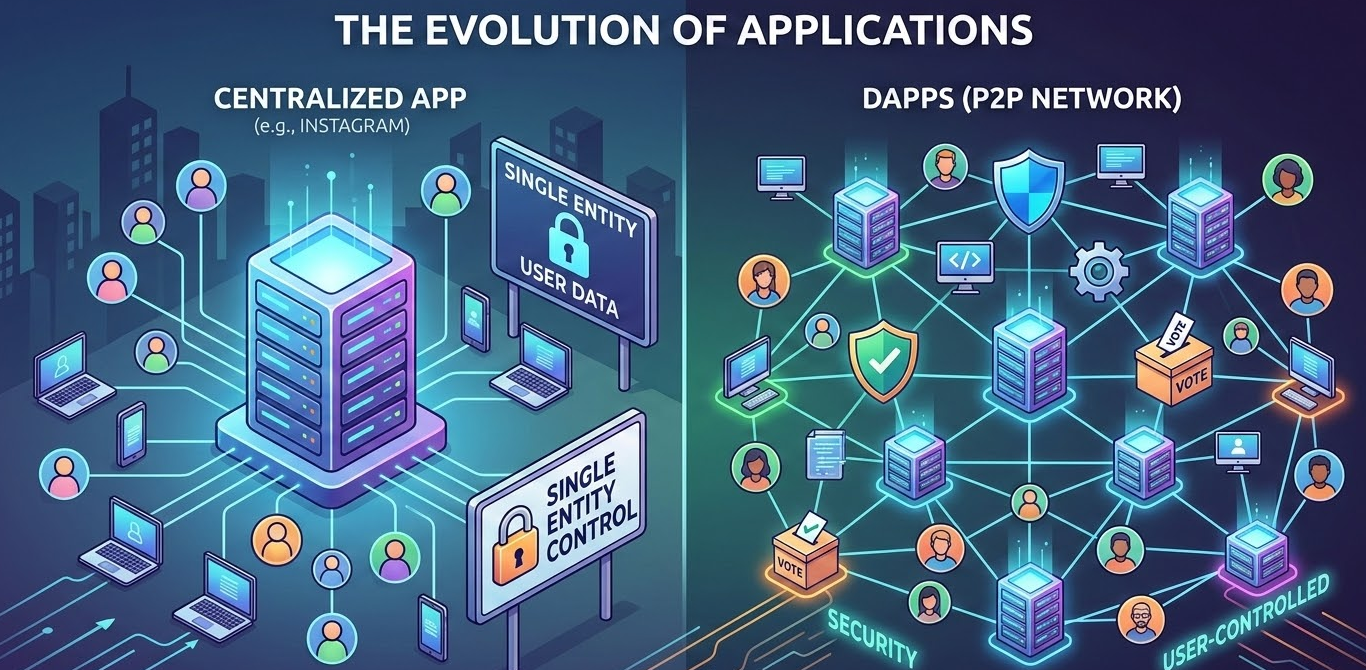
Dapps are run on peer-to-peer networks of computers (the blockchain) as opposed to centralized servers. When looking for an example of a traditional application, like Instagram or PayPal, each of these companies controls their entire user base and data, whereas DApps are controlled by their users and the underlying code that makes up the DApp.
Key characteristics
To qualify as a true DApp, an application must have four common characteristics:
- Open Source - the code should be freely available to review and contribute to.
- Decentralized - All data related to the operation of the Application must be stored on the Blockchain.
- Incentivized - Use of token to incentivize users/validators of the application.
- Protocol-Based - The Community must agree on a cryptographic proof mechanism that will show value to the DApp.
Technical aspects
At the heart of every DApp is the Smart Contract. Laws of Smart Contracts: A smart contract is essentially a decision tree stored on the blockchain. When certain conditions are met, the contract automatically registers a transaction. This type of contract can be executed without an intermediary such as a bank or title company. Smart contracts allow users to complete transactions with confidence that there is transparency in the process.
Operational principles
Unlike traditional applications that run on AWS or Google Cloud (the two largest cloud platforms), decentralized applications (DApps) run on a distributed, peer-to-peer network. When a user takes action within a DApp, the user signs the transaction with their wallet (for example, MetaMask or Phantom), sends that request to the DApp's underlying blockchain network, and the state of the DApp will be updated at all nodes simultaneously. Because all nodes are responsible for verifying the authenticity of transactions and the integrity of the DApp, this process is also safe and transparent.
Types of DApps
The DApp ecosystem is no longer just a simple form of money movement between parties. By now (2024-2026), DApps have grown into many diverse types and uses.
Financial DApps (DeFi)
Decentralized Finance (DeFi) has by far been the most significant sector for DApps. These DApps offer financial services such as lending, borrowing, and trading on crypto assets without the involvement of a financial institution (i.e., no bank). Also, with Decentralized Exchanges (DEXs) such as Uniswap, users can exchange cryptocurrencies for other cryptocurrencies directly between two users without any intermediary such as an exchange. Users can also use liquidity pools to earn rewards and to act as market makers by staking their cryptocurrency.
Gaming applications
The Play-to-Earn DApps evolved into the Play-and-Own DApps. DApps in the Gaming sector allow players to truly own and control their in-game assets using non-fungible tokens (NFTs) and have many different types of significant and complex economies within the games. DApps in this sector include many different Blockchain game genres from massive open-world games built on the Solana Blockchain to strategy games built on Immutable X, where tokens may also be used for governance of the protocols and to upgrade the assets of the players.
Social media platforms
In recent months, decentralized social networks have been gaining popularity as users are seeking ways to escape from centralized censorship. These new platforms, including Lens Protocol and Farcaster enable users (content creators) to have control over their own follower graphs, removing the possibility of being "de-platformed" (losing access to a platform due to the actions of a single governing entity) by any centralized authority through the use of DApps (decentralized applications).
Storage solutions
Decentralized Applications are designed to help users have control over their own data. In particular, storage DApps like Filecoin take your files and break them down into fragments to be stored over a decentralized storage network, making it nearly impossible for hackers to gain access to your files.
Identity management
In addition, identity management DApps will assist in providing your "Sovereign Identity," and enable you to prove who you are without disclosing personally identifiable or sensitive documentation.
Supply chain DApps
Supply chain management has seen a change in the corporate world; supply chain management is being transformed by the use of DApps. Dapps are used on a decentralized network to track goods from the factory, to the distribution center and finally to your front door. Dapps are also used to provide authenticity and help to reduce fraud in various industries, i.e., luxury goods and pharmaceuticals.
Benefits & Challenges
While there are many advantages to a decentralized model, there are also challenges in doing so.
Advantages analysis
- Censorship Resistant - There is no way for one organization/entity to shut down a DApp.
- Privacy - Most DApps can be used by anyone without having to undergo a strict KYC (Know Your Customer) process.
- Trustless Transactions - When transacting with DApps, there is no need to trust anyone other than the code itself.
- Uptime - Because DApps run on a global network of nodes, they will have a guaranteed zero downtime.
Key challenges
Development of a DApp is much more complex than traditional software development. If there is a programming error in a smart contract, then it is possible for a hacker to exploit the error and will result in the loss of a user's crypto tokens.
Security aspects
The blockchain network is considered secure; however, the "bridge" between multiple blockchains is frequently a target for malicious actors. But, by 2026, Polygon and ZK-rollups have become increasingly popular because they provide faster transaction times and lower transaction fees which allow for dApps to be utilized in our daily lives.
User experience
The user-experience aspect remains quite behind in terms of development. Additionally, for non-technical users, managing their wallets and private keys can be a very intimidating task.
Popular DApp Examples
In order to gain an understanding of the DApp market, we need to analyze successful DApp projects that have leadership in the industry.
Leading platforms
| DApp Name | Category | Blockchain | Key Feature |
|---|---|---|---|
| Uniswap | Exchange | Ethereum | Automated Market Maker |
| OpenSea | Marketplace | Ethereum/Polygon | Leading NFT platform |
| Aave | Lending | Multi-chain | Liquidity pool for loans |
| Raydium | Exchange | Solana | Lightning fast cryptocurrency swaps |
Success stories
Uniswap is a good example of how decentralized applications can manage billions of dollars of volume. Other earlier successful DApp examples are Cryptokitties, while the new leading DApps utilize AI technology and Real World Assets (RWA) together.
Market impact
The impact of these platforms is seen in how they handle massive transaction volumes, rivaling traditional financial systems and creating new digital economies.
User adoption
According to DAppRadar, the number of active users in DeFi and gaming has tripled since 2024.
Participation Methods
There are several methods you can do to be a part of the decentralized revolution by participating with DApps.
Investment options
Investment: You can invest in the native token of a DApp you believe in. As that DApp becomes successful, the native tokens may also increase in value.
User engagement
Use DApps: The simplest way to be involved in the DApp ecosystem is to just use them. To get the best prices on your cryptocurrency, connect your wallet to a decentralized exchange.
Development opportunities
Developers have numerous opportunities to create new solutions. Those who learn Solidity (for Ethereum) or Rust (for Solana) will have the skills necessary to build the next generation of decentralized applications (DApps).
Community involvement
Many DApps are governed by a decentralized autonomous organization (DAO). As a token holder, you can vote on the future goals and direction of the DApp you are part of.
Future Prospects
DApps have tremendous potential for growth in the coming years. As we take a look at the late 2020s, the following trends will emerge in terms of market opportunities for businesses to incorporate DApps into their everyday operations.
Market trends
The overall effects of DApps will be most apparent in the Internet of Things (IoT) and artificial intelligence (AI) industries. DApps have the ability to allow AI agents to trade cryptocurrencies with one another, without human input.
Development direction
Version 1 of DApps we see being used in 2024 was just the starting point. Over the next two years, developers will focus on making it possible for users to use DApps without even realizing they are taking advantage of blockchain technology.
Growth potential
This "abstraction" will be key to the mass-market adoption of DApps.
Industry impact
There is a shift toward DApps functioning as the invisible backbone of the internet as we know it today.
Conclusion / The Bottom line
Decentralized applications are not a futuristic concept; they are a real-world solution. With the removal of a central authority, DApps provide an equitable, transparent, and secure way to interact with the digital ecosystem we now call the internet. While user experience has yet to be perfected, the decentralized nature of DApps will ensure they are a permanent part of our digital landscape. Whether you are trading on Uniswap, playing games on Solana, or securing your data, DApps are the key to a truly open and decentralized version of the internet.
FAQs
How are DApps different from traditional apps?
Unlike traditional apps, DApps run and operate on a decentralized network (blockchain) rather than a centralized (on-premise) server. There is no single company that controls the data in a DApp and is capable of shutting a DApp down.
What makes a DApp successful?
A successful DApp has a strong use case, secure smart contracts, a strong group of community-based token holders, and a user interface that is consistent with traditional apps.
How can users get involved with DApps?
A user can become involved with DApps by creating a crypto wallet (i.e., MetaMask), acquiring an Ethereum or Solana token and then connecting to a decentralized platform such as Uniswap or an NFT marketplace.
What are the risks of using DApps?
The primary risks of DApp use are: vulnerabilities within a smart contract, the volatility of crypto assets, and the non-custodial nature of a wallet (which means your funds are lost forever if you lose your private key).
Which blockchain platforms support DApps?
While Ethereum is the most popular DApp platform today, there are other major DApp platforms (i.e., Solana, Polygon, Binance Smart Chain, and Cardano) that provide a variety of trade-offs in terms of speed, security, and cost.
Want to learn more about crypto arbitrage?
Get a subscription and access the best tool on the market for arbitrage on Spot, Futures, CEX, and DEX exchanges.
You might be interested
Digital Tokens Explained: Complete Guide 2026
Cryptocurrency Nodes and Masternodes: Complete Guide
Cryptocurrency Decentralization: Complete Guide
