


Hyperliquid–CEX Funding Arbitrage on Long-Tail Perps Explained

with ArbitrageScanner!
Delta-neutral funding arbitrage between Hyperliquid and centralized exchanges allows the arbitrageur to earn the difference in funding rates while maintaining a pair of offsetting positions (one long and one short), such that the price movement of the asset has little impact on the overall trade outcome. For both Bitcoin and Ethereum, the net return on delta-neutral arbitrage will typically fall within a low single-digit annual percentage rate range. The higher end of the return spectrum (20-60%+) will typically be associated with longer-tailed perpetual futures markets that represent newly introduced tokens, where there is a high level of volatility and an imbalance between funding rates for long positions and short positions. The primary limitation to an arbitrageur's success is the total transaction costs associated with executing the strategy (i.e., transaction fees for market making/taking, slippage, and variability of the funding rate between the two positions), all of which may be estimated through the use of a funding-rate screener, spread calculator, and depth-aware filters before committing capital to the trade.
What is Hyperliquid–CEX funding arbitrage?
Funding arbitrage, which is also known as delta-neutral funding arbitrage, is a "delta-neutral" trading strategy that relies on the concept of maintaining equal-sized, opposite-direction positions in the same underlying asset (one position receives funding, one position pays funding) to generate yield from the spread between the two positions. As the two positions move in tandem, the profit or loss due to price fluctuations will approximately offset one another. Consequently, the only source of profit or loss will be the difference between the funding rate received from the long position and the funding rate paid from the short position, along with any transaction costs that occurred.
On perpetual futures contracts, funding is periodically paid/received by both long/short contracts to ensure that the perpetual price remains within a specified range of the spot price. Whenever the perpetual price exceeds the spot price, the longs will pay the shorts, whereas the shorts will pay the longs when the spot price exceeds the perpetual price. Hyperliquid pays hourly funding on perpetual contracts, while traditional CEXs will typically pay funding on an eight-hour basis, resulting in different rates of funding payments. There are two main ways to structure a funding arbitrage:
- Spot to perpetual: You would keep an asset (spot) long on a central exchange and short the equivalent perpetual (non-expiring) on Hyperliquid, or vice versa. If the perpetual short leg is positively funding, you would collect funding on that.
- Perpetual to perpetual: You would long the perpetual where you would receive funding and short the perpetual where you are charged less, essentially creating double funding exposure but avoiding holding any fiat.
With the growth of Hyperliquid, this is becoming more than just a niche funding arb opportunity; as of June 8, 2026, they have a reported 7.6% of all perpetual exchange volume (Source: Cryptopolitan). The more volume a perpetual has, the tighter the spreads will be between major market-making exchanges; thus at times resulting in extremely large funding disparities from smaller tokens.
Funding arbitrage does not involve betting on the price; it involves collecting the difference between two venues paying and charging to maintain the same market position.
Why long-tail perps carry fatter funding
Long-tail listed perpetuals see higher funding than deep liquidity perpetuals because of increased arbitrage opportunities between both; however, both will attract large influxes of capital once the funding differentials widen, and the spread will rapidly compress. After a successful long-term perpetual arbitrage between BTC and ETH, it has had a reported net return of approximately 3%-12% APR; net returns will be lower than this after transaction costs (source: NeuralArb). Therefore, treat BTC and ETH as the standard; they have deep liquidity, highly liquid markets, were very predictable, and have relatively low-risk reward ratios.
Long-tail listed perpetuals behave differently from BTC and ETH; new listings typically draw directional activity and trader crowds into either long or short trades based on some hot theme, such as HYPE or XPL, or on expected value related to governance token unlocks. Crowding causes the funding rate to stay high for extended periods of time since fewer arbitrageurs are willing to hold on to the unattractive offsetting leg of the trade. The funding rate, which is typically reported as being anywhere from 20% to 60%+ APR (source: NeuralArb), is based on what amount of capital is being arbitraged between long and short futures contracts (perpetual swap contracts) across exchanges with differing rates.
The reasons why the funding rate stays high on long-tail perpetual swap contracts are:
- The thinness of the two-sided market. With few arbitrageurs competing to capture the funding differential between long and short futures contracts, it takes longer for the differential to disappear; thus, keeping the funding rate high.
- Directional conviction. There is directional conviction behind the long-tail perpetual swap contracts. In a narrative-driven environment where the majority of the flows are one-sided, funding rates remain skewed in one direction.
- Asymmetry of liquidity. There can be an asymmetry of liquidity when a long-tail perpetual swap contract might be listed and available on Hyperliquid but the same token has limited or no liquidity on spot or perpetual contracts across the major Centralized Exchanges (CEXs); therefore, resulting in funding rates being untethered for extended periods of time.
The corollary to all the factors listed above that keep the funding rates high is that they also increase the risk of trading long-tail perpetual swap contracts. The thinning of the liquidity pool increases the risk of large trades resulting in slippage; likewise, the directional conviction of traders will be susceptible to sudden reversals of conviction based on news or other events that will affect an entire market.
The funding rate on a long-tail perpetual swap contract is not an opportunity for free yield; it is an opportunity to earn a funding yield in exchange for the risks inherent in being subject to a thinly traded and asymmetric liquid market along with the need to size the position correctly.
The real cost stack
The complete picture of trading costs associated with trading long-tail perpetual swap contracts includes multiple layers of an expense stack associated with receiving the funding differential.
1. Maker and Taker Fees. Trades of both legs when entering and exiting a trade incur expenses on both sides, thus simply reaching break-even on both legs is generally contingent on posting maker orders via limit order types rather than taker orders via market order types. According to the report from NeuralArb, breaking-even requires >1.30 basis points of funding per 8 hours, which means that the funding you collect on your position must more than cover the trading fees in order for you to net a profit.
2. Risk from Funding Changes. Funding rates are not always constant. The rate you initially believed to be appealing can decrease or become negative. If the funding rate shifts unfavorably towards your short position, you will be charged instead of receiving payment. For example, with the long-term funding rate used to calculate long-term funding with perpetual contracts, this can happen very quickly (in as little as eight hours).
3. Order book slippage due to increased volumes. This is where order size limitations are most crucial. Slippage rates for many liquidity types start at around 12 basis points when trading an initial position of $500,000 on Hyperliquid and can exceed this value depending on the specific characteristics/features of the contract.
4. The costs associated with converting borrowed collateral. Many forms of spot-market collateral require periodic rebalancing (i.e., transfer back to the underlying asset), which incurs associated transactions until either the terms have changed or enough time has passed to make it advantageous.
| Cost component | Typical driver | Where it bites hardest |
|---|---|---|
| Maker/taker fees | Order type, venue tier | Every entry and exit |
| Funding flip | Rate volatility | Long-tail perps, short windows |
| Slippage | Order-book depth vs. size | Positions $500K+ on thin books |
| Inventory/rebalance | Spot borrow, delta drift | Spot-vs-perp structures |
A worked APR example
Example of funding differential based on annualised funding rates (APR): Assuming a long-term funding rate differential of 0.05% between two long contracts traded each eight-hour period within 24 hours results in 0.15% in total income per day, and 54.75% gross dollar income annually.
Daily funding = 0.05% × 3 windows = 0.15% per day
Annualized = 0.15% × 365 = 54.75% gross APR
(54.75) minus the total of all transaction-related costs; currently, the average total costs of trading are then added together and your net annual return is calculated last by simply subtracting the total of the transaction costs from the total gross dollar income collected annually. Let's use the following assumptions regarding friction and round-trip fees amortizing to about 0.02% per window (maker orders, reasonable size, no slippage):
Net per window = 0.05% − 0.02% = 0.03%
Net daily = 0.03% × 3 = 0.09% per day
Net annualized = 0.09% × 365 = 32.85% net APR
Next, let's scale that to a $500,000 position on a thin book and add 12 basis points (0.12%) for one-time slippage on the entry and same on the exit:
Round-trip slippage = 0.12% × 2 = 0.24% one-time
Days to absorb = 0.24% ÷ 0.09%/day ≈ 2.7 days of net funding
So at size, nearly 3 days' worth of net funding would be used up just paying to enter and exit the trade. If the funding adjusts or flips before that point, the trade could finish negative with a 54% Gross Headline. This is precisely why depth-aware sizing is important: The same percentage spread would be exceptionally profitable in a small position but marginally profitably as a large position on the same instrument.
A trade with a 50%+ gross APR could become a negative trade if one-time slippage at size and mid-trade funding-adjustment flip at entry are not priced in before entry.
How a screener and spread calculator surface these trades
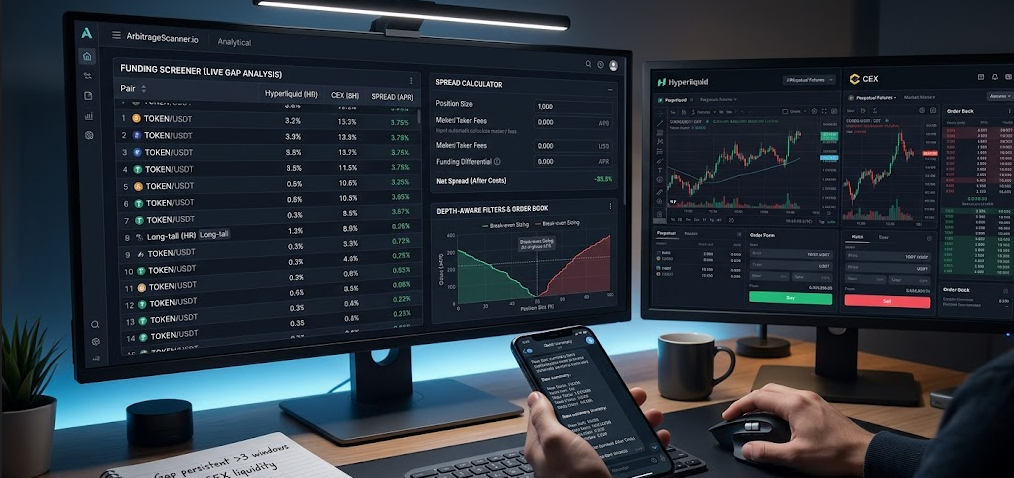
It is virtually impossible to manually search for funding dislocations across dozens of venues and check the depth of each at the speed of funding. Tools exist to aid you, not make the decision for you. Tools will show you the 4 costs above before you enter into a trade. The funding-rate screener gives you an overall ranking of live funding differentials by venue, enabling you to see the most significant divergences between Hyperliquid and a CEX account and whether these divergences are likely due to a temporary, one-time spike or have been trending over multiple windows in time. A long-term trend would point towards the potential for successful arbitrage, while only experiencing a singular spike would be categorized as noise.
By using the spread calculator to input your funding differential, fee tier, and intended order size, you can quickly compute your total cost (i.e., net spread) so that it only requires a few seconds of input instead of using a spreadsheet following the example above.
The depth-aware filters will allow you to separate between a clean backtest and a real loss, thereby identifying potential opportunities based on order book depth. The depth-aware filters will determine how far your intended order size would move the market past the break-even price based on your gross APR. A book that has a depth of $30,000 with a gross APR of 40% is an entirely different instrument than a book which has $2 million of depth at the same gross APR.
We cover over 80 CEXs and more than 25 DEXs across 40+ chains with real-time updates. ArbitrageScanner.io is completely manual; it shows you available arbitrage and the size of each opportunity. Because it does not connect to your exchange via API, you retain complete ownership of your funds. Your selected exchange to execute the CEX leg of your arbitrage would be determined by where you find your original CEX funding gap from either OKX, Bitget, or Binance.
This is how a typical workflow would flow:
- Use the funding-rate screener to locate a persistently higher funding gap on a long-tail perpetual future.
- Use the spread calculator for both your actual fee tier and desired size.
- Use the depth-aware filters in the futures arbitrage screener to make sure that the book will absorb your size within break-even.
- Place maker orders on both legs of the trade; continually check for funding flips and rebalance delta, if necessary.
FAQ
Is funding arbitrage ever delta-neutral?
In theory, it is; because equal and opposite positions will cancel out the vast majority of the directional P&L. In reality, delta will drift as price changes and legs of trades are filled at slightly different sizes, which means if you want to be delta-neutral, you will need to periodically rebalance yourself to maintain your neutral state. The key is "neutral" should always be a target you are trying to maintain and not something that you set and forget about.
Why are BTC and ETH funding returns so much lower than returns on long-tail arbitrage?
Because major cryptos such as BTC and ETH have lots of liquidity and are heavily arbitraged, the price difference between markets will quickly become negligible as soon as they show any attractive premium. In contrast, long-tail markets typically have less trading capital available for arbitrage, so they will generally continue to have elevated funding rates for quite some time as they are only able to do so because of their one-directional flows, which leads to higher liquidity risk for long-tail markets.
What size position is considered "too large" to trade Hyperliquid?
There is no fixed threshold; it all really comes down to the order book liquidity for each particular perp trading. The general benchmark for determining when to limit your trading volume is around $500K clearly; when you start seeing slippage around $500K near 12 bps, that will usually mean you have begun to eat into the spread with slippage from the depth of the book (meaning you're not going to get filled enough on one leg of the trade). You should look at the actual market depth prior to entering the market rather than relying solely on a single threshold.
Does ArbitrageScanner hold my capital or trade on my behalf?
Absolutely not. The ArbitrageScanner is an entirely manual tool; there is no API access for doing so on any exchanges whatsoever. We simply evaluate and provide data about the underlying position, provide delta to calculate spreads, and identify limitations you've placed on yourself; it's up to you to place any orders on your behalf and your funds will always remain yours.
What happens if I have a flip in funding while I am in a trade?
If you had a flipped funding situation when you entered a trade, the leg that was receiving funding from the counterparty will become a cost for you and cause you to go from having a positive carry trade to being a negative carry trade. This scenario, especially for the long-tail markets, can happen within one funding period; therefore, you have to monitor and persist in checking both at the time of trade entry and afterwards for funding flips more than the current rate and adjust your carry accordingly.
You can sign up for a free test drive of ArbitrageScanner for one day to see for yourself how ArbitrageScanner will provide you with live funding differentials, net spreads; you'll need to do all size checks and order placement through ArbitrageScanner, and your funds will remain completely under your control: https://t.me/arbitragescanner_info25_bot
Important Note: We are software engineers, not advisers, therefore, we do not create positions based on investment opinion or recommendation whatsoever, and we will never indicate what you should do with your funds. All of the financial results we have shown for our clients are results that are achieved from proper execution of their own activities in the marketplace, and all financial outcomes are entirely dependent on the actions that each customer takes as well as overall market conditions.
Want to learn more about crypto arbitrage?
Get a subscription and access the best tool on the market for arbitrage on Spot, Futures, CEX, and DEX exchanges.

You might be interested
Sandwich-Proofing Your DEX Swaps: A 2026 MEV Protection Playbook
SpaceX Perp Arbitrage on Hyperliquid: The SPCX Basis Trade Explained
Token Unlock Arbitrage: Trading HYPE, ZRO & WET Cliff Windows
