


SpaceX Perp Arbitrage on Hyperliquid: The SPCX Basis Trade Explained

with ArbitrageScanner!
SPCX-USDC, a perpetual futures contract on SpaceX, was launched on May 18, 2026 with no underlying shares. It began with a reference price of USD 150, hit a high of USD 216 and ultimately settled at USD 203. The "fair value" of an unlisted company like SpaceX is very difficult to determine, and as a result, the reference price and corresponding spot value of SPCX-USDC will be dislocated from any other synthetics as well as from the actual market. Normally, basis trades aim to profit from the difference between two assets' prices that should converge, but before participating in basis trades of synthetics such as SPCX-USDC, you need to understand how each portion of the trade is priced, how funding works and what happens if there is no convergence.
What properly characterizes a pre-IPO and tokenized stock perpetual
Unlike other types of perpetual futures (also known as perps) in which the underlying assets settle to some known date, a pre-IPO perp does not settle to a known date and thus has no underlying assets to establish a settlement price. In a traditional perp contract, the settlement price is a result of periodic funding payments made by both the long (bullish) investor and the short (bearish) investor. These funding payments cause the contract's price to align with the spot price of the underlying asset among many different exchanges.
In the case of SpaceX and SPCX-USDC, there is no spot market for SpaceX shares as it is not publicly traded. As a result, there is no way for an investor to buy a share (and thus no ongoing order book and no market price) and, at the time of listing, no liquid underlying asset for the contract, which means the price of SPCX-USDC was originally independent of any actual stock market activity and the price was established solely based on the opinions of other traders who entered into opposing contracts. Hyperliquid claims that SPCX-USDC was first priced based upon speculation about how much other traders would pay for shares when the company eventually goes public, but the actual price of SPCX-USDC was based on the hope of future share prices and thus bears no relation to the actual market. Here’s the important thing for you to keep in mind as you read through the rest of this guide:
When trading a pre-IPO perpetual, you are playing a price discovery game without any sort of anchor. Literally, the fair market value is whatever the collective opinion of the marketplace says it is, and there isn’t any spot leg that you can hold onto for the purpose of forcing convergence.
That is fundamentally different than trading tokenized stock that has been issued against physical custodial shares, of which there is a corresponding amount of equity held by the issuer, and that can be redeemed. When SPCX was originally launched, it was synthetic (meaning no backing shares existed), and that is the single most important distinction for making sure you know which one you are trading in.
Defining “Basis” Without an Underlying Asset
In traditional futures trading, basis means the contract’s future price subtracted from the asset’s spot price as follows:
basis = future_price – spot_priceIn the case of a normal futures contract, whenever basis becomes unbounded due to arbitrage opportunities (wherein the price of the future trades extremely high in relation to the spot), losing money on one side of the trade while making money on another ultimately forces the two contracts back into alignment before expiry, due to having deliverable products at both locations. Thus, in classic futures trading, if there were no deliverable product available at either location, then there would be no way to determine basis.
For example, suppose a trader has a short position in a future with a future price of $50, but then goes to buy the same thing at $40 somewhere else. The basis would equal the difference between those two prices; in this case, basis = $50 - $40 = $10.
In a pre-IPO synthetic contract, however, you are unable to calculate basis as defined above because there is no underlying spot asset against which to define basis. Therefore, traders will either use:
- Cross-venue basis: The same (or equivalent) product traded on two platforms at differing price levels. In this example, the basis would be defined as the gap between those two locations’ market prices. This type of “basis” provides greater tradability than referencing the previous option, since both legs of the transaction have sufficient liquidity to enter or exit the trade at will.
- Event-anchored basis: Excluding the conventional means of achieving a basis-trade arbitrage (using a price difference against an expected future settlement is much harder to accomplish because neither the date nor the value of the future settlement can be known).
Tiger Research discovered that the average price for Bitcoin perpetual contracts on Binance was 0.93% greater than the price on Hyperliquid, while the average price for SK Hynix perpetual contracts reached 2.3%. These gaps are the types of prices that basis arbitrage traders look for.
When there is no spot-traded standard to use as an anchor point for your basis trades, you would solely be able to use the price differential that exists between similar exposure assets traded on two different venues. It appears that there are 2% plus differential markets available out there for both pre-IPO and tokenized-equity perpetual contracts.
Structuring a Cross-Venue Basis Trade
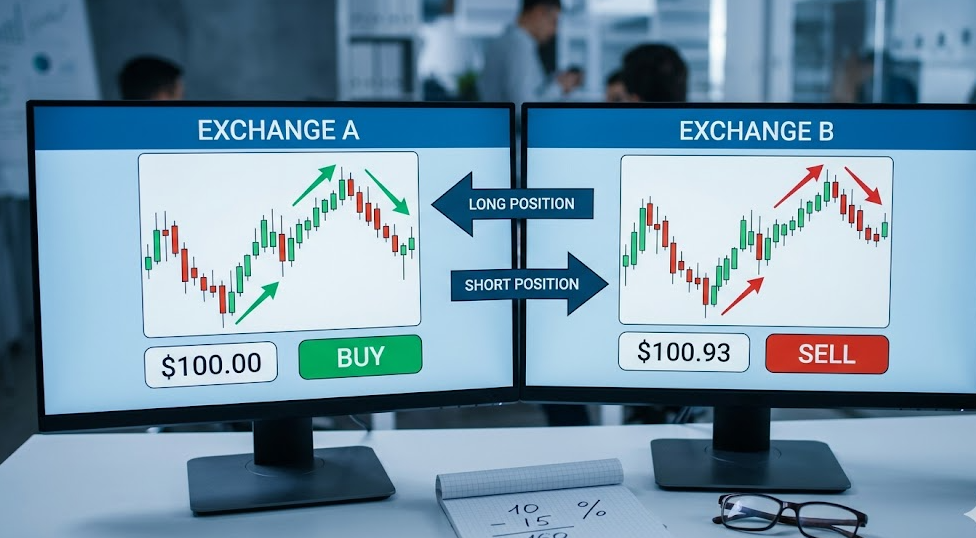
Structuring a cross-venue basis trade is simple: you would go long (buy) on the less expensive venue while at the same time going short (sell) on the more expensive venue, while sizing both trades to have delta neutrality (i.e., $100 of long position and $100 of short position). The profit from the transaction would result from the coupon that you would receive while the prices of the two trades converge regardless of whether or not the underlying equity moved in the preferred direction relative to each of the venues.
An example of a cross-venue basis trade can be illustrated based on the Tiger Research report regarding the average price differential between Binance and Hyperliquid trading.
Setup
- Venue A (Hyperliquid): perp trades at $100.00
- Venue B (Binance): equivalent perp trades at $100.93 (0.93% higher)
- You want $10,000 of notional exposure per leg
The two legs
| Leg | Venue | Action | Price | Notional |
|---|---|---|---|---|
| 1 | A (cheap) | Long | $100.00 | $10,000 |
| 2 | B (rich) | Short | $100.93 | $10,000 |
If the gap fully closes (both converge to, say, $100.50):
- Long leg gain: ($100.50 − $100.00) / $100.00 × $10,000 = +$50.00
- Short leg gain: ($100.93 − $100.50) / $100.93 × $10,000 ≈ +$42.60
- Gross before costs ≈ +$92.60, i.e. roughly the 0.93% gap on $10,000.
Now subtract the real costs, which is where most of these trades live or die:
net = gross_gap
- taker_fees_both_legs
- funding_paid_net
- slippage_both_legs
- borrow/financing_on_collateral
If round-trip fees and slippage on both legs eat 0.30 - 0.50%, a 0.93% gap is workable. A 0.25% gap usually is not. The discipline is entirely about measuring whether the gap is wider than your total cost stack - which is why a spread calculator that nets fees, funding, and notional into one number is more useful here than raw price feeds.
Funding: The Cost That Quietly Decides the Trade
On perps, you do not hold the position for free. The funding rate is exchanged between longs and shorts - typically every 1 or 8 hours depending on the venue - to pull the contract toward its index. In pre-IPO synthetic derivatives, funding is more naturally aggressive than with BTC or ETH. There are two major reasons for this:
- There is not much liquidity and there is a lot of directional demand. With everyone wanting to go long on what may be the next "hot" listing, those who want to go long must pay a very high funding rate to balance their positions with those who are going short. This type of funding rate can run several basis points greater than you would see in a liquid BTC market.
- There is no spot arbitrage to bring down the funding rate. In the BTC market, arbitrageurs will take the spot market long and a synthetic perp short when the funding is high and thus will create mechanical pressure on the funding rate to go back down. In the synthetic perp market you cannot take a spot position in order to take advantage of discrepancies in the funding, and so you will experience extreme funding for longer periods.
When you make a cross-venue basis trade in a synthetic perp, you receive funding on the leg that is short the crowded side and you pay on the leg that is long the expensive side. The net effect of the two funding payments is the actual cost of your position. If the funding payment is the primary trade and the price difference is secondary you do not know until you compare the live funding rates of both venues.
With synthetic perps, unlike in the formally traded market, funding is not ancillary or negligible. The amount and duration of the funding carry might be much greater than the price difference you are hoping to capture.
Settlement Risk—The Part That Eliminates the Advantage
There are risks associated with trading synthetic perps that are different from those involved in trading ordinary cryptocurrencies. These risks justify a separate section on their own.
To distinguish between the two different types of settlements—ordinary and cross-exchange—you must keep in mind that ordinary cross-exchange spreads will converge only because the two contracts are both tracking the same underlying, visible metric. Terms of Settlement for an IPO pre-synthetic may include the following: Virtually all standard terms providing for a specified settlement price or the conversion to a future token will involve some form of cash settlement linked to an oracle and/or a good faith effort to comply with the oracle price at the time of the settlement. Alternatively, a venue may prohibit settlement through a delisting or rule change.
The difference between $150 and $216, and the final settlement price of approximately $203, illustrate how critical the selected settlement price is in influencing the final outcome. What is concerning to a basis trader is the asymmetric nature of the two sides of the trade. If Venue A and Venue B have different settlement or maturity terms (i.e., different trading days, different oracle source), an alleged 'neutral' basis position will only be 'neutral' until one side of the trade has settled. Once one side settles, you will have a long position and a short position (but you do not wish to hold either).
If one venue socializes losses or auto-de-leverages during a spike in volatility, your profitable short position may close at a profit, but your unprofitable long position will remain.
Practical trading recommendations include:
- Read both venues' terms of settlement and auto-de-leverage before entering into trades.
- Trade only pairs that are continuously traded unless it is impossible to determine the date of settlement.
- Ensure that size limits your exposure to liquidation.
- Approach defense mechanism (or guaranteed convergence at the IPO) with caution, as it is impossible to know or determine the IPO date, IPO price, or if the contract will even survive until the IPO.
Why a Real-time Cross-Venue Screener Provides an Advantage to Identification of These Inefficiencies
Due to market dispersion, gaps in the market are very small, very brief, and exist within venues across the industry. If you're switching between 2 different windowed browsers, it might be hard to see a 0.93% average gap due to the fees changing the math by the time you get to look at the gap with your eyes.
The Workflow in a Practical Way:
- Use a futures arbitrage screener to detect a live cross venue gap every second between the same exposure across the 2 different exchanges.
- Use a spread calculator to net your costs- fees, funding legs, expected slippage so you can see "after fees" what the net profit you have at that time or what the headline price gap is.
- Watch the current funding rates (carry) live, if you are working with synthetics because the carry can change the way you see your thesis.
- Use an arbitrage screener to scan the broader market outside of just one thinly traded pre-IPO name.
ArbitrageScanner.io has a fully manual toolkit which means we have no access to the exchanges' API's as we don't provide the trades, sizes or risk for you; you maintain complete control over your own access whilst utilizing the tools provided by ArbitrageScanner.io. Bitget, OKX and Binance are partners to arbitragescanner.io so if you utilize the platform you can see all 3 of these venues simultaneously. You can also compare the access level of all 3 exchanges via the pricing page.
FAQ
Is the SPCX perpetual contract backed or related to real SpaceX stock?
No, SPCX was launched on Hyperliquid as a synthetic perpetual price created by traders without being backed by any shares; its price was created by traders (i.e, $150 reference price → $216 high price → ~$203 settlement).
What is a basis if there's no spot price?
You can't use the spot price as the cost to subtract; however, you can substitute the price difference on a cross-venue basis for the same exposure or you can consider the difference from an expected future settlement. The cross-venue basis will be more tradable.
How big are the cross-venue gaps on Binance?
For the documented pre-IPO/tokenized-equity (perpetual) contracts, the Samsung futures contract on Binance was above Hyperliquid’s contract by an average of 0.93% and the gap for SK Hynix was 2.3% (Source: Tiger Research).
Is there any risk related to settlement with typical cryptocurrency arbitrage?
Settlement risks arise if each leg settles under different rules, at different settlement times, and from different oracle sources your delta-neutral position will turn into a one-sided position exactly when you're least able to meet the risk.
Why should I use a screener to watch 2 exchanges manually versus manually watching both exchanges?
The gaps are small and moving every second overall the #1 focus will always be profit net of costs. In order to maximize success you should always follow a cross-venue arbitrage screener on a second by second and net your fee plus funding into 1 total number to act upon an "edge" anyways rather than upon a "headline" price gap.
Test out ArbitrageScanner for a single day at no cost: see @arbitragescanner_info25_bot
Important Notice: We are developers of a software product and therefore do not provide investment advice or earnings guarantees nor do we provide any input as to where your capital should be placed. Additionally, all execution by our examples of how other clients profited via arbitrage in the past is simply an illustration of successful trades; your own results will all depend on market conditions and your decisions.
Want to learn more about crypto arbitrage?
Get a subscription and access the best tool on the market for arbitrage on Spot, Futures, CEX, and DEX exchanges.

You might be interested

Token Unlock Arbitrage: Trading HYPE, ZRO & WET Cliff Windows

Wallet Intelligence in 2026: Tracking Smart Money With 272 Criteria

Solana MEV in 2026: The Retail Arbitrageur's Survival Guide
