


WET's 111% Unlock: What Happens When a Token Doubles Its Float Overnight

with ArbitrageScanner!
On June 9, 2026, HumidiFi (WET) unlocked about 256.67 million tokens, valued at approximately $14.66 million in a single event. This number was approximately equal to 111.59% of the entire supply of WET that had already been released into circulation (meaning the new tokens added to circulation were equal to 111.59% of the supply that had already been out). In addition, this event added substantially more liquidity to WET than was previously available overnight, creating a substantial amount of floating supply in the market between all three categories of holders. The 256.67M tokens were allocated as follows: 106.67M to the Foundation; 83.33M to Labs; and 66.67M to the project team and ecosystem. When an unlocking event exceeds 100% of the currently circulating supply of tokens, and the order book is considered thin (meaning very few tokens are offered for sale), a very large amount of post-unlock supply will likely be dumped into the marketplace at a much steeper than usual price decline (dump curve) and the pattern for the price decline will likely be very predictable over a much longer time frame than would occur with a typical 2-5% supply unlock event. This article will outline the mechanics of >100% token unlock events, how an investor can reasonably expect the post-unlock price decline to perform differently than for standard events, the importance of distinguishing between cliff and linear vesting, and how to hedge risk around the date of an unlocking event; with the understanding that nothing in this article should be considered as investment advice.
In general, most token unlocking events are relatively unimportant to the market. The protocol is on a regular schedule of releasing tokens to holders (usually on a monthly basis), the market has known when the tokens will be unlocked for a year, and the price tends to be stable over time. However, the WET token unlocking on June 9 was unique because, when an event is 100% or more than the total amount of tokens currently being traded, it is likely that the amount of liquid tokens in the market is going to increase by approximately double (or more than double) and that creates a fundamental shift in the supply and therefore the prices of tokens. This article provides information on the WET unlock event, including how it exceeded the circulating supply, how the new supply will create thin order books in the marketplace, the impact of event WET on the liquidity of the market, how event WET created structured hedges or short reserves in the market, and the differences between cliff vs linear vesting schedules for unlocks.
This article does not constitute a financial recommendation for any trading activity.
Details of the unlock and rationale
On June 9, 2026, a total of 256,670,000 WET was unlocked via the HumidiFi protocol (A Decentralized Exchange built on Solana Blockchain). The value of the total WET unlocked was approximately 14,661,000. When looking closely at the total number of WET unlocked, and broken down by each of the respective unlock categories, the most outstanding takeaway from the data was that the unlock presented approximately 111.59%, as opposed to 111% of the floating supply of WET.
Thus it can be concluded that a total of approximately 256 million or approximately 250 million new WET tokens were added via the HumidiFi unlock. Various tracking methodologies indicated that the circulating WET supply would increase from approximately 230 million to approximately 355 million, which represented an increase of approximately 54% in the floating supply of WET. In addition, the unlock to market cap was approximately 100% since only approximately 23% of total WET had been released to date.
Allocations associated with the unlock were as follows:
| Recipient | Amount of WET unlocked | % of total unlock |
|---|---|---|
| Foundation | 106,670,000 | 41.6% |
| Labs | 83,330,000 | 32.5% |
| Team/Ecosystem | 66,670,000 | 26.0% |
| Total | 256,670,000 | 100% |
In conclusion, two main structural elements caused analysts to identify the WET unlock as an "alarming amount" of WET for the Month of June 2026. First, the entities that would be managing or distributing big positions were the Foundation, Labs and team - none of these three would likely hold on to their positions passively. Secondly, WET has a very thin market; i.e., one liquidity measurement indicates there is about a 0.43 annualized turnover. That means that when a large order eliminates the available liquidity from the book and creates a substantial difference in price, it is likely to be a sign that the volume of sales in WET is low.
Why an unlock event greater than 100% behaves differently
The reason that an unlock event greater than 100% will behave differently from a regular unlock event is due to the degree of marginal supply on the time of the unlock event. For example, if 3% of the total float were released by way of unlocking, the worst-case scenario would be all 100% of 3% being sold in the market. Therefore, the market would need to absorb 3% in addition to the existing float over a period of time. Typically, order books for tokens with a liquid market place can absorb large quantities of inventory with minimal price fluctuations.
Unlocking 100% or more of any circulating supply can be thought of as entirely different type of event. Here is the logic behind that conclusion presented simply. All saleable tokens had been either in circulation or in locked contracts no longer accessible to the market. Therefore, prior to an unlocking event, unlocked tokens were not part of the market. As soon as those tokens are released, the number of possible holders that may wish to sell increases exponentially from a historical level to, as a result, become available to sell at a future date based upon a larger number of sellers. In other words, with a 20% sell rate on a normal unlock of 3%, it would be considered as negligible in terms of the previous lockup float. However, in the case of unlocking 111% of the current float, a 20% sell rate creates a lot of activity and support compared to the historic unlocked float level. The consequence of more than 100% unlocks is that the post-event curve becomes predictable and sharp. The supply overhang (total number of tokens not yet sold that will sell due to an event) will far exceed the total number of tokens that were previously held in demand before the event date. The market has priced this into the trading curve; traders who follow the unlock dates will know when to expect an overhang, thus positioning themselves prior to it. The anticipation of the unlocking event itself explains the predictable behavior of the curve - selling is not unexpected for the traders, therefore a portion of the selling will occur before the unlock and the relief and continued price movement after the unlock is a situation that traders look to capitalize on.
The main point of emphasis here is that if there are more tokens being unlocked than the circulating supply, then the effect of those unlocks is no longer marginal; it is an entire paradigm shift in the amount of supply that the order book must accommodate.
Supply overhang meets a thin order book
When the supply overhang from the unlock occurs at a time when the order book is thin, the price impact of the unlock is two-fold. Price impact is based not just on the total number of tokens that are unlocked, but relates to how many tokens are being unlocked compared to how much demand there is in the order book for them (at what price level). These are two different things, and WET demonstrated both.
When the order book is thin the size of resting bids below the market price is weak. Thus, when a large sell order occurs, it will eat through each bid order until it reaches a significant discount and the average realized price will be significantly below the market price. When a very low-turnover token has a lot of tokens sold compared to the market cap, that is what we refer to as "slippage". With a turnover reading of approximately 0.43, WET has this exact parameter; it has a lot of available tokens but does not have a lot of trades or liquidity to back up the tokens, causing very large trades to significantly impact the current market price of the token.
Now, we need to look at what happens when you have an overhang of token holders. The concern we have is not just about the number of tokens that are going to be sold on the first day; it is the actual knowledge that there are still six (6) weeks of double the number of people willing to sell their tokens. Because of this overhang, we are likely to see a decrease in the willingness of market makers and retail buyers to make aggressive bids. Bid prices widen, and liquidity providers will reduce the size of their trades, so that no liquidity provider wants to take on the risk of being the one to take on a distribution from the Foundation or Labs. The interaction of a thin book and a very large amount of tokens available to be sold will create a feedback loop. The heavy overhang makes the order book thinner, and a thin book will cause a person to incur a greater amount of loss when they attempt to sell their tokens.
There is a legitimate counterbalance to this situation. According to reports, HumidiFi has over $1B in daily volume on decentralized exchanges, plus WET has a fee-rebate utilization for its long-term holders. Also, by maintaining significant trading volumes allows a good supply of demand to be created, allowing for a decent amount of liquidation to occur. So there is a complex dynamic between the structural overhang and the thin liquidity of the order book, which all comes down to both demand for WET as well as supply of WET due to the distribution. Therefore, a market trader's job is one of attempting to read the market and interpret whether either the structural overhang or the demand for WET due to the utilization will have a greater or lower impact during the next trading day.
Cliff versus linear vesting, and why it matters here
One way to express the two types of unlocks are cliff and linear. In cliff vesting, all of the tokens become available for trading on the same date; for example, after three months of no liquid tokens, all of the tokens become liquid at once. The WET event was essentially a cliff: 256M tokens came available all at once on June 9, rather than being distributed over time. A cliff not only creates a supply shock, but also builds anticipation before the event occurs. The dump curve around a cliff tends to be sharp and front-loaded, building weakness in advance as positioning occurs, with a spike of realized supply on or shortly after the event; this will either create a relief bounce if the selling was exaggerated or slow continuation as the overhang continues to limit price.
Linear vesting releases tokens continuously, in small increments either every block or every day, but over a period of months. The full amount of the total supply enters the market; however, they are spread out. Linear unlock schedules rarely lead to a dramatic date. Instead, they create a slow persistent headwind of continuous sell-side supply. That is, they create a continuous downward limit on price because they limit the potential for upward price movement based on the total amount of supply that is coming into the market over an extended period.
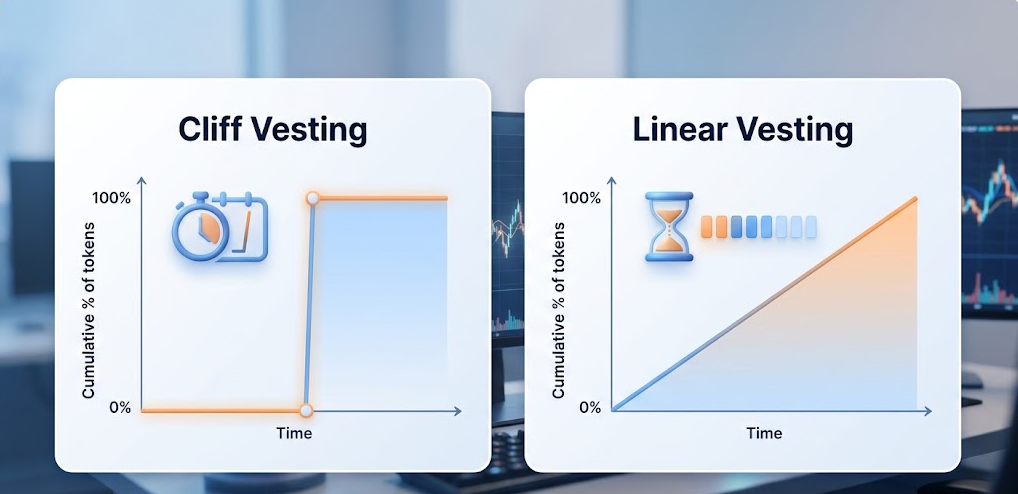
For a trader, the practical evidentiary read-through is as follows: a cliff is a date around which to trade. A linear unlock is a condition upon which to base your bias for weeks or months. Misidentifying a linear unlock as a cliff is a classic mistake. For example, a person may initiate a short position in anticipation of a cliff-style drop on a date that ultimately has no corresponding event date or quantity of supplies coming into the market, but the market had already absorbed a gradual supply rate through a linear unlock process prior to the date. The WET event was concentrated upon a cliff event, however, thus justifying concentrated date specific attention which is why WET was reaffirmed prior to June 9.
How the June 2026 unlock cluster framed the trade
The June 2026 unlock cluster established the trade framework for WET. June 2026 had one of the largest unlock calendars we've seen recently as the Tokenomist data showed that over $1.839 billion worth of tokens were scheduled to be unlocked over about one month’s time. The timing of these unlocks has an important impact on the market as clustered unlocks create selling pressure and negative sentiment therefore creating thinner bids across the entire altcoin complex.
To better illustrate this point, here are how the tokens allocated for unlocking in June affect each other.
| Token | Approx. unlock size | Type of unlock | Why it is/was important |
|---|---|---|---|
| WET (HumidiFi) | ~256.67 million tokens (~111% of the circulating supply) | Cliff (June 9) | Has the greatest dilution amount for the month and more than doubled the floating supply |
| SPK (Spark) | ~27% of the floating supply (~900 million tokens, ~$17.8 million) | Cliff (June 17) | A large percentage of the float will be released into the market in one instant. |
| HYPE (Hyperliquid) | The core contributors allocation, ~23.8% of the total circulating supply | Cliff (early June) | High absolute value has been used as a bellwether |
| ZRO (LayerZero) | ~25.71 million tokens (~29.4 million), ~2.57% of the circulating supply | Cliff (June 20) | High dollar value, but small relative to the floating supply; this gives this token a different case study to other coins discussed above. |
The important comparison is the ZRO line where ZRO has released a large dollar value of tokens, but only 2.57% of the total floating supply. This has been a typical marginal event. Conversely, WET has released a smaller total dollar amount of tokens but 111% of the total circulating supply. Therefore, in terms of how much impact the unlocking of each coin has on their market price the percentage of the total floating supply increases in importance to the total dollar amount of dollars released at unlock. An example would be if a company unlocks $29 million worth of assets that are equal to only 2.57% of the total floating and the book is thin, that company is very liquid and would have a much easier transition period because they would have a much smaller volume over time compared to a company that unlocked $14.66 million worth of assets and has added 111% of their total floating supply. The most valuable thing you can take from this cluster relates specifically to the concept of hedging against dangerous cliff unlocks.
How a hedge or short gets structured around an event like this
Let's go over how a trader might structure their position (hedge / short) around an event like this. This is a mechanical section only - just read the disclaimer at the end of this document before using real capital.
When traders position themselves around a significant cliff unlock they typically consider three types of tools.
Directional perpetual short position: The most basic way to express a negative view (or thesis) on a cliff unlock is to do a short on the perp of the token, with the amount you’re shorting sized such that if you took a wrong position it wouldn’t be liquidated. The two factors that determine if this is possible or not are funding and liquidity. If the perp has already been deeply negative on funding, everyone is still shorting, you pay to hold your position, and then the squeeze occurs, so by the time the unlock supply comes flooding back onto the market, you’re stuck. So, funding rates are assessed first and not last.
Spot hedge for current holder: If you’re holding WET for the fee-rebate function and don’t wish to hold any unlock-related risk, you can short against your perp holding thereby locking in a price band through the event and also keeping the spot asset you have. This is very basic delta Hedging, as it completely avoids having to determine the bottom of the market through timing.
Sizing position for slippage not just directional: The cost of entering and exiting a trade for a given token may exceed the price movement you’re most interested in capturing. If you have made a correct directional call, the chances of making or losing money to slippage when entering and exiting an order are influenced by the size of the order relative to volume, as well as whether or not the order will increase or decrease the trading volume available. For that reason, event traders tend to size down dramatically when trading illiquid names and often take positions smaller than what a particular thesis would suggest.
The theme of this analysis is that the edge in unlock trading is usually not in the direction of the trade; both the direction and the price have been largely established, and will therefore have a smaller price impact than the way in which execution is done and when execution occurs, given the crowding at the time that the trade was executed. An example is the unlock of HumidiFi (WET) on 6/9/2026. The market is already aware of the 111% unlock, and therefore knowing that there will be an unlock does not give anyone an edge, and the work involved in this example is to read the funding and liquidity depth of this asset on the futures contract, as well as the pace at which tokens were distributed from the accounts holding these tokens (i.e. unlocked wallets) after 6/9/2026.
Where the tooling fits
All of the elements mentioned above would fall under the category of monitoring issues. In order to effectively trade on these issues, traders must effectively monitor the following: when does the cliff occur, what is the float before and after the cliff, how is the funding traded in relation to the perpetual futures market on the asset being traded, where are the funds being traded, and are the unlocked wallets actually moving tokens to other accounts. All of these issues cannot be answered by simply looking at a price chart (i.e. "eyeballing" a price chart).
Using a listing and unlock calendar will allow you to see in advance the date at which the float will be affected or expire. A perpetual futures-based view will allow you to see both the funding and basis for the asset that you are monitoring, thereby identifying whether the short side of the market is already crowded. By looking at the funding rates across the venues, traders can see where the funding is providing a carrycost, and by watching the order books across all of the exchanges at least once per second, the order books are available for any of the unlocked accounts to use to execute. The goal is to create defined and discoverable numeric criteria related to the perception that a "WET unlocks look bad", prior to rather than after the occurrence.
Our tools
The network of arbitrage tools was specifically designed to support you in fulfilling this objective. The ArbitrageScanner is a professional-grade screener that monitors prices on 80+ exchanges, 25+ DEX's, and 40+ blockchains with second-by-second updates that allow you to view thin liquidity conditions immediately prior to an event, as opposed to finding them after you have already executed a trade. It is 100% manually operated, and does not retain API access to your account; thus all your funds remain securely in your control.
If you would like to build out the order book using the calendar as well as the entire pre-unlock liquidity landscape, start by utilizing the forthcoming listings calendar to track supply events, the perpetual futures screener to read basis and positioning, and funding rates to determine whether or not there's already excessive short selling occurring. By using the ArbitrageScanner, you will be able to view the liquidity in the spot market from multiple venues and observe any books that are thin enough to be a significant factor.
Frequently asked questions
What was the WET HumidiFi Token unlock on June 9, 2026?
HumidiFi (WET) unlocked a total of ~256.67M WET tokens worth approximately ~$14.66M in their first cliff unlock at which point they added an amount equal to ~111.59% of the previous circulating supply of WET. The distribution that occurred in a single day increased the total circulating supply of WET by more than 2X. The large majority of the unlocked tokens (~106.67M) were allocated to the "Foundation", ~83.33M of those tokens were allocated to "Labs", and the remaining ~66.67M tokens were distributed to the team and ecosystem.
What makes an unlock greater than 100% of circulating supply so hazardous?
The reason is this would about double the number of tokens available to sell in a given timeframe. A normal 2-5% unlock adds marginal supply to what a market can usually absorb. But when you compare the entire amount available for sale (entire float) with the amount of newly unlocked tokens, the pool of probably sellers has more than doubled. Therefore, even if there is a moderate sell rate among new holders, it will represent a significantly larger flood of new selling relative to the volume of trading activity prior to the additional supply coming into the market, resulting in a steeper and much more predictable price-impact curve than there would have been before the additional supply.
How does having price impact from a supply greater than the circulating supply mean to play?
In short, price impact does not just represent a small adjustment to the price of a single trade any longer. Instead, the mirroring effect changes the market into a new regime. In order for the discrete book to maintain price stability, it must absorb larger sellers walking through the existing bids, and the slippage associated with those larger trades are significantly magnified. Moreover, the percentage of total supply released does matter more for the price coefficient than the gross amount of supply.
What is the difference between cliff vesting and linear vesting?
Cliff vesting generally results in a very large volume of tokens released at one point in time, creating a very sharp dump curve to trade around as an event - an instantaneous price impact. Linear vesting, however, produces a constant headwind in the form of a consistent release of tokens distributed over a longer period of time, thereby producing a much slower headwind than would be the case with cliff vesting. WET was cliff vested, which is why there was so much focus on the specific date of cliff vesting.
Where does WET fit in with the other unlocks scheduled for June 2026?
On June 2026, over $1.839 billion worth of supply was scheduled to unlock. On June 17, SPK unlocked approximately 27% of the available supply; HYPE released a Core Contributors tranche, approximately 23.8% of the total available supply; and ZRO unlocked approximately 2.57% of their supply, and WET's approximate unlock rate of 111% is considered the highest risk for dilution among other tokens, despite being the smallest by dollar size.
Is it possible to short a token before its unlock?
Trading is never a "safe" bet. The unlock date and the float amount have already been priced in to some extent, so there is no secret advantage for determining direction from these two pieces of data. Additionally, you may already have negative (i.e., costly) funding to hold a short position, there is a chance of a short squeeze occurring before the unlock supply arrives, and if liquidity is very tight, entering or exiting will be more costly. Any position taken can be regarded to hold substantial risk, whether or not it is risk tolerated.
Try ArbitrageScanner free for 1 day — get access to the full crypto arbitrage and analytics toolkit, scanning markets every second, across 80+ exchanges.
This article is for educational/informational purposes, and not to be considered financial/investment/trading advice. Trading cryptocurrencies (including perpetual futures) and event-based strategies surrounding token unlocks can involve significant risk, including losing 100% of your capital. The information in this document uses figures obtained from third parties at a point in time, and may change; tokens, prices, funding rates, liquidity, will frequently change, and prior performance does not guarantee subsequent events. Nothing contained herein is meant by the author to be construed as a recommendation to purchase, sell, short or hold any asset. ArbitrageScanner only provides a manual way of scanning crypto and you will not use an API key to add your account for use/control; you will maintain all of your funds. Please do not use any of your capital without independently researching whatever it is you have used/are using.
Want to learn more about crypto arbitrage?
Get a subscription and access the best tool on the market for arbitrage on Spot, Futures, CEX, and DEX exchanges.

You might be interested

How to Calculate Your REAL Arbitrage Profit: A Full Cost Breakdown

Delisting Risk in Crypto Arbitrage: How to Spot a Coin About to Be Removed Before You Get Stuck
Negative Funding Rates Explained: How to Get Paid to Hold a Delta-Neutral Position
